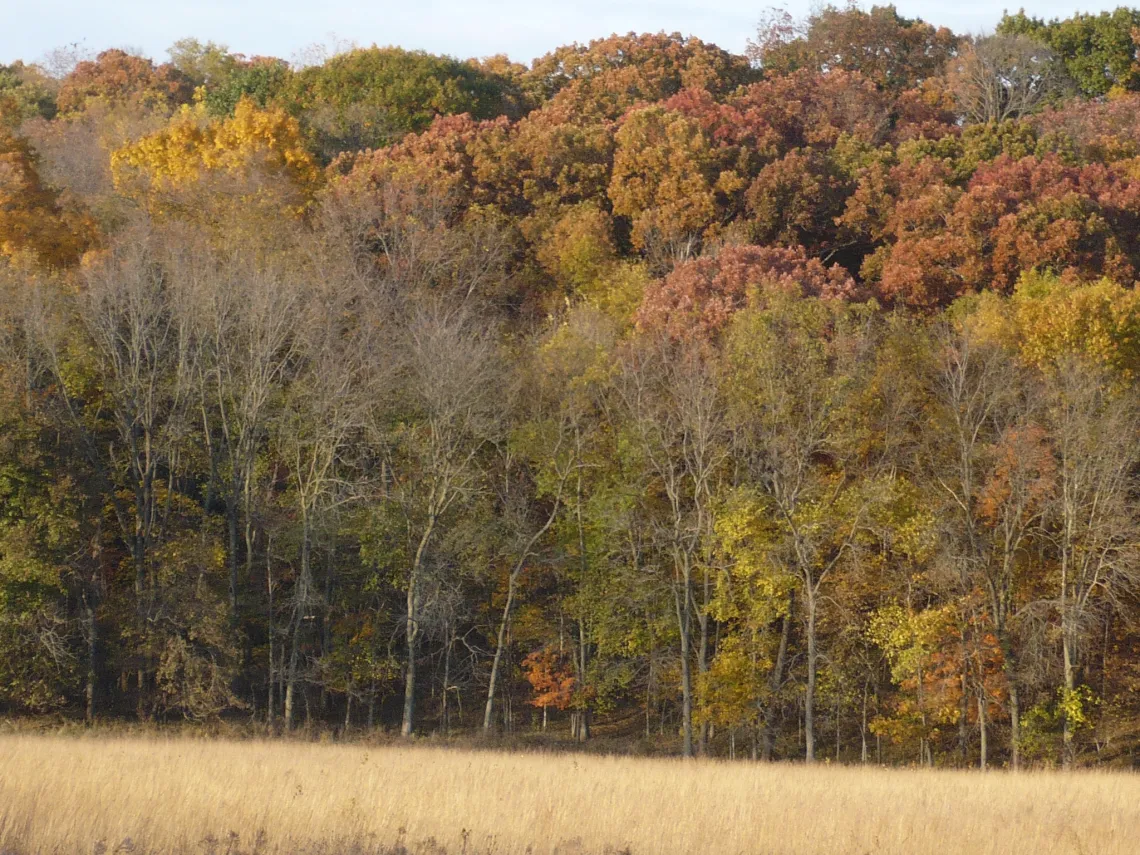
Bills would restrict property tax exemptions on forest and fruit tree reservations
Update: the legislature adjourned and did not pass these bills.
Currently forest and fruit tree reservations are given a property tax exemption. Efforts are underway to eliminate that exemption.
Bill SF633 (formerly SF219) and HF634 would tax forest and fruit tree reservations based upon where the reservation is located and where the landowner lives. If the forest and fruit tree reservation is in the county where the owner lives, it is taxed at $2 per acre. If the forest and fruit tree reservation is in a contiguous county to where the landowner lives, it is taxed at $3 per acre. If it is not in a county where the landowner lives or in a contiguous county, it will be taxed using a formula based on average property taxes due in the county with the most forest and fruit tree reservations and the average corn suitability rating. This formula would also be used for forest and fruit tree reservations in city limits.
- The Senate passed SF633 (formerly SF219). Ask your state representative to oppose HF634 and SF633. To look up your House member, see see www.legis.iowa.gov/legislators/house and to find your legislators, see www.legis.iowa.gov/legislators/find
Bill HF142 would eliminate the forest and fruit tree reservation exemption in 2031. It would begin assessing property taxes on the forest and fruit tree reservations. If the property is used for fruit production, has hunting or fishing leases, or is pastureland, it would be taxed $12 per acre in property taxes. Other conservation areas larger than 5 acres would be taxed $8 per acre.
- Ask your state representative to oppose HF142. To look up your House member, see see www.legis.iowa.gov/legislators/house and to find your legislators, see www.legis.iowa.gov/legislators/find
A bill - SF17 - has been introduced that would restrict the property tax exemption on forest and fruit tree reservations to those with a homestead tax credit. The requirement for a homestead tax credit is troubling. Having a homestead tax credit should have absolutely no bearing on whether a forest or fruit tree reservation is given a property tax exemption. Some people who own a forest or fruit tree reservation do not have a homestead tax credit. A person living in an apartment does not get a homestead tax credit - that same person could own a woodland so they would not qualify for the tax exemption. A person could live in a rental house on a farm, the person could own land with fruit-trees or a forest, that same person would not qualify for the homestead tax credit. Beginning farmers could be seriously impacted by this, especially if they are living in their parent's home while trying to get started farming and acquiring land, some of which might have a forest or fruit-tree reservation.
Ask your state senator to oppose SF17. To look up your senate member, see www.legis.iowa.gov/legislators/senate and to find your legislators, see www.legis.iowa.gov/legislators/find
Why forest reservations are valuable to Iowans
A landowner should be rewarded for protecting woodlands. A way to encourage the on-going protection for forested areas is to grant the landowner a property tax exemption on the forest. Woodlands and forest reservations are important to Iowa’s environment.
Forests protect highly erodible land. Some land should not be put into row crops.
By protecting highly erodible land, soil is kept out of our rivers, streams, and lakes, thus improving water quality. Soil destroys fish habitat.
Trees help cleanse the air. Plus trees capture carbon dioxide.
Forests provide habitat for both non-game and game animals.
Trees provide beauty. They attract tourists in the fall who enjoy looking at the fall leaves.
There is value in the landscape for things other than crops.
Property tax exemptions are provided for other purposes, so it is not out of the ordinary to provide a property tax exemption for forests and fruit tree reservations.
Fruit and nut trees are part of the economic activity in the state.
The derecho damaged large numbers of trees in Iowa.
Iowa is losing a large number of ash trees due to the emerald ash borer.
We should be encouraging landowners to invest in those properties and keep them in forests and fruit tree reservations.