Fall has arrived. I hope you have a chance to get outdoors and see the leaves as they turn, take some hikes, and enjoy the fall weather.
Take care,
Pam Mackey Taylor, Chapter Director and Newsletter Editor
Photo at the top is a view of the Loess Hills and the Missouri River floodplain in the distance, taken at Hitchcock Nature Center in Pottawattamie County, Iowa.
What you can do to help the environment
Contact the Department of Natural Resources about the revisions to Iowa's threatened, endangered, and special concern species
Watch the Sierra Club webinar on data centers - "Data Centers: Power Plays - But Who Pays?" - and learn about their effects on electricity, water withdrawal, air pollution
Read Sierra Club's new report "Dirty Truth"
Attend the Chapter's press conference "Iowa's Energy future - Nuclear Risks vs. Renewable Solutions"
Donate to the Iowa Chapter of the Sierra Club so that we can continue our work on protecting Iowa's environment.
Attend the Lunch and Learn presentations - Live-streamed on Facebook on Fridays at noon - https://www.facebook.com/IowaSierraClub
Missed the live-stream lunch and learn? No problem, find them on our YouTube: https://www.youtube.com/@IowaSierraClub/videos
In this issue of the Iowa Sierran
Pipelines
Polk County Court considering next steps on October 10
Energy
NEW Sierra Club Report: "Dirty Truth" - Iowa’s Largest Electric Utilities Stall Clean Energy Transition at Customers’ Expense
Iowa’s Energy Future - Nuclear Risks vs. Renewable Solutions
Wildlife and Wildlife Habitat
Revising Iowa’s Endangered, Threatened, Special Concern Species Lists
See recording of book reading of "Iowa's Changing Wildlife: Three Decades of Gain and Loss" by James Dinsmore and Stephen Dinsmore
Plus
IRA Qualified Charitable Distributions Can Benefit the Iowa Chapter
Lunch and Learns Fridays at noon
Contribute to the Iowa Chapter
Volunteer for the Iowa Chapter
Calendar of events
To see the archive of previous Iowa Chapter newsletters
Summit Begs Utilities Commission to Approve New Route
Last week, Summit Carbon Solutions submitted a Petition for Amendment to Permit for its original route. In 2023, Summit received a permit to construct its pipeline, and now Summit wants to change the conditions required by the permit. They did that by filing the petition with the Iowa Utilities Commission.
The bottom-line is that Summit cannot meet the conditions of its permit so now it wants to change the conditions.
After Summit was granted its permit for Phase 1, they went back to the Utilities Commission with a Phase 2 plan which added 15 ethanol plants to its pipeline network. The Utilities Commission has not even held hearings about the Phase 2.
Now Summit is requesting changes to Phase 1, which also includes an additional ethanol plant. Plus, there are significant changes to Summit’s proposal including pipe size and rerouting. Furthermore, there are critical unanswered questions such as where the pipeline route would go once it leaves Iowa and what the end use of the carbon dioxide would be.
Based on the permit changes Summit is requesting, it appears that Summit is finally admitting that it cannot go through South Dakota and will instead route the pipeline through Nebraska. Summit’s request drops all references to South Dakota and North Dakota. One big change is that they are increasing the pipe size from 12 inches to 24 inches on the segment that goes into Nebraska. Beyond that, Summit is not stating where the pipeline will be rerouted through and beyond Nebraska. It also is not indicating what the end use of the CO2 will be.
Sierra Club Iowa Chapter is calling for the Iowa Utilities Commission (IUC) to deny Summit’s request. If Summit wants to change their proposed project, it should surrender its Phase 1 permit and start all over.
Ironically, Summit representatives repeatedly say, “you can’t change the rules in the middle of the game”, yet that is exactly what they are asking the Iowa Utilities Commission to do.
Polk County Court considering next steps on October 10
On June 25, 2024, the Iowa Utilities Commission granted a permit and the right to use eminent domain to Summit Carbon Solutions to build a pipeline to carry carbon dioxide to North Dakota. Sierra Club and other interested parties intervened in the Utilities Commission proceeding to prevent the issuance of the permit and eminent domain. Despite all of the evidence that was presented, the Commission ruled in favor of Summit anyway.
The next step was for Sierra Club and other intervenors to file petitions for review in the Polk County District Court. The oral argument was to be presented to the judge on October 10.
However, Summit has asked that the judge send the case back to the Utilities Commission to consider their petition to amend the permit. This is called a motion to remand.
So, the next legal step is for the parties to argue before the judge whether the original appeal should be considered or if the whole case should be sent back to the Utilities Commission.
As a result, the October 10 hearing will be to consider to the motion to remand; the judge will not be considering the appeal of the original permit.
Summit launches new PR campaign
Last week, Summit Carbon Solutions sent a letter to county officials promising that they have turned a new leaf and prioritize safety and transparency. We’ve seen this before - and we’re not falling for their new PR campaign.
In the letter Summit bragged about safety enhancements and offering community grants and payments. However, many of the items referenced are already required, industry standard or things Summit already conceded to in their hearing. Most of this is not new and not “above and beyond”. The costs and dangers of Summit’s proposed project far outweigh the benefits to communities.
Summit also announced increased payments to landowners who sign voluntary easements. However, their method pits neighbor vs neighbor, and that’s not how Iowa operates. Their program incentivizes landowners to pressure their neighbors to sign easements. Counties with higher voluntary easement percentages will receive higher payments. Unfortunately, the payments they are offering are pennies compared to what Summit will make off of our tax dollars every year.
One of the biggest problems with Summit’s letter is that it talks a lot about transparency, but it appears to be all talk and little action. Summit continues to fight being forced to file their plume modeling and other safety documents that expose the true risk of their pipeline. And most importantly at the same time Summit sent this letter, it filed a request to amend their permit without disclosing where their pipeline is going and what the end use of the CO2 will be.
The bottom line is, Summit is still trying to place a dangerous pipeline near our homes. Summit is still trying to abuse our property rights through the use of eminent domain. Summit is still aiming to take our tax dollars for their privately-owned project. Summit is still threatening our land and our water. Nothing about that has changed. This project is still all risk and no reward.
Read Summit’s letter: Starts at page 47
NEW Sierra Club Report: "Dirty Truth"
Iowa’s Largest Electric Utilities Stall Clean Energy Transition at Customers’ Expense
Sierra Club released its annual Dirty Truth Report, which grades 75 utilities across the country on their plans to retire coal plants by 2030, not build new gas plants through 2035, and transition to clean energy through 2035. This year, Berkshire Hathaway-owned MidAmerican Energy, as well as Alliant Energy-owned Interstate Power and Light (IPL), both received the lowest grade possible, an F.
It is IPL’s second year in a row to receive a failing grade, while MidAmerican’s score dropped 10 points over the last year from 23 out of 100 (D) to 13 out of 100 (F). MidAmerican’s and IPL’s low scores reveal the utilities are resistant to fully transitioning to affordable clean energy, and continue to rely on expensive, polluting fossil fuels. At the same time, Americans’ protections for clean air and water are being rescinded, and electricity bills are increasing faster than inflation.
According to MidAmerican’s and IPL’s latest energy plans, both utilities intend to build new gas power plants while continuing to operate outdated, costly coal power plants. IPL plans to add 1,275 MW of gas-burning power over the next 10 years, and MidAmerican is slated to add 1,164 MW. With a power grid increasingly dependent on fossil fuels, Iowans will face rising energy prices and devastating health impacts.
“MidAmerican and IPL have an opportunity to be the renewable energy leaders they claim to be, but instead, they keep clinging to gas and coal,” said Pamela Mackey Taylor, Sierra Club Iowa Chapter Director. “While the wind turbines are hard to miss, it’s Iowa’s dirty secret that there are still 6 coal plants across the state polluting our air and water. But together, Iowans can demand better from our utilities. It’s time these companies acted in our best interest, and that means phasing out dangerous fossil fuels to save lives and lower bills.”
Faced with rapidly increasing load projections, utility companies are failing to meet this critical moment by championing renewable energy—instead, they are backsliding on their commitments and doubling down on fossil fuels. Across all 75 utilities, the companies scored an aggregate of 15 out of 100 points, earning an F. This marks the lowest score since the first year of this report in 2021, and the first time the score has ever dropped below the inaugural report.
In an interactive webpage, users can see their utility’s score and what progress, if any, the utility has made toward transitioning to cleaner, more affordable energy since the first version of the report in 2021.
“It is alarming that for the first time since 2021, utilities are regressing on their clean energy transition,” said Sierra Club Chief Program Officer Holly Bender. “By adding more gas and keeping costly coal plants online, utility companies are ignoring renewable energy—the cheapest form of energy—and forcing their customers to pay more. As energy costs rise and extreme weather becomes more frequent, now is the time to phase out polluting, volatile, expensive fossil fuels and invest in stable, reliable, and affordable, clean energy.”
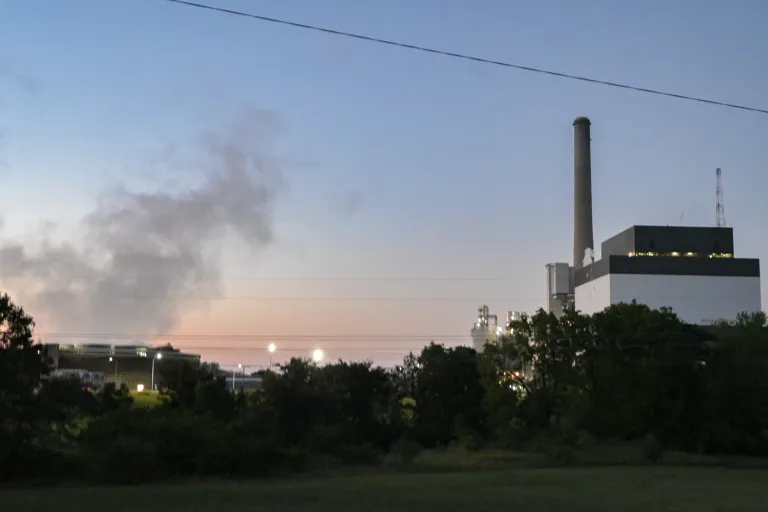
Photo below: Ottumwa Generating Station by Emma Colman.
IRA Qualified Charitable Distributions Can Benefit the Iowa Chapter
IRA Qualified Charitable Distributions, also referred to as Charitable IRA Rollovers or IRA QCDs, are a way to support the Sierra Club Foundation and the Iowa Chapter as a qualifying charity without incurring federal income tax liability.
To be tax-free, the donation must go directly from your IRA account to the Sierra Club Foundation without passing through your hands. Don’t deposit the distribution into your personal bank account or it will not qualify as a charitable distribution and will be treated as taxable.
To Qualify:
You must be 70 ½ years or older when the gift is transferred.
You may transfer up to a maximum of $108,000 to qualified charities per year. Gifts must be made by December 31 of each year.
If you are a joint tax filer, your spouse can also give $108,000 per year if he or she is over 70 ½ and has an IRA.
This only applies to eligible individual retirement accounts and does not apply to group plans, 401(k) plans, or 403(b) plans.
Additional Considerations:
Certain states may not exclude gift amounts withdrawn from an IRA for state income tax purposes.
If you reach are 73 or older, you can use your gift to satisfy all or part of your required minimum distribution.
How To Make a Gift:
To make a gift from your IRA to the Sierra Club Foundation, contact your IRA administrator to arrange a direct transfer from your account. The check should be made payable to the Sierra Club Foundation and include "Iowa Chapter" on the memo line. You can download a sample letter to your IRA administrator here. We strongly recommend you instruct your broker to include your name and address with the check. The gift should be mailed to:
Sierra Club Foundation
2101 Webster Street, Suite 1250
Oakland, CA 94612
Please note that the Sierra Club, as a 501(c)(4) social welfare organization, is not eligible to receive IRA charitable rollovers. Confirm with your IRA custodian that your IRA charitable rollover is made payable directly to the Sierra Club Foundation as the qualifying 501(c)(3) public charity.
The Sierra Club Foundation does not provide tax or legal advice. Please consult your own professional tax or legal advisor before making any charitable gift decision based on this information.
For more information, see https://www.sierraclubfoundation.org/ira-qualified-charitable-distributions
Photo below: Hiking in the Loess Hills at the Hitchcock Nature Center, Pottawattamie County, Iowa. Photo by Pam Mackey Taylor.

Revising Iowa’s Endangered, Threatened, Special Concern Species Lists
Definitions
Endangered species – any species of fish, plant life, or wildlife which is in danger of extinction throughout all or a significant part of its range.
Threatened species – any species which is likely to become an endangered species within the foreseeable future throughout all or a significant portion of its range.
Species of special concern – any species about which problems of status or distribution are suspected, but not documented.
Extinct – any species where the last member of the species has died.
Current process
The endangered, threatened, and special concern species are published in the Iowa Administrative Rules. Currently, to be put on one of three lists, the lists go through a rule-making process, which includes public comment. The lists have not been updated in quite a while, animals since 2009 and plants since 1994.
There is also a federal list of endangered and threatened species. A species can be endangered in Iowa and not be on the federal list. All federally listed endangered and threatened species that exist in Iowa are on the state lists.
Proposed changes to how lists are maintained and published
The Governor issued Executive Order 10, which required the Department of Natural Resources (DNR) to review its administrative rules. As part of the review, the DNR was expected to reduce the use of restrictive terms, such as shall, will, must, may not, required, prohibited. The DNR was also expected to remove duplicative language with the statutes in the Iowa Code. Also, the Executive Order required reducing the regulatory burden of the rules, i.e., reducing protection provided by the rules.
As a result of Executive Order 10, Department of Natural Resources is updating the threatened and endangered species lists in its administrative rules. Several species of plants and animals are being added to the threatened and endangered species lists. DNR is also updating the species of special concern lists.
However, DNR is removing the species of special concern list from the administrative rules in order to comply with the executive order since the Iowa Code does not define species of special concern. Instead, DNR wants to put the species of special concern list on their webpage. This is troubling:
It minimizes the importance of the species of special concern.
Items on the webpage can be arbitrarily updated without the rule-making process, including public input. That may be OK for adding species, but a problem when species are removed.
DNR does not allow public input on changes to their webpages.
This does not recognize the importance of the special concern species and keeping species from becoming threatened, endangered, or even extinct
What you can do
Tell the Iowa Department of Natural Resources that you do not want the species of special concern removed from the administrative rules
E-mail comments to the DNR by 4:30pm on September 24 – email addresses are Kelly.poole@dnr.iowa.gov and john.pearson@dnr.iowa.gov
Attend the virtual DNR hearing about these changes on September 24, 2025, 10 to 11am. To obtain access information, write an email to kelly.poole@dnr.iowa.gov and john.pearson@dnr.iowa.gov
Endangered Pallid Sturgeon Found in Lower Des Moines River
Every spring the Iowa Department of Natural Resources (DNR) samples the sturgeon in the Des Moines River. This spring, they were greeted with a surprise – two pallid sturgeon that were caught near Ottumwa. The pallid sturgeon is on the federal endangered species list.
Generally, the DNR finds shovelnose sturgeon and sometimes finds lake sturgeon. Pallid sturgeon and lake sturgeon cannot be kept by anglers.
As part of the recovery efforts, young pallid sturgeon are reared in hatcheries. However, these two individuals were not raised in a hatchery. They had traveled to the Des Moines River for spawning.
Pallid sturgeon are slow-growing and late to mature, with females not spawning until they are 15 to 20 years old. Their populations have been declining in their populations in the Missouri and lower Mississippi River basins. They had never been documented in the Des Moines River.
Iowa’s Energy Future - Nuclear Risks vs. Renewable Solutions
NextEra Energy is seeking to restart the Duane Arnold nuclear plant, following a model used at Palisades in Michigan. Simultaneously, NextEra is abandoning three proposed solar projects by requesting the Federal Energy Regulatory Commission to transfer their interconnection tariffs to the nuclear plant. The company and other nuclear proponents claim that the growth of data centers requires nuclear power. Iowa, historically a leader in renewable energy, still has the capability to meet energy needs through wind, solar, and other clean energy sources.
We are hosting a press conference on September 29 at 11am to discuss the proposed restart of the Duane Arnold nuclear plant, currently in decommissioning status since August 2020, and the broader implications of nuclear energy in Iowa. The event will provide factual information about the risks of nuclear power, including health and safety, radioactive waste, water use, and costs, while highlighting renewable energy as a safer, sustainable alternative for Iowa’s energy needs.
Confirmed speakers include Mark Z. Jacobson, Professor of Civil and Environmental Engineering at Stanford University; Joseph Mangano, Executive Director of the Radiation and Public Health Project; Wally Taylor, Environmental Attorney; and Don Safer, Co-chair of Sierra Club's Nuclear Free Team and Small Modular Reactor expert.
This is an opportunity to hear directly from experts on nuclear energy, public health, and climate science while learning how local communities and policymakers can help shape a safe, renewable energy future for Iowa.
Virtual Press Conference: Iowa’s Energy Future - Nuclear Risks vs. Renewable Solutions
When: Monday, September 29 @ 11AM
Where: Join Zoom Meeting
https://sierraclub.zoom.us/j/6479616651?omn=93779777592
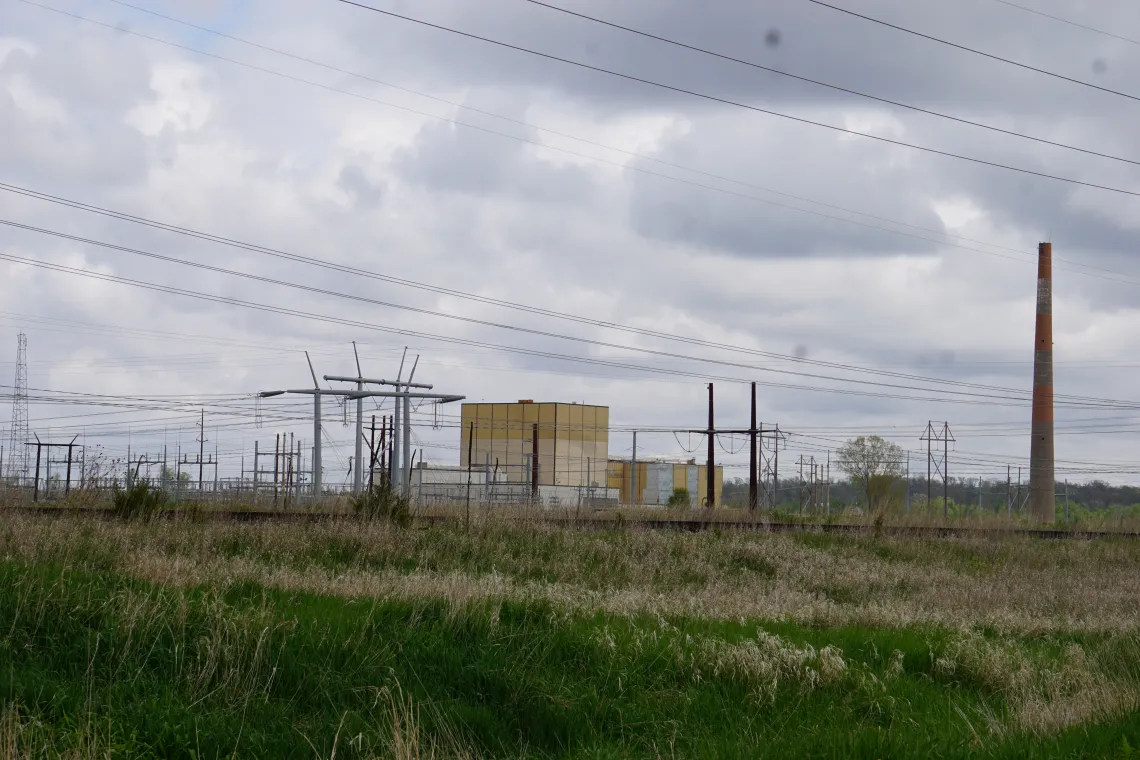
Photo below: Duane Arnold nuclear power plant
Data Centers: Power Plays - But Who Pays?
In case you missed it, Sierra Club recorded a webinar "Data Centers: Power Plays - But Who Pays?" The webinar explores how the rush to build large data centers is driving a new climate crisis and what we can do about it. You've undoubtedly heard that the growth of artificial intelligence and data centers have started to have huge effects across the county - clogging electricity systems, threatening climate targets, and increasing electricity bills. And if you haven't heard yet, Sierra Club is working hard to get guardrails in place and push Big Tech to go clean, fast.
Watch "Data Centers: Power Plays - But Who Pays?" to see what data center load growth means for our climate, health, and wallets - and what activists and policymakers can do about it!
"Iowa's Changing Wildlife"
On September 17, Tom Reardon, Executive Committee Vice-Chair of the Sierra Club Iowa Chapter, led a discussion about the book Iowa’s Changing Wildlife: Three Decades of Gain and Loss by James Dinsmore and Stephen Dinsmore. In case you missed it, we recorded it.
This discussion dived into how Iowa’s wildlife and natural landscapes have evolved over the past 30 years along with species that are thriving, which are disappearing, and what these changes mean for the future of conservation in our state.
Lunch and Learns Fridays at noon
Fridays at noon, we do a Lunch and Learn livestream. See us on Facebook at "Sierra Club Iowa Chapter". These will be recorded so you can watch them anytime. Topics will be selected based on what is happening during the week. During the legislative session, we cover issues coming before the Iowa legislature.
In case you missed our past webinars and lunch and learn sessions, you can still see them on YouTube.
Watch: "Revising Iowa’s Endangered, Threatened, Special Concern Species Lists", September 19, 2025
Stay up to date on: "DNR Water Quality Triennial Review", September 12, 2025
Tune in to: "Uranium: Mined, Not Renewable", September 5, 2025
Stay up to date on "Sierra Club Iowa Chapter Upcoming Events", August 29, 2025
Get an "Update on Judicial Review of Summit CO2 Permit", August 22, 2025
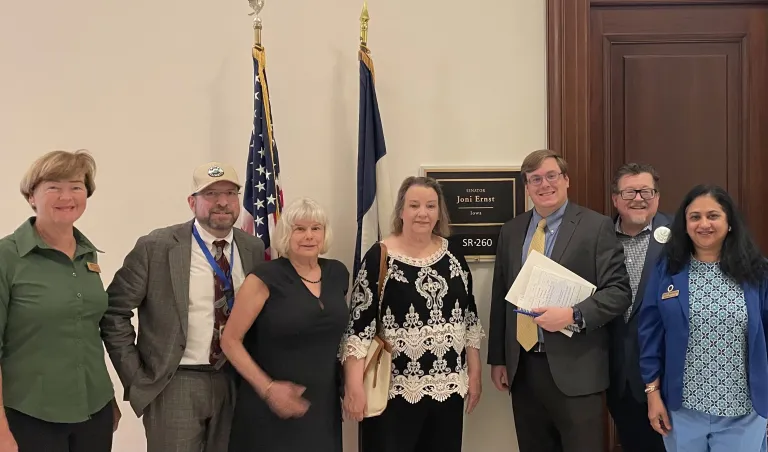
Debbie Neustadt, fourth from left, and Mike Carberry, second from right, traveled to Washington, DC to join other volunteers in lobbying members of the United States House and Senate on the Farm Bill.
Volunteer for the Iowa Chapter
Almost everything we do is done by volunteers like you. If you would like to volunteer for the Iowa Chapter, please let us know by sending an E-mail to Iowa.chapter@sierraclub.org. Or sign up by using the online form. There are many opportunities for you to make a difference:
making phone calls
developing graphics for banners and flyers
working on legislative issues
working on elections
fundraising
organizing events
joining an issue committee
If you would like to join our legislative action team, sign up here. Keep on top of what is happening at the Iowa legislature. Be alerted when you should contact your legislators about pending legislation.

Photo: camping by Jess Mazour.
Contribute to the Iowa Chapter
Sierra Club - working every day on Iowa’s environmental problems
Sierra Club is Iowa’s oldest and largest grassroots environmental organization. Not only that, we are the best bet in the state for achieving bold solutions to Iowa’s environmental problems.
We work in the courts, before Iowa’s public agencies, and in the halls of the legislature. The Iowa Chapter's effort to protect the environment takes financial support. The Chapter receives very little financial support from the national Sierra Club. Can we count on you for a donation to ensure even more victories? Your contribution will be put to work here in Iowa on issues that affect every day Iowans – water quality, clean air, protection of Iowa's soil, parks and natural areas, and a strong democracy. The Iowa Chapter is relentless in fighting back bad legislation that affects every one of us.
Your non-deductible contributions make it possible for us to fight bad legislation and to promote good legislation. We appreciate your past and on-going support of these efforts. You can make a non-deductible donation with a credit card. A non-deductible donation supports the Chapter's effective, citizen-based advocacy and lobbying programs. If you prefer, a non-deductible check can be written to the Sierra Club Iowa Chapter and mailed to:
Treasurer
Sierra Club, Iowa Chapter
PO Box 1058
Marion, IA 52302
You can also make a tax-deductible donation with a credit card. Tax-deductible activities are limited to public interest education, research and legal actions. A deductible check can be written to the Sierra Club Foundation with “Iowa Chapter” written in the memo line.
Thank you for your support.
Donate your used vehicle
As the Sierra Club Foundation's Iowa Chapter continues to raise charitable funds to support its work in Iowa, won’t you consider participating in our vehicle donation program? Our partners over at CARS have made the process of donating your unused or unneeded car, truck, motorcycle, boat or RV easy, efficient and secure. They’ll take care of everything from picking up your vehicle to sending you a tax receipt for your generous gift. To learn more about The Sierra Club Foundation's Iowa Chapter vehicle donation program, please call 844-674-3772. Or visit our webpage to get started today!
Sierra Club Foundation promotes climate solutions, conservation, and movement building through a powerful combination of strategic philanthropy and grassroots advocacy. The Foundation is the fiscal sponsor of Sierra Club’s charitable environmental programs.
For more information
Planned giving . . . naming the Sierra Club Iowa Chapter in your will
Ensure your environmental legacy by naming the Iowa Chapter in your will or trust. These gifts cost you nothing now. You can hold onto your assets for as long as you need them.

Thank you for supporting our work!
| When | Earliest: Latest: |
| What |
|
| Word or Phrase | Word or phrase to search for: |
| Leader | All or part of leader name to search for: |
No Matching Activities Found
Loading
| Date | Activity (click title for full description) | Sponsor | Category | Type | Difficulty | Links |
|---|
Loading ...
 Outing
 Team/Committee
meeting
Team/Committee
meeting
 Volunteer Event
 Activist event
 Multiple events
(map only)
Multiple events
(map only)