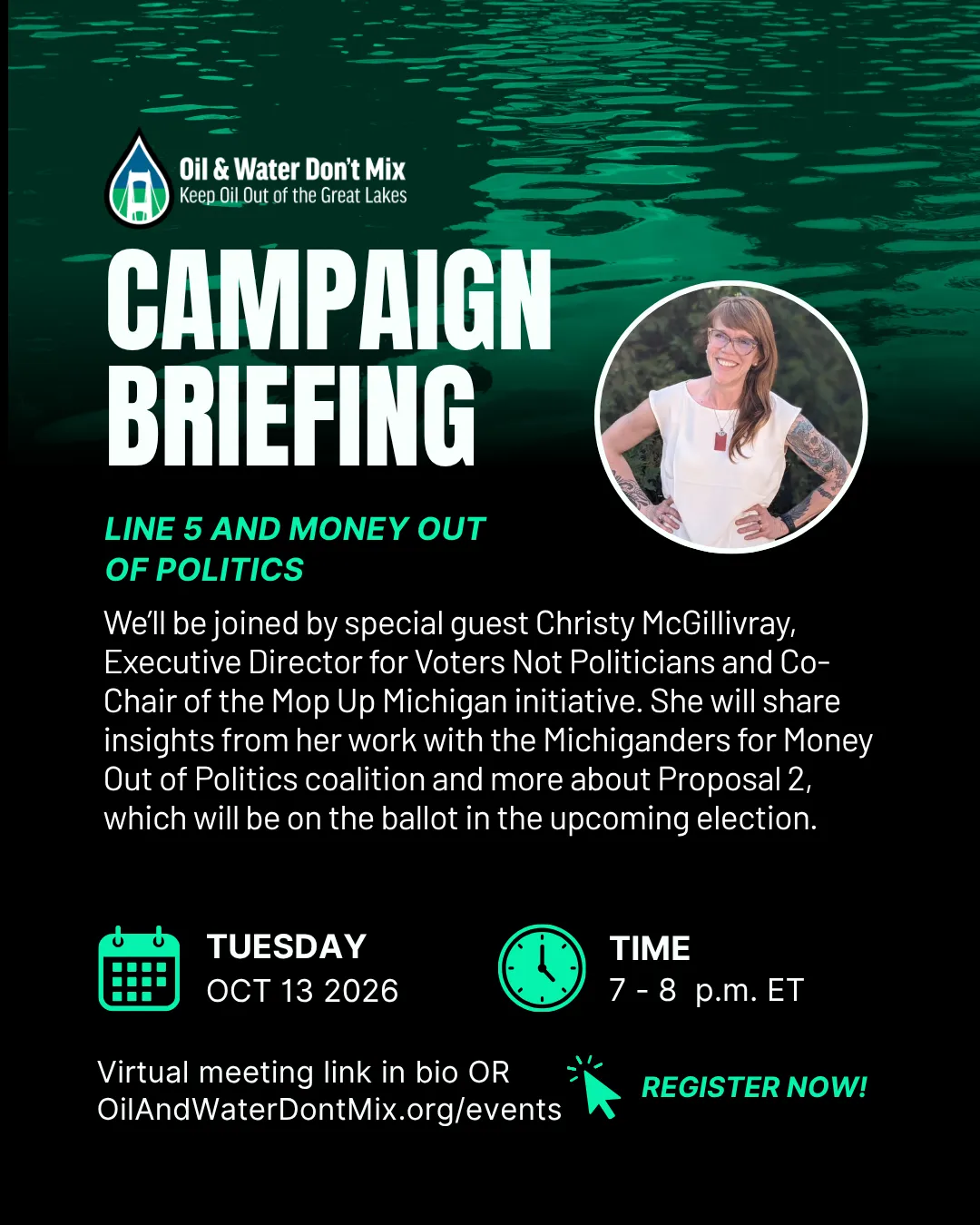
Join Oil & Water Don't Mix for our October Campaign Briefing on Tuesday, Oct. 13 at 7 p.m. Eastern Time.
We’ll be joined by special guest Christy McGillivray, Executive Director for Voters Not Politicians and Co-Chair of the Mop Up Michigan initiative. She will share insights from her work with the Michiganders for Money Out of Politics coalition and more about Proposal 2, which will be on the ballot in the upcoming election
While there is not a direct link between Enbridge and Proposal 2, the potency of the money in politics is certainly an issue. Enbridge and the broader fossil fuel industry have used political money to buy influence for years in Lansing as well as DC. Since at least the 1960s, oil industry players like Enbridge have been spending millions of dollars in advertising and political contributions across the country to make our government pretend that climate change isn’t happening and that they aren’t causing it.
Note: OWDM is a coalition that represents organizations involved in the Line 5 fight, so we have not taken a position on Proposal 2.
Register to join us via Zoom on Oct. 13, 2026, at 7 p.m. EDT for our Campaign Briefing. Come and meet the organizing team and volunteers who have been hard at work building the grassroots pressure to protect the Great Lakes and climate from new fossil fuel infrastructure. While it's in Governor Whitmer's hands now, we need your help keeping up the pressure so the administration withdraws support for the tunnel and finishes the job by shutting Line 5 down.
Governor Gretchen Whitmer and EGLE Director Phil Roos took bold action on September 9th, announcing they are halting a key tunnel permit and reopening the review.
This follows the Michigan Supreme Court's July 31 ruling, which restored the Michigan Environmental Protection Act and the public trust as the measure of what the state may permit. Now, the state will take a meaningful look at this proposed, unprecedented tunnel through the Straits of Mackinac.
In a letter sent yesterday to Enbridge's CEO, the Governor told them to stop treating the tunnel as the only option and to start working now to get oil out of the Straits. A tunnel has never been the solution, and we applaud the Governor and Director Roos for their continued commitment to protect the Great Lakes.
This is a game-changer - and we need your help to acknowledge it.
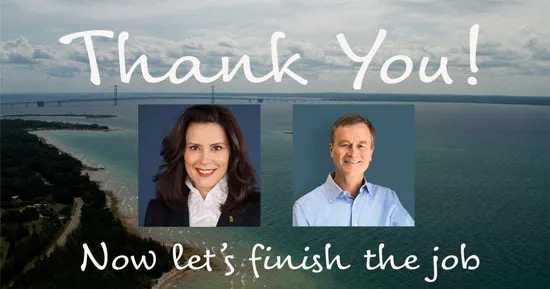
Click here to take action and send a message thanking the Governor and Director Roos for taking a strong stance on the proposed tunnel, and let them know the work is not done. Now it’s time to finish the job and shut down Line 5 for good.
It's hard to overstate how incredible this turn of events is, and it took all of us to get there - you, the tribes, anyone who took action, emailed, or demonstrated. Please join me in thanking them. And watch and share our video about this on Instagram, Facebook, or TikTok.
A History of Line 5
The Enbridge Line 5 pipeline was constructed in 1953 and built to last 50 years. The pipeline runs from Superior, Wisconsin to Sarnia, Ontario. The 30-inch pipeline splits into two separate 20-inch lines and runs under the Straits of Mackinac, a 4.5 mile wide stretch of water in Michigan, which separates Lake Michigan from Lake Huron.
Enbridge and the Kalamazoo River Disaster
The July 25, 2010, Kalamazoo River Disaster caused by Enbridge Energy's broken pipeline was one of the biggest inland oil spills in U.S. history. At least 1 million gallons of diluted bitumen (dilbit), a heavy, thick crude oil that’s hard to pump without diluting it with hydrocarbons, spilled into the Talmadge Creek, near Marshall, and then flowed downstream to the Kalamazoo River, contaminating 35 miles of the river. When the line broke, the sludge gradually sank to the bottom while the volatile hydrocarbons poisoned the air. Hundreds of homes and businesses had to be evacuated. About 150 families moved away permanently In 2013, University of Michigan experts identified the Straits of Mackinac as the worst place in the Great Lakes for an oil spill. The current in the Straits changes direction 180 degrees on an average of every 1.5 days, and the peak flow of water through the Straits is over 10 times the flow of water over Niagara Falls. This is also an important indigenous cultural resource and one of the busiest shipping lanes in the Great Lakes. (2012 report - Inside Climate News). No one can say for sure how much sludge the dredging operation left at the bottom of Talmadge Creek and the Kalamazoo River.
In 2012, the National Wildlife Federation (NWF) published ‘Sunken Hazard’ calling attention to Enbridge Line 5 in light of the disaster from the massive breach of the company’s pipeline in the Kalamazoo River basin. NWF’s report brought attention for the first time to the potential dangers posed by Line 5, which was virtually unknown until then. Michigan tribes, environmental organizations, businesses and communities began to organize to seek a shut down of Line 5.
In 2016, University of Michigan experts identified the Straits of Mackinac as the worst place in the Great Lakes for an oil spill. The currents in the Straits change direction 180 degrees on an average of every 1.5 days, and the peak flow of water through the Straits is over 10 times the flow of water over Niagara Falls. This area is an important indigenous cultural resource and is also covered by treaties that guarantee tribes will have access to fishing throughout the region in perpetuity. The Straits are one of the busiest shipping lanes in the Great Lakes.
Line 5 has leaked more than 33 times and at least 1.1 million gallons along its length since 1968. Yet, every day nearly 23 million gallons of oil flow through these aging pipelines located in the heart of the Great Lakes, threatening one of the most ecologically sensitive areas in the world. The Great Lakes are home to 21 percent of the fresh surface water on Earth, providing 40 million people with clean drinking water and supporting a thriving economy for Michigan families.
In 2018, a dragged anchor struck Line 5 in the Straits of Mackinac, causing three large gouges in the pipeline. Enbridge control systems didn’t detect the anchor strike, and despite not having video evidence of the pipeline’s condition for over two weeks, Enbridge never shut the pipeline down. Just two years later, another anchor struck Line 5, damaging structural support – likely caused by an Enbridge contractor. A judge ordered a temporary shutdown until the damage could be assessed.
During the 2018 election, both Gretchen Whitmer and Dana Nessel committed to taking steps to shut down Line 5 where it crosses the Straits. As attorney general, Nessel moved quickly to sue Enbridge in state court seeking to shut down the pipeline across the straits. In November 2020, Governor Gretchen Whitmer and Department of Natural Resources (DNR) Director Dan Eichinger revoked the 1953 easement which allowed Enbridge to operate their Line 5 dual pipelines under the Straits of Mackinac. The state revoked the easement for violations of the public trust doctrine and the unreasonable risk Line 5 poses to the Great Lakes. Enbridge was given 180 days to comply with the shutdown order. The deadline came and went, yet Enbridge continues to operate the pipeline today, violating the law. Court battles have ensued, and as each day passes, Line 5 remains a ticking time bomb in the Great Lakes.
University of Michigan experts identify the Straits of Mackinac as the worst place in the Great Lakes for an oil spill, with over 700 miles of shoreline at risk if Line 5 ruptures.
The Great Lakes Tunnel & Environmental Impact Statement (EIS)
Enbridge wants to relocate a portion of Line 5 into a new tunnel under the Straits of Mackinac. However, a tunnel is not a safe solution. Experts have warned there is a risk of explosion, based on a geotechnical investigation. This could be deadly to construction workers inside the tunnel, not to mention an explosion could have catastrophic consequences for the existing Line 5 pipeline, the Straits of Mackinac, and the treasured Great Lakes. Additionally, building new fossil fuel infrastructure is counterproductive to the policies in place to combat the climate crisis.
Before Enbridge can move forward with construction on the Great Lakes Tunnel, they must acquire permits from the Michigan Department of Environment, Great Lakes and Energy (EGLE), the Michigan Public Service Commission and the U.S. Army Corps of Engineers (USACE). In 2021, EGLE issued permits to Enbridge but later determined that Enbridge had significantly understated the amount of wetlands to be affected. In addition, many organizations engaged in the permitting process are arguing that the State of Michigan has an obligation to require and review permits for the construction of the proposed tunnel under the Great Lakes bottomlands, which has not yet happened. Enbridge has reapplied by the EGLE permits and in April 2025 EGLE is reviewing these applications for completeness, with an expectation that public input will be taken on the proposed permits later in 2025.
In 2021, the USACE announced they would conduct an Environmental Impact Statement (EIS) on the proposed Line 5 tunnel before arriving at a permitting decision. This environmental review process under the National Environmental Policy Act (NEPA, enacted in 1970) requires federal agencies to consider environmental and other effects of their proposed actions prior to making decisions and gives citizens the opportunity to voice their opinions. However, in April 2025, under President Trump’s Energy Emergency Executive Order, the USACE authorized “special emergency processing procedures” for this project as well as others. This change is expected to undermine the NEPA review process.
Bad River Band of Lake Superior Chippewa vs. Enbridge Line 5
Simultaneous with the fight to shut down Line 5 across the Straits of Mackinac, the Bad River Band of Lake Superior Chippewa are fighting to remove Line 5 from illegally trespassing on tribal lands and block it from building a new pipeline just upstream of their lands. Sierra Club Wisconsin Chapter and many others are supporting the efforts of the tribe to end an imminent threat to their way of life from the pipeline, which is on the verge of being exposed along the Bad River through decades of erosion. Permitting for the proposed reroute of the Line 5 pipeline is under consideration at both the USACE and the Wisconsin Department of Natural Resources in early April 2025. A 2024 documentary film, “Bad River,” provides an excellent overview of the fight to remove Line 5 from the tribe’s lands.
Learn More!
Additional resources include:
The Place of the Great Turtle, a 2023 SIERRA Magazine article and film about the fight to shut down Line 5 in the Straits of Mackinac.
Also, check out The Current, a blog by Jeffrey Insko for Oil and Water Don’t Mix covering the history and current situation of Enbridge Line 5 here.
Stay up to date on Line 5 news by checking out our partner organization, Oil & Water Don't Mix: