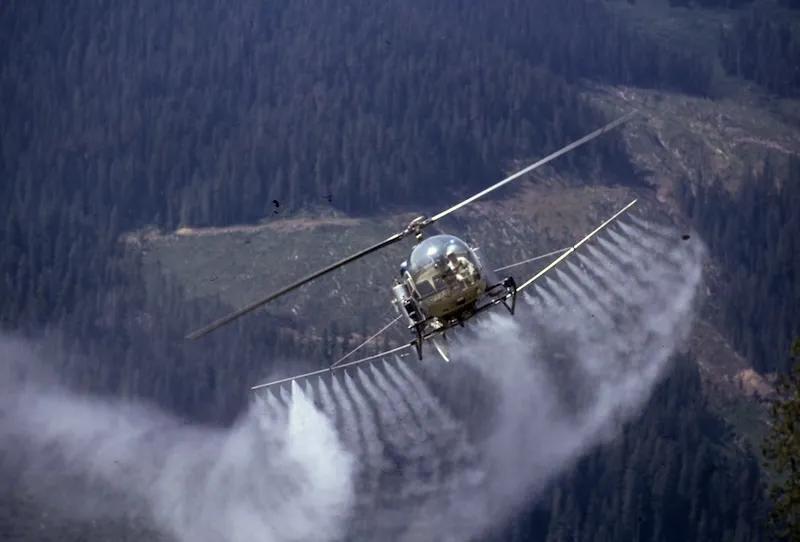
Photo courtesy USDA
Helping the public learn about the past and current use of toxic pesticides is key to the challenge of limiting their broad scale application. Last month, the Sierra Club Oregon, with participation by North Coast Communities for Watershed Protection, sponsored screenings of the award winning documentary The People vs Agent Orange in theaters in Portland, Eugene, and Corvallis, with nearly 100 people attending.
Filmgoers learned that the Agent Orange catastrophe did not end with the Vietnam War. Today, the world over, a primary chemical of the toxic defoliant (2,4 D) controls weeds in forestry, farming, parks, and playgrounds. It wreaks havoc on the human genome, causing birth deformities and deadly cancers. Agent Orange was a 50:50 mix of two herbicides: 2,4,5-T, which was found to be highly contaminated with dioxin because of the high temperatures at which it was produced, and 2,4-D, which contained other forms of dioxin as well. Between 1961 and 1971, the U.S. sprayed 12 million gallons of contaminated Agent Orange and 8 million gallons of other herbicides on Vietnam, Laos, and Cambodia – an average of 5,200 gallons a day for 3,735 days. Over 7,813 square miles of upland and mangrove forests and 781 square miles of crops (an area roughly the size of New Hampshire) were destroyed. In total, more than 66,000 square miles of South Vietnam were impacted, along with large areas of Laos and parts of Cambodia.
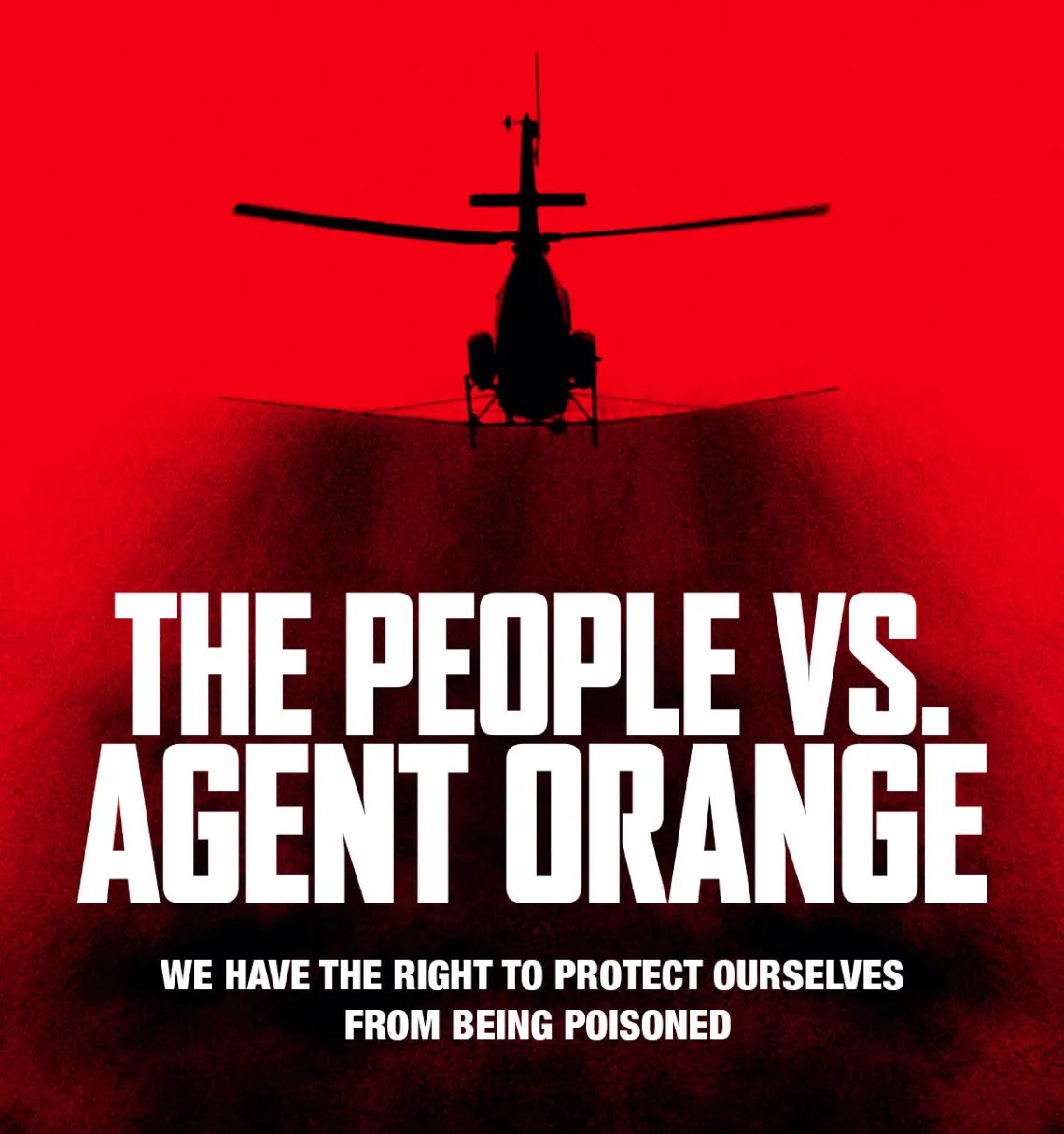
The People vs Agent Orange was directed and produced by Alan Adelson and Kate Taverna. “We hope that the film will make denial impossible and will stir action for reparations,” shared Adelson. “To our surprise, as we were finishing the edit, we repeatedly encountered contemporary news that is integrally related to our film. Agent Orange is as relevant now as it was during the Vietnam war years.”
“Contemporary news” abounds in Oregon, as pesticide sprays often have devastating consequences on local wildlife and the surrounding environment. If swaths of land are sprayed with pesticides via backpack sprayers, helicopters, or drones, edible food sources, like salmonberries and mushrooms, can also become contaminated. Even when sprayed in specific areas, pesticides can spread broadly by drift, revolatilization (turning back into a vapor when warmed by the sun), and by getting into nearby streams and waterways, especially after it rains. In 2024, 381 aerial spray operations were completed in Oregon forest lands, which translates to ~610,000 acres. Pesticides used in forestry management practices were found in 38% of bivalve sampled along the Oregon coast and have been linked to behavioral abnormalities in salmon (e.g., swimming performance, seaward migration, adult returns), compromised immune systems, and endocrine disruption.
A 2008 report from the Oregon Department of Agriculture concluded that 3,098,503 pounds of pesticides were applied in the southern Oregon coastal region in one year, and glyphosate, followed by 2,4-D, were the most commonly applied pesticides. Lobbyists work on behalf of chemical and timber companies and have persuaded legislators to pass laws shielding them from liability for poisoning Oregon residents and wildlife and limiting any local restrictions on spraying. For example, a key provision of Oregon’s Right to Farm statute states, “Persons who locate on or near an area zoned for farm or forest use must accept the conditions commonly associated with living in that particular setting.”
Following the film, Carol Van Strum, Susan Swift, and Debra Fant (all activists featured in the film), as well as Nancy Webster (lead for North Coast Communities for Watershed Protection; NCCWP), and Chuck Willer (Director of the Coast Range Association) engaged the audience in discussion. Individuals shared their personal experiences and asked questions about how to restrict the use of pesticides and keep drinking water safe. Coastal communities rely on surface drinking water; NCCWP offers resources and is asking people to sign their petitions to protect natural resources and prevent clearcutting in key watersheds. Carol VanStrum was on hand to autograph copies of her widely praised chronicle of the anti-spray movement in Oregon, “A Bitter Fog: Herbicides and Human Rights”, resources and information about how to sign up for Oregon Department of Forestry’s FERNS notification system was shared, and people were asked to participate in an Sierra Club Oregon survey about drinking water.
Please help our organizations address the harms from pesticide spraying in Oregon timberlands by participating in this brief online survey!
There is interest in offering additional screenings of the film in coastal communities like Astoria and Tillamook, so stay tuned!
To learn how you can get involved in protecting forests and drinking water from clearcuts and spraying, contact Carol at illinoisvalley@oregon.sierraclub.org.