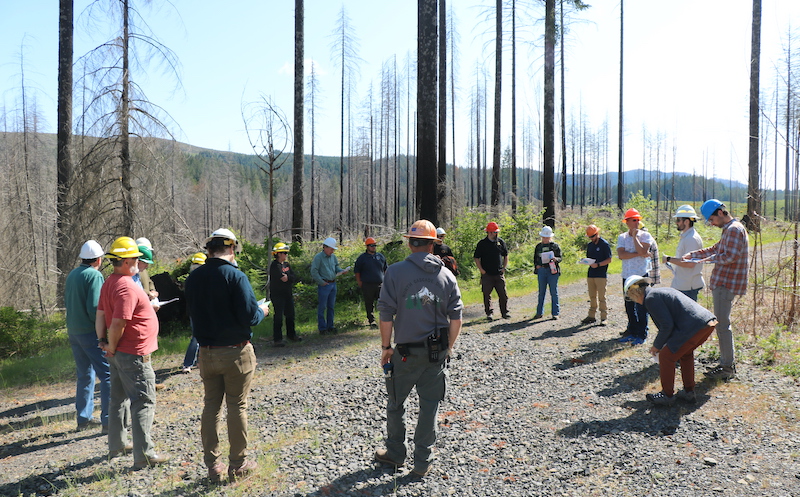
SFAC on Santiam Forest tour by Greg Jacob
By Greg Jacob, Ph.D
For nine years I have served as an environmental representative on the State Forest Advisory Committee (SFAC), and my third three-year term is coming to an end in the fall of 2026. The mission of SFAC is to advise the Oregon Department of Forestry (ODF) on managing state forestlands of 640,000 acres. The committee offers guidance on the implementation of the Oregon Forest Management Plan (FMP), which calls for balancing timber sales, habitat conservation, and recreational use.
I have attended many SFAC meetings and tours over the years and have met people representing all facets of forest management. There is always a push for more timber harvest in spite of concerns over healthy watersheds, carbon sequestration, and habitat for threatened and endangered species. I have been troubled and concerned that environmental voices are outnumbered and secondary to the voices of the timber industry and District Foresters who are worried about meeting timber harvest quotas. Clearcutting and herbicide spraying are still standard practice, and thinning in the guise of fire mitigation is too frequently business as usual.
The two or three environmental representatives on the SFAC often argue for an ecological approach to forest management in our state forests: low-intensity harvest protocols that protect the forest canopy, heterogeneous forest stands, carbon sequestration, less herbicide spraying, and habitat for endangered species. Several times I have asked why so little progress has been made on increasing complex, layered stands. In 2010, the FMP called for 30%; today, across the state forests it is a mere 11-12%. Why does the Oregon Department of Forestry still clearcut complex, layered forest stands? At the last meeting I spoke on behalf of the Oregon Chapter for a measurable and aggressive Climate Change and Carbon Plan. The language in the new draft FMP regarding climate is general and lacks measurable targets.
Admittedly, it is difficult for the ODF to manage state forests with an ecological approach because of the state’s funding model. ODF’s revenue is timber driven, with two-thirds of the revenue from timber sales on state forests going to schools and counties, the other third to the department. A new funding model must be decided upon and implemented.
SFAC currently has fourteen committee members with representation covering forest operators, timber industry, Forest Trust Lands, environment, watershed councils, recreation, non-motorized and off-highway vehicles (OHV), OSU Extension, and three non-affiliated representatives. SFAC holds three or four meetings per year, one always being at the Salem ODF headquarters. SFAC members also are invited to join an annual forestry tour. This year’s will be a visit to the South Fork Forest Camp and the Tillamook Forest Center.
In several months there will be five openings on the SFAC, and we need people on the committee willing to challenge the forest industry model. Changing that model will be crucial for addressing the climate and biodiversity crises in Oregon.
Visit the SFAC website for more and to contact the committee, or email us here if you're interested in getting involved.