“Our doubts are traitors,
And make us lose the good we oft might win,
By fearing to attempt.”
— Measure for Measure, Act I, Scene IV
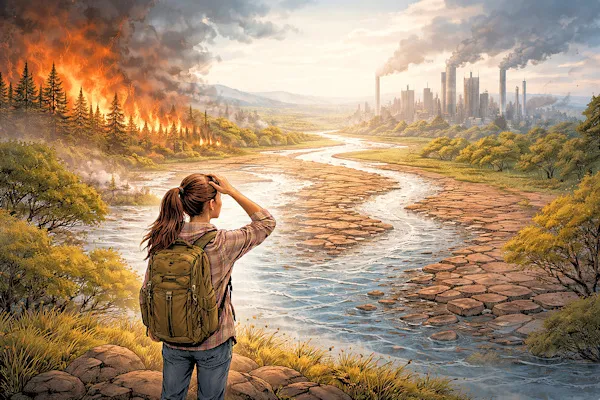
For those paying close attention, climate change can feel like a slow-motion emergency unfolding in plain sight. The science is clear, the stakes are high, and the window for meaningful action is narrowing (according to the Intergovernmental Panel on Climate Change, 2023). And yet, our collective response remains uncertain, divided, and often inadequate. Why?
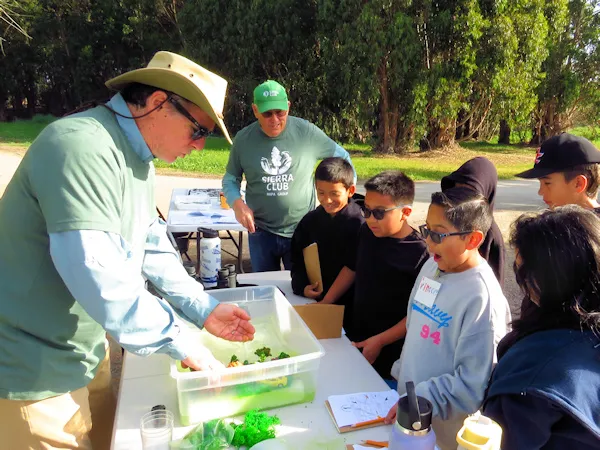
As a volunteer with the Napa Sierra Club, I’ve been circling this question for about seven years. Before that, as a middle school science teacher, I found myself thinking about it in a different way: what kind of world are these kids walking into—and why aren’t we acting like it matters?
Why aren’t we acting as if our hair is on fire?
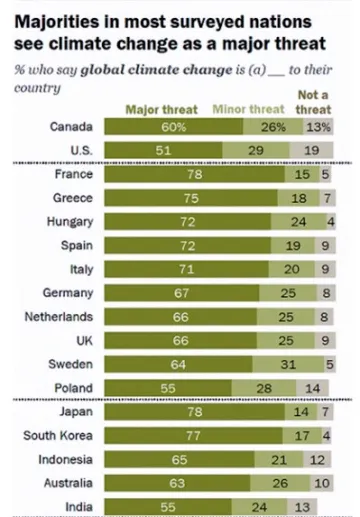
It’s easy to call it indifference. But that explanation doesn’t quite hold up. Most people, when pressed, will say they care (see Pew Research survey, left). A lot of them genuinely do. So something else is going on.
I’ve taken a look across many fields such as psychology, behavioral economics, and evolutionary theory. They suggest a less satisfying answer: it’s possible we are behaving exactly the way we’re wired to behave. The problem may not be that we don’t care. It may be that we’re not particularly well-equipped to respond to a threat like this.
The Mismatch Problem
Many scientists argue that the human brain evolved to handle immediate, visible threats: predators, food scarcity, hostile neighbors. Climate change is none of those things. It is abstract, gradual, and often invisible in daily life. The result is what’s known as an evolutionary mismatch.
A global temperature increase of 1.5–2°C doesn’t trigger the same instinctive alarm as a wildfire—even if its long-term consequences are far more severe. The threat unfolds slowly, across decades and continents. Our brains struggle to register that as urgent.
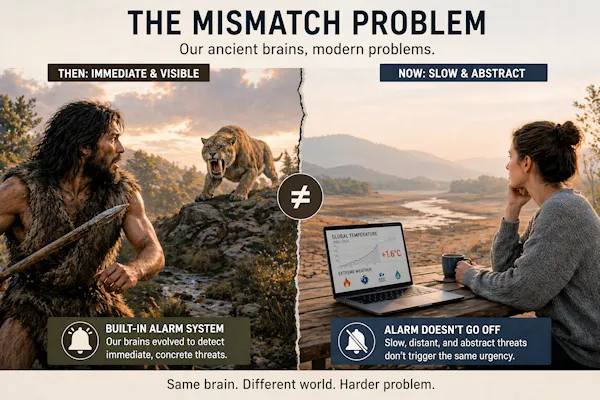
I’ve long been interested in Evolutionary Psychology, which suggests that just as we evolved physical traits to survive—like the opposable thumb—we also evolved mental shortcuts and instincts shaped by a very different world. Work by Leda Cosmides and John Tooby points to a growing gap between that ancient wiring and the modern risks we now face. As Psychology Professor Daniel Gilbert has argued, climate change lacks the qualities that typically trigger human alarm: immediacy, intent, and moral clarity.
I sometimes wonder whether our ancestors could have recognized a shifting climate as a threat at all. Probably not. But what we’re experiencing now isn’t a slow, natural shift—it’s rapid, human-driven change unfolding on a timescale no species has previously encountered.
That alone should be enough to set off alarms. It doesn’t.
Present Bias and the Tyranny of Now
Behavioral economics offers another piece of the puzzle: present bias.
We tend to prioritize immediate rewards over future benefits, even when the long-term stakes are enormous. It’s the classic “marshmallow test,” scaled up to a planetary level. We know we’d be better off waiting—but that marshmallow is sitting right there, and I want it now.
This tendency—documented by Daniel Kahneman and Richard Thaler (both Nobel Laureates in the field of Behavioral Economics)—pushes us toward short-term comfort. Cutting emissions often means higher costs or inconvenience now, while the benefits are delayed and uncertain.
So we wait. And then we wait a little longer.
System Justification and Status Quo Bias
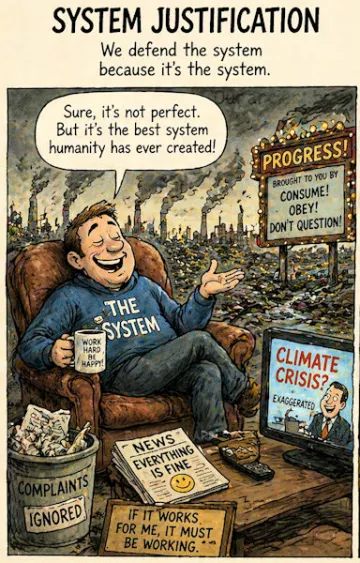
There’s also a quieter force at work: our tendency to defend the way things already are. Research by John Jost shows that people are motivated—often without realizing it—to rationalize existing systems. Even when those systems aren’t serving us particularly well. We make up false stories to keep the way things are so as not to disrupt who we have made ourselves out to be.
I see this in myself more than I’d like to admit. It’s easy to point fingers about climate inaction until you’re standing at the grocery store, justifying a choice you already know isn’t aligned with your values. That piece of meat looks so darn good. Or, gosh, I just need to pass this draft through ChatGPT because it needs tightening up a bit. Climate hypocrisy. We’re so very good at explaining away things to ourselves, especially when it goes against our comfortable lifestyles we've created.
Modern life is deeply entangled with fossil fuels. Challenging that system isn’t just a policy question—it can feel like pulling on a thread that unravels everything from jobs to identity to daily convenience. So we default to what we know. Or we tell ourselves small incremental adjustments are enough.
The Role of Uncertainty and Ambiguity
Climate science deals in probabilities and projections. The overall conclusions are strong, but uncertainty at the margins gives people room to hesitate. Research by Psychology Professor Paul Slovic shows that humans are not particularly comfortable with probabilistic thinking. When outcomes aren’t certain, we tend to delay decisions.
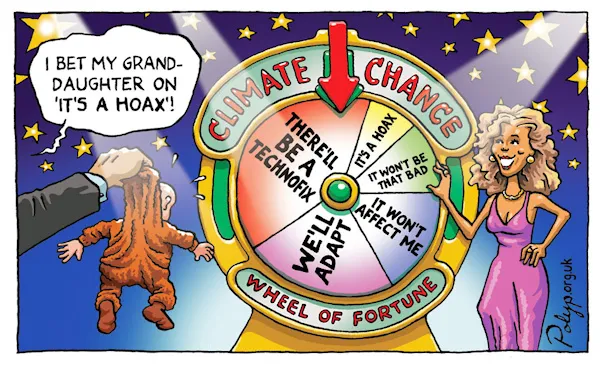
That tendency hasn’t helped, especially given the well-documented efforts of industries, the wealthy and politicians to amplify doubt (see Merchants of Doubt by Naomi Oreskes and Erik M. Conway). So uncertainty becomes an off-ramp: maybe it’s not that bad… maybe we have more time…maybe it is a hoax.
Emotional Overload and Numbing
Then there’s the emotional side of it. The scale of climate change is hard to process. When a problem feels too big, people tend to shut down rather than lean in.
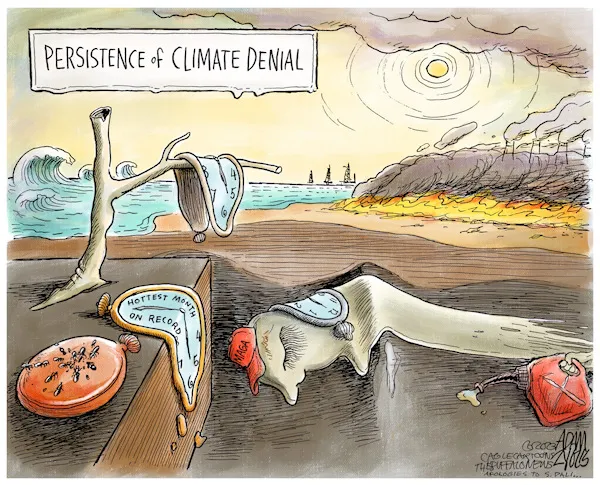
Paul Slovic calls this “psychic numbing”—our sensitivity drops as the scale of harm increases. Huge numbers don’t move us; they flatten us. The U.S. uses over 100 quadrillion BTUs of energy a year, most of it from burning fossil fuels. That should be staggering. Mostly, it just feels abstract. Heck, what is a BTU anyway?
Professor of Psychology and Public Affairs, Elke Weber, has found that people respond more strongly to immediate, personal risks than distant ones. Our risk assessments and decisions can also be culturally determined. All of this suggests that what looks like apathy may actually be a kind of emotional self-preservation.
When the Abstract Becomes Local
All of this helps explain why climate change can feel distant. But that explanation starts to wobble in places like Napa County.
We’ve lived through the fires. The Glass Fire wasn’t abstract. Neither were the smoke-filled days, the evacuations, the creeping sense each fall that this might be the year it happens again. Add in prolonged drought and strain on water systems, and it’s hard to argue this is someone else’s problem.
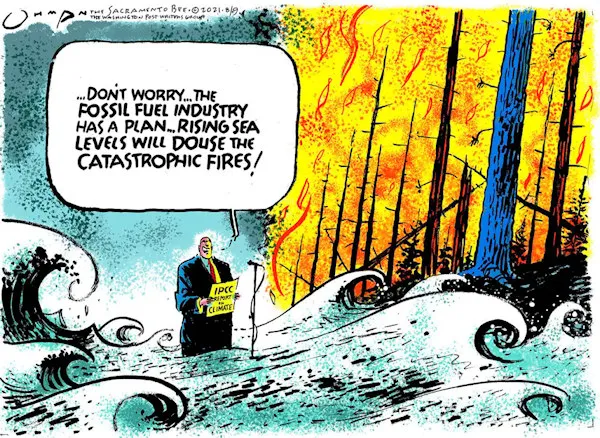
And yet, even here, the response is uneven. Part of it is how we interpret what we’re seeing. A fire becomes a bad fire year. Smoke becomes an unfortunate season. We’re good at folding extraordinary events back into something that feels familiar.
There’s also an economic reality that’s hard to ignore. Napa’s identity—and much of its livelihood—is tied to an industry that depends on a stable climate while existing within a carbon-intensive economy. Fully confronting that tension can feel… threatening (which ties in well with System Justification, above). What exactly are we supposed to replace it with?
And then there’s adaptation. Hardening homes, adjusting vineyard practices, managing water more carefully—these are all necessary. But they can also create the impression that the problem is being handled. That we’re adapting our way out of something that ultimately requires deeper change.
If anything, Napa makes the larger point sharper: even when the threat is visible and personal, our underlying habits of thought don’t change as much as we might expect.
Social Norms and Cultural Signals
We also take cues from each other. Research by the American Psychologist and author Robert Cialdini shows that behavior is strongly influenced by perceived norms. If no one else seems to be changing, it’s easy to conclude that change isn’t necessary. I’ve caught myself thinking some version of: if my neighbors aren’t doing this, why should I?
At the same time, work by the Dutch Social Psychologist Sander van der Linden suggests the flip side is also true—when people see that others care and are taking action, it can shift behavior quickly. People act when action feels normal. This could be key.
The Structural Overlay
And then there’s the part that has nothing to do with psychology. Even highly motivated individuals operate within systems that limit their choices. Energy infrastructure, transportation, housing patterns, economic incentives—these shape what’s possible.
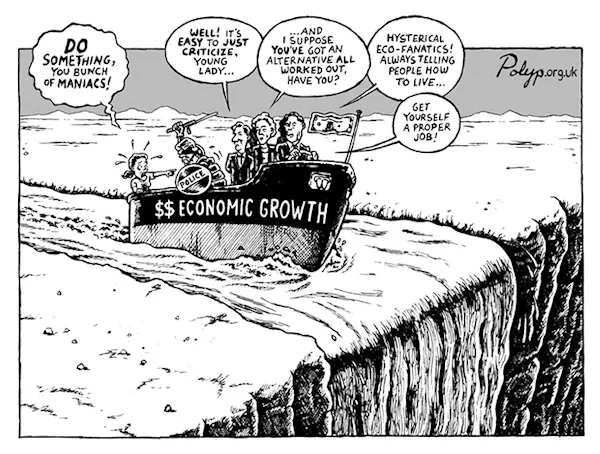
Organizations like the International Energy Agency and United Nations Environment Programme make it clear: emissions are baked into the structure of modern life. It’s not just about better decisions. It’s about the range of decisions available (or the lack thereof).
What This Means for Action
If all of this is even partly true, it complicates the usual answer: “we just need more awareness.” We’ve had awareness for a long time. In my years teaching, I rarely met a student who, once they understood the basics, didn’t care. They got it. Rising temperatures, melting ice, extreme weather—it wasn’t that hard to grasp. The problem was never a lack of information. The problem was what came next.
Because knowing something is wrong and knowing what to do about it are very different things—especially when the “doing” involves costs, trade-offs, and systems that don’t make better choices easy.
It’s one thing to tell people to drive less in a place built around cars. Or to consume less in an economy built on consumption. Or to think long-term in a culture that rewards short-term gains.
At some point, the conversation shifts from individual responsibility to something less comfortable: the structure of everyday life. And that’s where things tend to stall.
A Less Comfortable Conclusion
The conclusion I keep coming back to isn’t very satisfying. There may be nothing uniquely broken about us. We are responding to climate change in ways that are consistent with how humans tend to think, decide, and live within systems.
We favor the present.
We follow social cues.
We adapt to what’s in front of us.
We rationalize.
And maybe most importantly—we work within the choices we’re given.
That doesn’t make the outcome inevitable. But it does make it harder to believe that this will be solved simply by asking people to care more, or try harder.
Which brings me back to my students. They understood the science (well, sort of). Many of them were more open, more concerned, and more willing to change than the adults around them. And yet, they are inheriting a world where most of the big decisions have already been set in motion.
So maybe the question isn’t why aren’t we acting? I’ve just spent pages trying to answer that. The more useful question is whether we’re willing to act with that knowledge in mind—to push past the habits and systems that keep us stuck.
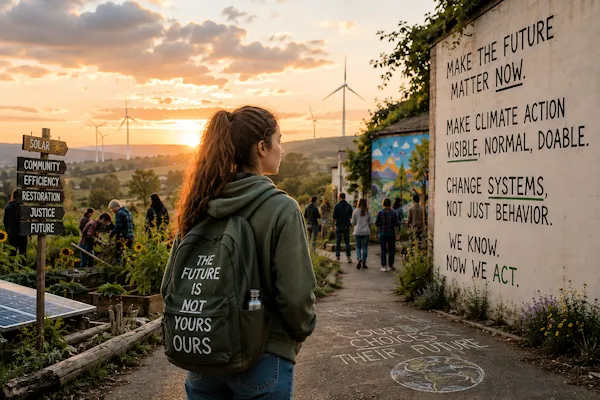
If we know we default to the present, then we have to build incentives that make the future matter now. If we know we follow social cues, then we have to make climate action visible and normal. If we know systems constrain choices, then we have to change the systems—not just ask individuals to behave differently.
None of that is simple. But at least it’s not a mystery anymore.