US Faces Triple Threat of Climate Crisis, Economic Hardship, and Donald Trump
Scientists warn Trump’s “systemic assault” on science comes as we enter an unprecedented Danger Season
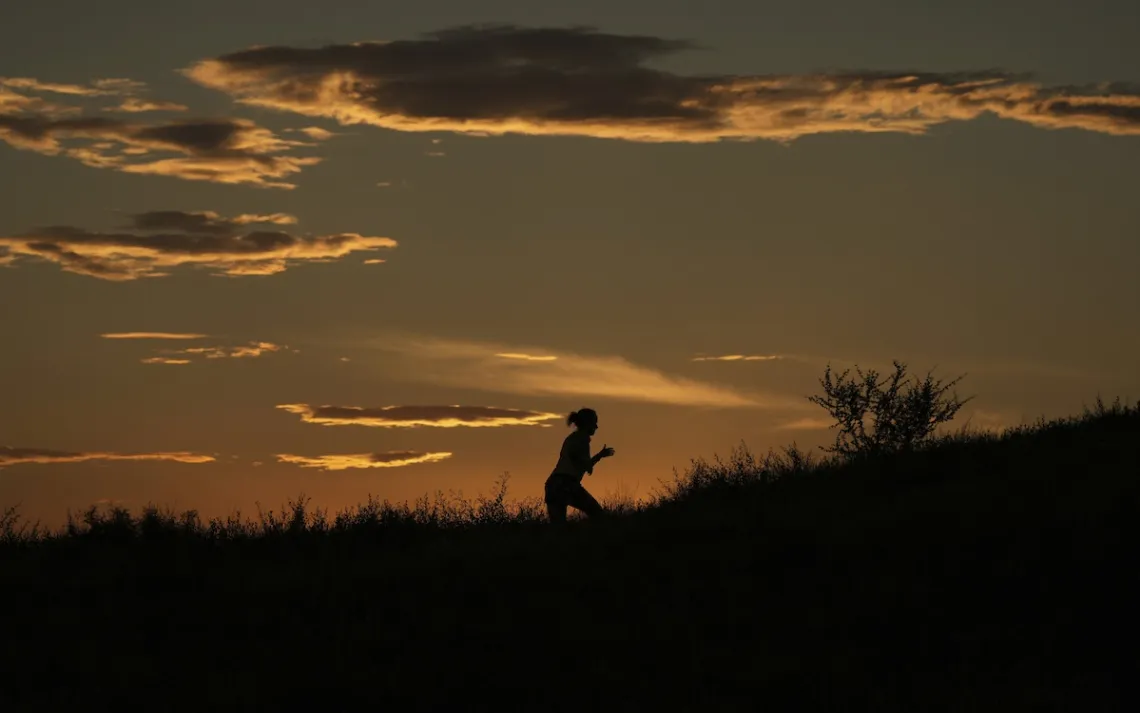
A jogger in San Antonio, Texas, as temperatures hit record highs. | Photo by Eric Gay/AP
As Americans head into a summer that is expected to deliver extreme heat and other climate-intensified weather hazards, experts at the Union of Concerned Scientists (UCS) warn that these dangers will be compounded by a reckless federal administration and an expanding affordability crisis, posing a triple threat that has little precedent in US history.
“Danger Season” is the name the science advocacy organization uses for the period of May through October, when North America typically experiences the most severe extreme weather like heat, flooding, drought, and wildfires that are now supercharged by climate change. This year, that season is “colliding with an affordability crisis and the Trump administration’s anti-science actions,” elevating the risks and leaving us less prepared to cope, according to a recent UCS press release.
With global heating accelerating, the peril posed by its damaging and deadly impacts is on the rise. So is climate denial, thanks to the return to power of Donald Trump and his administration. Since his reelection, efforts to monitor and respond to the climate crisis have been swiftly undermined or trashed altogether as the administration set out to slash federal agency budgets and staff while dismantling climate science and policies along the way.
“Last year, with the second Trump administration and the destruction that they initiated with federal agencies, there was a new kind of danger introduced,” Erika Spanger, director of strategic climate analytics at UCS, told Sierra.
Spanger notes that this destruction is continuing, pointing to the recent announcement of plans to axe a key ocean monitoring system as one example. The Trump administration is also fueling economic insecurity as policies on everything from tariffs to the war on Iran drive price increases to consumers.
“Now, the administration has created this third danger, which is why we’re framing 2026 as a triple danger,” Spanger said. “They’ve created an affordability crisis.”
In a blog post published last month, Spanger argued that 2026 is shaping up to be “uniquely perilous,” warning: “This is the year when the triple crises of climate change, a reckless authoritarian government, and economic insecurity will start to collide.”
Extreme weather and the forecasted El Niño
This year has already gotten off to an active start in terms of climate-related hazards like blistering heat, extended drought, and destructive wildfires. Such extreme weather is not expected to let up anytime soon and will likely intensify, especially with a looming El Niño poised to amplify warming and related impacts.
In March, much of the western United States sweltered through an unusual and record-breaking early spring heat wave, which climate attribution researchers say would have been “virtually impossible” absent human-caused climate change. That month ranked as the hottest March on record for the contiguous US, where the average temperature from January through April was also the warmest on record. Most of the continental US is projected to experience above-average heat throughout the summer.
Large parts of the country—roughly 50 percent of it—are experiencing drought conditions, which exacerbates wildfire risk, strains water supplies, and jeopardizes agriculture, putting further pressure on food prices. And the heightened fire risk comes as the US has experienced a well-above-average number of blazes and burned areas already this year. More than 30,500 wildfires have been reported so far, and 2,412,214 acres have burned across the country as of May 31, according to the National Interagency Fire Center.
Then there is El Niño—the warmer phase of a natural climate system cycle called the El Niño–Southern Oscillation spurred by above-average sea surface temperatures in the equatorial Pacific. That adds even greater risk of severe weather. The World Meteorological Organization recently reported that there is an 80 percent likelihood of an El Niño forming from June through August, and some forecasts suggest it could be the most powerful El Niño ever recorded.
“We need to prepare for a potentially strong El Niño event—which will exacerbate drought and heavy rainfall and increase the risk of heat waves both on land and in the ocean,” WMO Secretary-General Celeste Saulo said in a statement.
Marc Alessi, science fellow at the UCS, told Sierra that some models indicate this year’s El Niño could rival or even surpass the one documented in the 1870s that led to major loss of life, drought, heat waves, and widespread impacts to crop yields.
The combination of a very strong or super El Niño and the ongoing human-made warming makes for a particularly perilous situation, climate scientists warn.
“If there is a strong El Niño later this year, there’s a serious risk that the effect of climate change and El Niño will result in unprecedented weather extremes,” said Friederike Otto, a professor of climate science at the Centre for Environmental Policy, Imperial College London, and cofounder of World Weather Attribution.
Alessi argued that it is now more important than ever to be tracking shifts in the climate system through agencies like the National Oceanic and Atmospheric Administration, which has been targeted with deep cuts by the Trump administration.
“We should not only be maintaining funding and staffing for NOAA, its research, its observational network, but we should be increasing funding because the climate is changing and we need to be on top of that, especially since it will affect the United States’ economy and how people live their lives,” Alessi said.
“This is malfeasance”
Instead, the opposite is happening. The Trump administration continues what Spanger calls its “systemic assault” on federal agencies that help inform the public about climate and extreme weather risks and that help Americans recover from disasters.
“The climate extremes of Danger Season 2026 will be compounded by something that has no equivalent in our nation’s history: a US administration that is not simply failing to protect people but is actively removing protections, exacerbating risks, and inflicting harm, all with a hardening quality of authoritarianism,” Spanger writes in her blog post.
“This is malfeasance,” she argues.
In addition to staffing and budget cuts at NOAA—affecting offices like the National Weather Service and the National Hurricane Center—the administration has targeted satellite infrastructure and data used for weather and hurricane forecasting, scrapped the scientists working on the next National Climate Assessment, and discontinued the government’s tracking of billion-dollar climate disasters. It has also taken aim at the National Center for Atmospheric Research, considered a “crown jewel” of climate science.
With disaster preparedness and response, experts say the administration has severely undermined the Federal Emergency Management Authority through deep staffing and budget cuts, delays on aid delivery and even politicization of disaster response. Trump’s proposed FY 2027 budget includes axing $1.3 billion in FEMA funds for state and local emergency preparedness. And according to Climate Power, the US is entering this hurricane season with the smallest disaster workforce since 2021.
“With NOAA and FEMA understaffed, the remaining staff are often inexperienced, stretched too thin, or burned out,” said Monica Medina, Climate Power co-chair and former principal deputy undersecretary of NOAA. “Life-saving alerts are at risk, and critical warnings and government emergency response could be delayed—leaving families unprepared and having to fend for themselves when a hurricane or dangerous storm hits. It only takes one missed forecast for there to be tragic consequences. With these cuts, Trump is gambling with people’s lives.”
An affordability crisis compounds safety challenges
Climate advocates say these dangers are compounded further by an affordability crisis exacerbated by Trump’s own policies, such as the ongoing war in Iran and his relentless attacks on cheaper clean energy, while simultaneously propping up dirty and expensive coal power. Just last week, Trump announced plans to pour $700 million into coal plants—a move that Sierra Club’s climate policy director Patrick Drupp said would “make Americans sicker and drive up electricity prices even more.”
Electricity prices have already risen by 18 percent on average since the start of Trump’s second term in January 2025. Higher electricity costs could make it harder for some families to afford to run air conditioning, which has become a critical adaptation during excessive heat events that can literally save lives. According to the National Energy Assistance Directors Association, the cost of electricity for home cooling is expected to reach nearly $800 on average for this summer, up 8.5 percent from last year.
“Families are squeezed from both directions. They are paying more for electricity, and they need more of it to stay safe during increasingly hot summers,” said Mark Wolfe, executive director of NEADA.
“In extreme events, you need resources to cope,” Spanger told Sierra. “You need to be able to run your air conditioning during an extended heat dome. You need to be able to put gas in the car and pay for a hotel during a hurricane evacuation. This third source of stress is simply dangerous for the nation going into what is poised to be a really active summer.”
What can be done?
Preparation is especially important given the converging triple threats that make staying safe more challenging, Spanger said. Make a plan, whether that is for evacuation in the event of a hurricane or wildfire or for staying cool and hydrated during the next heat wave, she says. A simple plan in advance can help reduce additional stress when danger does strike.
Beyond that, Spanger argues that Americans should demand better from their elected officials and push to hold them accountable wherever possible.
“It’s about more than us getting through this next [danger] season,” she said. “It’s about getting to a place where we have the leadership and good governance that we deserve.”
“One opportunity this summer is the August recess, when federal lawmakers usually go back to their home districts,” Spanger added. “It’s a chance for them to hear from their constituents. It’s about showing up and saying, 'Why are you letting [the administration] dismantle our taxpayer-funded forecasting and emergency response infrastructure? Why are you letting them exacerbate this affordability crisis that makes it harder for us to cope and recover? This has to stop.'"