“In every walk with nature one receives far more than he seeks.” - John Muir
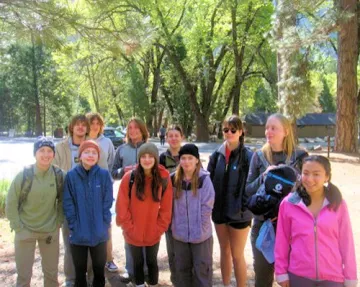
The sun dipped below the trees as we bundled around the campfire. Our only worry was handing out sticks for roasting marshmallows. Our feet hurt from the long day behind us as scents wafted from dehydrated meals. Each and every one of us was satisfied with our excursion as we laughed about our challenges, our feats, and the next day’s adventures.
Vintage High Backpacking Club holds about thirty members – about one third go on each trip. The trips range from the sandy slopes of Point Reyes to the expansive mountaintops of Yosemite. The club connects youth through their sense of adventure, their love for nature, and their willingness to do hard things. In the month of April, amidst prom, preparing for AP exams, and for many of us, sports championships, we embarked on our much-needed Yosemite excursion.
Connecting with nature is one of the most important things a youth can do for his/her well-being, and it is often the first step towards a life-long journey with environmentalism. The Vintage High Backpacking club fuels this connection by providing teen adventurers with the campsite and community necessary for a genuine connection with nature.
It’s no secret that society is becoming increasingly dependent on technology. Whether it be through AI usage or endless scrolling through social media posts, technology has become an integral part of many individuals' daily lives. It’s easy to become overwhelmed by this constant source of flowing information, especially while transforming into adulthood. To combat this overflow of information–this dependence on technology, escaping from it is necessary. The environment offers this escape.
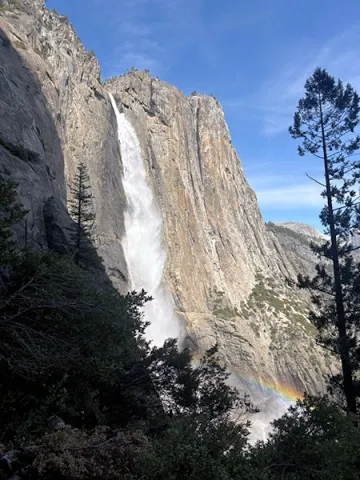
Yosemite Falls is one of the greatest waterfalls in the world. Millions of gallons come rushing down every second, the sound of water crashing on the floor fills the air. As fellow backpacker Natalie Trott and I hiked our way to the top (leaving behind the pack because of our overwhelmed excitement), our conversation fell silent as amazement took hold. The waterfall misted us as we climbed up the trail, mountains surrounding us from all sides. During our hike, I simply stopped and considered myself amongst my environment. I felt so small, my problems so trivial. I was in this amazing environment, one that had been here for billions of years. A habitat to thousands of creatures, a place where humans all over the world can come and admire. Looking ahead of me and seeing all of this, an awareness washed over me. How is my life, human existence, capable of destroying this, how are we as humans currently destroying our Earth, and why aren’t enough people concerned?
This awareness that flooded my brain as I continued to hike upwards was new. Despite being a student intern for the Sierra Club and a part of the environmental club at Vintage and all these different connections I had to environmental policy, the whole idea of human destruction seemed abstract, far away from the comforts of an air-conditioned classroom. But, being out there in the most beautiful place on Earth, where I had to rely on the environment for comfort– the shade of a tree during the hardest part of the hike, the water from a creek running through the trail, the divot in a rock to lay down–the importance of protecting the environment was no longer far-fetched. It was right in front of me. I have never felt more strongly about environmental policy than during my hike up Yosemite Falls. If we could just get more people out there, in active reliance on the environment, action would be a given, rather than something we have to fight for.
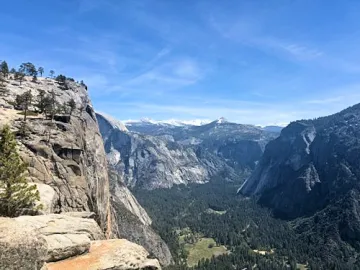
The awe took hold of not just myself, with my novel realization, but every one of the backpackers that made it to the top of the falls. For nearly two hours, we sat under a shaded tree, and looked out against the sky, sitting with our thoughts (something out of the ordinary for many of us). We saw Half Dome to our right, snow-covered peaks in the distance, mile-tall mountains across the parking lot, but most importantly, we saw hundreds of fellow admirers, couples, parents and child, friends, and clubs. We saw people who looked different than us, dressed differently than us, and talked differently than us. Yet, as we lingered upon the top of the mountain, we became united as one. We were a community of people who relied on the environment for relief from everyday life. We were a community with the passion necessary for change.
The Yosemite trip was more than just a few hikes. It was a time filled with memories that will last each and every one of our backpackers a lifetime. We sat around the campfire for hours, talking about everything that came to mind: college, passions, fears, dreams… We bonded in a way that many teens of our generation might never experience. We bonded without the distraction of phones, or rules, or social media, or television, or stress. Backpacking is a necessary experience, not for the views, but for the genuine, raw connection that is so rare to come by nowadays. These connections to one another, to the surroundings, to yourself are vital to the human experience. These connections are vital for enough people to care enough to foster change. Sitting around with my friends was perhaps the most impactful part of the trip, I was a part of a community focused on good. I felt a part of something powerful.
The ideologies of the Sierra Club center around the belief that access to green space is a fundamental human right. Ultimately, the Vintage High Backpacking Club is more than just a club–it is an access point to nature and an escape from the constant rush of everyday life. Because of environmental advocates like John Muir, I was able to backpack through Yosemite Falls and experience the beauty of the natural world firsthand. On that trip, I connected not only with my friends and surroundings, but also with myself. In a world full of distractions, nature gave me the opportunity to slow down and truly think. Experiences like this are only possible when we continue to protect our public lands and advocate for the environment. As John Muir once stated, “In every walk with nature one receives far more than he seeks.” Nature gives us far more than scenery–it gives us perspective, connection, and responsibility, which is why it is our duty to protect it.