 The Magazine of The Sierra Club
After the Deadly Floods In Texas, Many Surveyed Survivors Feel Left Behind
Many say the government has left them to recover on their own
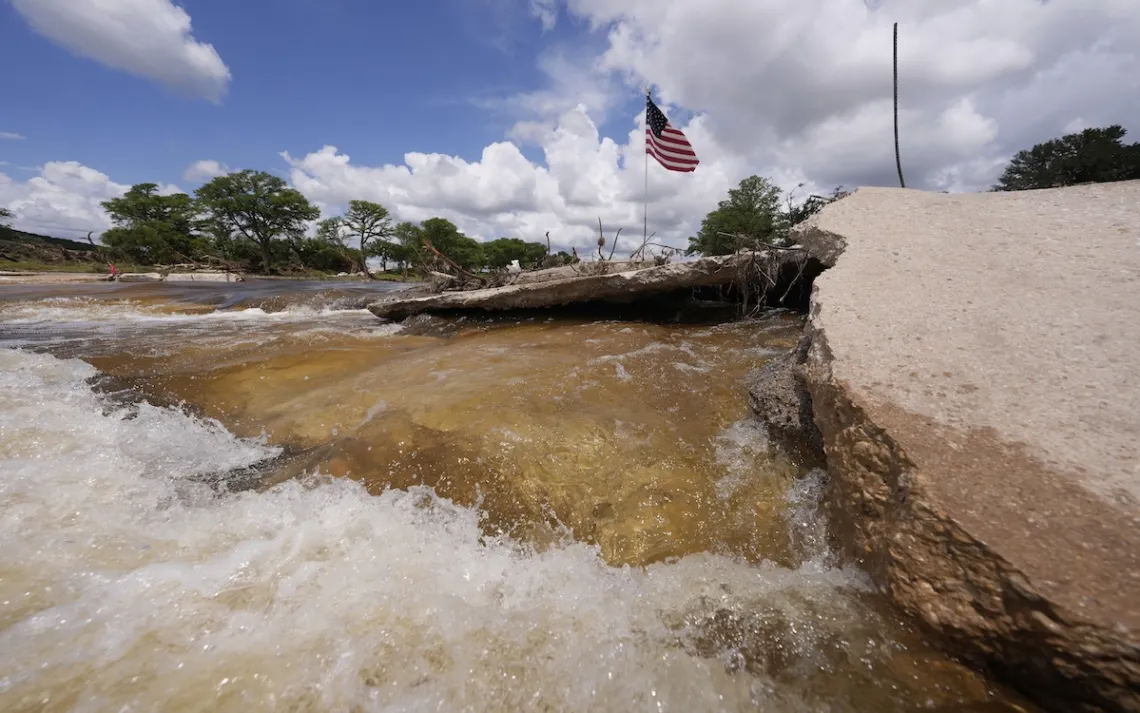
A destroyed bridge over the Guadalupe River after flooding in Kerrville, Texas, in 2025. | Photo by Gerald Herbert/AP
Kylie Nidever never imagined that she would become an advocate for survivors of extreme weather and their long road to recovery. But everything changed when catastrophic flooding hit her neighborhood one year ago.
The lifelong resident of Kerr County, Texas, was in her childhood home on the morning of July 4, 2025, when flash flooding hit the Guadalupe River. The deluge brought feet of water cascading into homes, damaging almost all of the 33 residential structures in the Bumble Bee Hills neighborhood. Nidever and her grandparents, who lived across the street, were among the five houses that were spared from flooding. The following day, Nidever helped her neighbor, who had gotten four and a half feet of water and were in their house “mucking-out process.”
“We were very, very fortunate in Bumble Bee Hills that nobody lost their life or was significantly injured,” she said during a press call hosted this week by Extreme Weather Survivors, a group that provides support and resources to a growing number of Americans who have experienced an extreme weather disaster. Overall, the flooding killed 139 people, including dozens of children at the Camp Mystic sleep-away camp.
Survivors of the disaster continue to face hardship. According to new survey data, many of them are feeling left behind by the government.
“The impacts did not end when the waters receded,” Lama Hassoun Ayoub, executive director and principal researcher at Partners for Social Impact, said during a press call. “Nearly a year later, many are still dealing with financial strain, housing and insurance barriers, emotional trauma, and a deep loss of trust in the systems that were meant to help them recover.”
Extreme Weather Survivors commissioned a survey based on a sample of 258 adults directly impacted by the July 2025 Texas floods. The survey was intended to gather insights on survivors’ experiences and their thoughts about recovery and what they would like to see change. More than half the survivors surveyed, 54 percent, said they felt abandoned by their government both during and after the disaster.
“When the floods happened, it was my neighbors who were checking on each other, pulling each other out from their homes,” Nidever said. “In the days and weeks that followed, being out in the neighborhood, I never saw firsthand any government officials, with the exception of I think someone from the Department of Wildlife, who came in one evening and I think was measuring the water level.”
“I feel like it was a governmental failure on all levels,” she added.
While Texas Governor Greg Abbott did call a special session to in part address the impacts of the Central Texas floods, only a few bills related to camp safety and early warning siren systems were approved. Instead, partisan issues like gerrymandered maps became the main focus. Recommendations related to the state's 2024 State Flood Plan were largely ignored.
According to the survey results, half of Texas survivors said they no longer trust that the government will help, with 53 percent saying that disaster survivors in this country are left to fend for themselves. Nearly three-quarters of those surveyed said that disasters have become harder to recover from, financially and emotionally.
These sentiments are consistent with those of other Americans impacted by extreme weather. The survey, which also included a national sample of 1,032 adults, found that 64 percent agree that people affected by disasters are often left to fend for themselves after the initial emergency passes.
“The thing that we heard again and again in Texas and in conversation with survivors all across the country is, ‘Where is our government?’” said Chris Kocher, co-founder and co-executive director of Extreme Weather Survivors.
Climate change, primarily caused by burning fossil fuels, is supercharging extreme weather like flooding, wildfires, heat waves, and hurricanes. As a result, more and more Americans are becoming directly impacted. Nearly all of the national survey respondents, 95 percent, said they have experienced at least one extreme weather event in their lifetime, while 51 percent said they have experienced four or more. And 91 percent said they believe that protecting people and homes from extreme weather should be a priority for elected officials.
Human-driven climate change intensified the heavy rainfall that led to the July 2025 Texas floods, according to a rapid attribution analysis. Researchers say that meteorological conditions similar to those that caused the floods are up to 7 percent wetter than they had been in the past, and that natural variability alone could not explain the increase in precipitation that led to the flooding event. “There is no doubt that burning fossil fuels has enhanced the precipitation associated with these floods,” said Davide Faranda, a French climate scientist and lead author of the study.
Meanwhile, the Trump administration has made deep cuts to federal agencies like the National Oceanic and Atmospheric Administration (NOAA) and the Federal Emergency Management Agency (FEMA) charged with weather forecasting and monitoring climatic changes as well as responding to disasters. It has also taken a wrecking ball to federal climate policies and environmental protections at a scale that has been unprecedented.
Over half of the Texas flood survivors, according to survey results, said they agree that fossil fuel corporations should help them recover given their accountability in driving the climate crisis.
Nidever said that she was not aware of “conclusive, empirical data” indicating that the fossil fuel industry was to blame for the flooding disaster. “But I definitely think they are playing a role in the country [in a way] that is affecting the weather,” she said.
Going forward, survivors say they want to have a seat at the table when it comes to decision-making; 65 percent said they should have a larger role in shaping climate policy and funding decisions. And almost three out of four Texas flood survivors, 72 percent, said that they trust other survivors or people who have lived through similar experiences more than they trust government officials and politicians.
“Survivors are doing this recovery work, but too many feel they are doing it alone and without the government support that they need,” Ayoub said.
“The journey to recovery is a quiet, ongoing struggle where the heaviest burden of financial instability is shouldered long after the headlines have moved on,” said Texas flood survivor Adial Carrizales. “My family and I still face day-to-day recovery, trying to find our normal life again.”