 The Magazine of The Sierra Club
In the Aftermath of Tren Maya
Conservationists call the Mexican government's plans for the train a disaster

José Urbina exhaled through his respirator and reached out to the column’s edge. Underwater, the support beam offered little resistance to his touch. Fragments of rusty steel crumbled beneath his gloves. A short two years after its ribbon-cutting, the once-promising Mayan Train was already falling apart.
In 2018, the Mexican federal government announced an ambitious project. They would build a 960-mile train route to ferry passengers across the Yucatán Peninsula, a region famous for pristine beaches, wild jungles, and crystal-clear swimming holes. At first, support was widespread. But by the project’s end, construction damaged mangrove forests, polluted cenotes, defiled major tourist attractions, and put locals’ health at risk. They call it Tren Maya.
“The concept was a beautiful promise of health, education, development, and tourism,” said Guillermo D. Christy, a speleologist, researcher, and president of the nonprofit Sélvame. “We all wanted to believe it because we deserve it, but it was ultimately the false promise of companies that wanted to take advantage of the great fountain of resources here. They were lying from the beginning.”
*
The Yucatán Peninsula reaches into the Gulf of Mexico like the toe of a boot. It is home to over 7,300 species of wildlife and the second-largest tropical rainforest in the Americas. Its eastern coast borders the Caribbean Sea and the second-longest coral reef in the world, the Great Mayan Reef. The region’s main resort towns—Cancún, Playa del Carmen, and Tulum—dot the coastline and attract millions of visitors annually.
When the government under President Andrés Manuel López Obrador initially revealed plans for Tren Maya, the price tag was about $7.4 billion. They suggested it would spread wealth west to lesser-known towns like Mérida and Campeche. It would streamline travel throughout Quintana Roo and the Yucatán and bring education, economic development, research, and more to southern Mexico, a generally underfunded region.
The train was originally slated to run along an already existing highway. Locals like Christy and Urbina (known locally as Pepe Tiburón for his scuba diving and shark activism) were optimistic about the project. They saw it as an opportunity to improve the highway, add a bike lane, and perhaps even move the cities’ electrical power underground to reduce power outages, which are frequent in the rainy season.
However, when the government released the train’s blueprints, large hotel conglomerates protested. They said the route would disrupt tourism and necessitate some expensive remodeling. So, the engineers altered the train’s course, moving the tracks inland to cut through 41 miles of the raw, virgin jungle. “The government didn’t listen to scientists, lawyers, or citizens, but listened to the hotel owners,” said Urbina.
In a rush to finish the construction before the end of López Obrador’s term in 2024, the government broke ground before completing sufficient environmental impact testing, said D. Christy. “They took the studies they did from the initial route and copied and pasted them on ‘new reports’ for the new construction,” said Urbina.
From an ecological perspective, the train was a disaster. The new route would dice up the jungle, contaminate the aquifer, pollute the mangroves, and bring enough construction and toxic runoff to rattle the Mayan Reef, said D. Christy. The government denied that protected species lived in the area, despite biological and photographic evidence. They didn’t have permission to change the classification of the land area from “forested” to “developed,” and didn’t wait for it, he said.
Protests erupted throughout the region. From a practical standpoint, the new route just didn’t make sense. Tourist towns hug the coast, but this proposed alternative would require travelers to venture inland and make two additional journeys to and from the train stations. This completely negated what was supposed to be a convenient alternative to the bus system that already runs direct from the airport to town centers. They argued that the train simply wouldn’t make any money.
The Zapatista Army of National Liberation rejected the project. The Regional Indigenous Council of Xpujil delivered a petition with 268,000 signatures to the Campeche Ministry of Environment and Natural Resources, asking for a suspension on environmental grounds. Locals protested that the proposed route would evict them from their homes. But despite legal action, construction continued with a few minor adjustments.
*
To prepare for the tracks, construction crews razed nearly 30 meters of jungle in both directions and built two fences on each side to prevent vandalism and wildlife interference. The train cut off jaguar movement in 12 corridors and severed migration patterns for monkeys and other transitory animals.
The train was designed to run on a raised platform, so crews began to dig for support poles. The entire region sits on the Great Mayan Aquifer—a complex system of underwater rivers and caves known as “cenotes,” some of which have gained popularity as swimming holes. Thousands of these limestone sinkholes interconnect like honeycomb just beneath the ground and supply drinking water to around 5 million people. That freshwater supply is already at risk due to rapid urbanization and overtourism. It is made even more vulnerable by its accessibility.
“As soon as you drill into the ground here, you reach the underground river, where all of our water comes from on the Yucatán Peninsula,” said D. Christy.
Unplanned settlements and a lack of centralized sanitation in the rapidly growing region mean leaky septic tanks easily contaminate the aquifer. Every hole dug for a train support column is another perforation in the thin barrier between the surface and the cenotes beneath, which are all connected and drain to the sea.
“As soon as they began drilling, we asked, ‘What are you going to do about all the chemicals, steel, heavy metals, and debris that you’re putting into the underground rivers?’” said Urbina. “Nobody answered.”
Construction barreled on. President López Obrador declared the project a national security matter and handed off construction, operation, and management to the Mexican military.
Crews drilled for about 15,000 support columns, which are now disintegrating into the aquifer, putting on aquatic-intergalactic shows for the scuba divers that encounter them in these cenotes. “We have seen the pillars burst because they were poorly made,” said Urbina. “So I cannot even imagine what we don’t see. There’s a pretty big chance that the train collapses.”
By January 2021, workers and archaeologists had uncovered 8,000 ancient artifacts during construction. Greenpeace organizers tied themselves to heavy machinery to derail the project. A group of celebrities rallied in opposition—comedian Eugenio Derbez, singers Rubén Albarrán and Natalia Lafourcade, and actress Kate del Castillo—and joined a new collective campaign led by D. Christy called Sélvame del Tren (sálveme del tren means “save me from the train,” and selva means jungle).
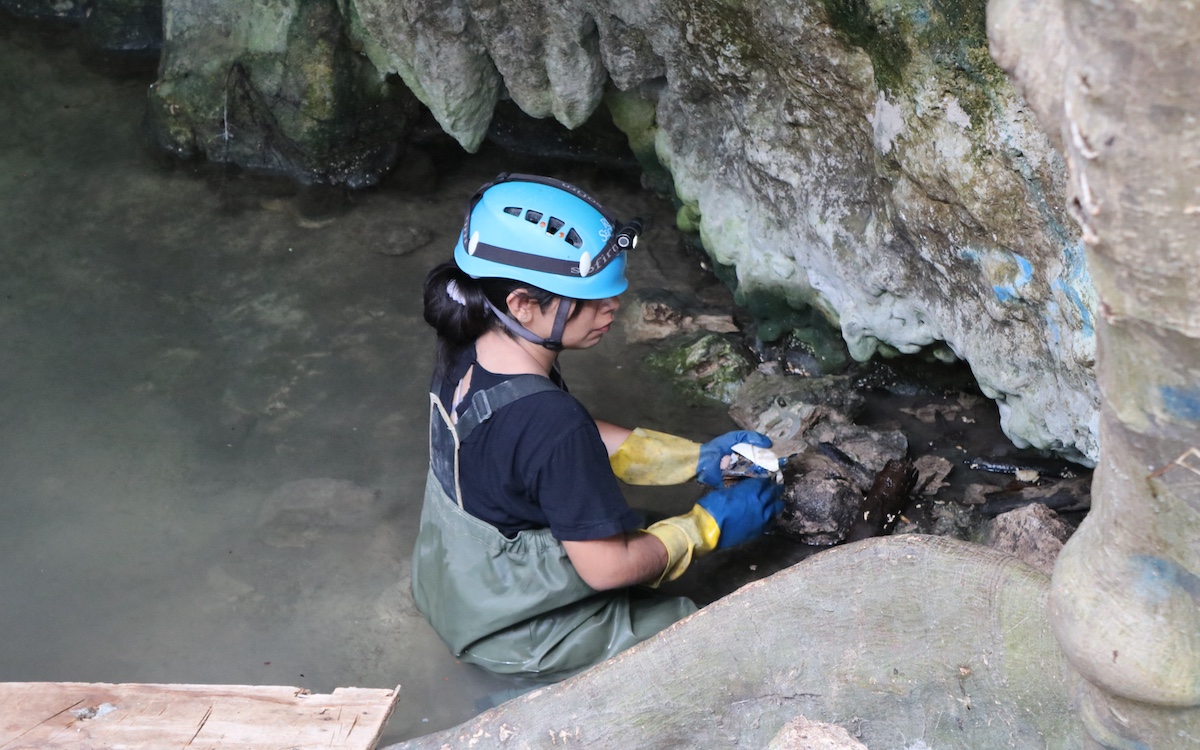
Sélvame was born from Cenotes Urbanos, a volunteer-led organization dedicated to mapping and cleaning surrounding caves and water sources in the region. Cenotes Urbanos is still monitoring the water quality of the cenotes and has documented E. Coli contamination in many of the most popular cenotes. For a city already facing the growing problem of smelly sargassum washing up on its beaches every summer, cenotes are rapidly becoming the main attraction. If visitors start associating them with gut bugs, the tourism industry, which employs thousands of residents, faces twice the crisis.
*
The Maya Tren officially opened in 2024. In total, construction destroyed more than 6,000 acres of tropical forest and contaminated cenotes, underground rivers, aquifers, and freshwater sources for local populations, said D. Christy. Experts worry that such fast construction could be hiding deep structural rot. So far, the project has been linked to more than 60 workplace deaths and allegations of faulty ballast from corrupt networks.
“About 12 million trees have been cut down, and around 125 cenotes have been damaged. There are 15,000 piles of concrete poisoning the water in underground rivers—water we humans, animals, and plants use to live here,” said Priscila Alaniz Uribe, general director of Sélvame.
Two years later, the project still isn’t profitable. The route is inconvenient, and the train only runs a few times per day, said Urbina. Tickets don’t cover operating costs, and hotels built along the route sit mostly vacant. “It’s losing somewhere between nine and 25 million pesos per day to keep it running. Add that to the 500 billion pesos they spent to build it, and at some point, the government is going to stop paying for it,” said Urbina.
“The train was a political tool,” said D. Christy. “The president wanted it finished before his term ended, and he succeeded.”
After the train opened, Sélvame faced the decision to dissolve or redirect its efforts. Because the train was constructed in previously untouched jungle, it opened up destructive new real estate opportunities. “The real estate industry is selling small parts of the jungle—of paradise—to golf courses, hotels, because the plots are near the train,” said Urbina. “If urban sprawl takes over that area so that the train ends up in the middle of a settlement—if we fail—then that will be the death of the Mexican Caribbean.”
Faced with new threats, Sélvame has decided to continue the fight. Now an official NGO, its goal is to create two natural reserves: one to protect the underground river systems of Quintana Roo and the other to conserve the remaining pristine jungle before it's too late.
“Our goal is to form the Xaman Ha reserve to protect the jungle from the northern part of Quintana Roo to Tulum, Cancún, and the Yucatán to the coast,” said D. Christy. “The other will be the first underground river reserve in the world, to protect all the water beneath our feet.”
According to the UN-Habitat study, the population of the Yucatán Peninsula will grow by about 42 percent by 2030. “They are going to need water, a place to live, which will probably be in the jungle,” said Urbina. “That will double our freshwater need, which is already an issue with saltwater intrusion and sewage contamination.”
D. Christy and Urbina both made it clear that they aren’t “anti-government” or even “anti-train,” but rather, they are working for the love of the wild jungle, their home. Through Sélvame, they’ve redirected some of that energy to the education of surrounding communities and international tourists. The fragility of the aquifer is not common knowledge, nor are the interworkings of the cenotes, the freshwater supply, the beaches, and reefs. “People don't know that this water gives life to the jungle, the people, the animals, and the reef,” said D. Christy.
Perhaps the government will eventually close Tren Maya for maintenance and reopen it years later as part of some other political campaign, said Urbina. Or it will slowly crumble into the cenotes and be washed out to sea. In the meantime, D. Christy and Urbina are focusing on the future, determined to conserve the remaining world-class resources of this irreplaceable region.
“You wanted a train. You got a train,” said Urbina. “Now help us protect what’s left.”