From Drought to Deluge: What the LA Fires and Hurricane Helene Have in Common
It all comes down to physics
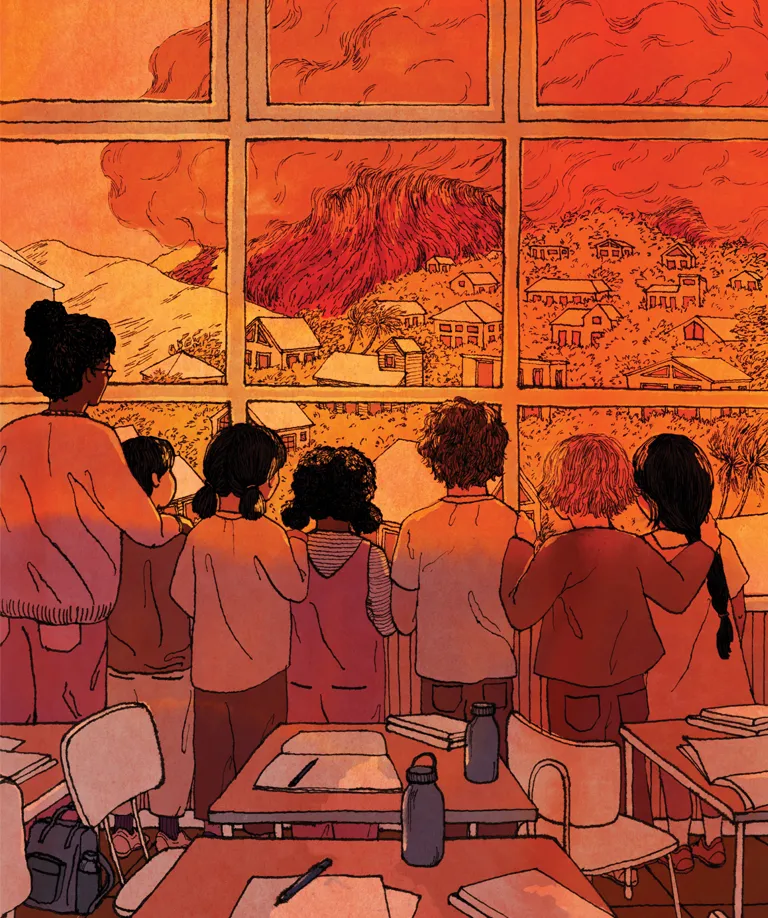
Illustration by Henrike Lendowski
On January 6, palm trees in Los Angeles were blowing sideways so hard they looked like flags. The National Weather Service issued its highest alert: “Particularly Dangerous Situation.” It sounded like a weather warning at Hogwarts. But this wasn’t fiction. A wildfire was threatening to ignite. If we saw smoke, we would have minutes to leave.
The next morning, I got a worried call from my husband. He was driving home on the 405. He could see a wisp of smoke somewhere in the mountains. Phone to my ear, I ran out of my garage barefoot. I saw that “somewhere” was the state park in front of our house. I didn’t hear the familiar thump, thump, thump of a water-carrying helicopter on its way to put out the fire. I didn’t hear any wailing fire truck sirens. They’re not coming in time, I thought. My mind raced as I tried to focus on evacuation steps. The fierce Santa Ana winds were blowing the smoke toward my kids’ school at the bottom of the hill. “Pick up the boys,” I told my husband. “I’ll pack quickly and meet you there.” I darted back into the house. First, I grabbed important documents like our passports. Next, I found Digby, my 11-year-old son Elliot’s stuffed dog. Then I picked up my eight-year-old son’s elephant with a resewn trunk. My boys would be comforted, wherever we slept that night.
I scooped clothes from each of our dressers and plopped them into a large suitcase. I threw it in the back of the car. What can we not live without? I grabbed valuable items. Also Elliot’s robotics team T-shirt so he could compete in some distant nonburning future. Toss, toss, toss. I frantically ran around, turning off the heater, closing windows, and unplugging everything. I felt like a blindfolded chicken who’d drank too much Coke. I had to leave before the fire closed off the only road out. I wondered if Elliot could see the smoke from his classroom.
I was in class when my teacher told us there was a fire outside. No one seemed worried. There were often small fires. The classroom phone started ringing. Kids were getting dismissed. My teacher got more annoyed with each call because she was trying to teach us math. Some of the kids were saying that I was probably the next to go home. Then the phone rang, and it was for me. The kids cheered because they guessed right. I zipped up my backpack and went down to the office. That’s when I looked up at the mountains and saw a humongous cloud of smoke. I realized this wasn’t a regular small fire. My dad couldn’t take us home because the fire was up in our neighborhood. We put masks on and stayed by the car to wait for my mom.
As I drove the three miles down the mountain, the bluebird day transformed. Smoke that contained small particles of burning things was getting caught in the atmosphere. That smoke bent the sun’s rays. Blue and green light scattered, leaving behind an eerie yellow twilight. Time seemed to slow down. A fire truck raced past me. But my ears heard nothing. Glancing up at the angry smoke mushrooming high above me, I shivered knowing the fire would follow its shadow. Only 20 minutes had passed since I had seen that wisp, and it had morphed into a monster. As I arrived at the school, I was filled with relief to see my husband standing with our kids in masks. “Mom,” Elliot said with big, serious eyes. “Go get more of my friends. Jace, Ryan—they’re still in there.”
I was not scared, but I was worried about my friends. My mom called the fire department and found a police officer to get the kids out. My parents decided to take some of my friends to a house down the street to wait for parents who had not come yet. Once my friends were picked up, we decided to get out of there. We could get trapped. I got into my mom’s car with my brother. My dad hopped into his truck alone.
Traffic was a nightmare. We turned right onto Sunset Boulevard, then made a U-turn to avoid going straight into the fire. It was pretty stressful. My dad had turned the other way onto Sunset Boulevard and got out more quickly. We were stuck. So my dad ditched his car and ran back to us through the smoke. He jumped into the driver’s seat and hit the gas. He drove on the wrong side of the road. Suddenly we were at the beach and free of the traffic jam. We drove to a restaurant in Santa Monica, and I got a caprese sandwich. We ate and watched the fire burn our town.
Southern California has regular wildfires because of its hot, dry summers. For thousands of years, 4.5 million acres of land burned yearly in California. That’s like all the Hawaiian Islands burning. Lightning strikes started some of the fires. Others were controlled burns, which Native Americans still use to manage land. Eventually, the winter rains would stop the fires, and the seasonal cycle continued. But in recent years, summers have gotten hotter and dryer. The rains also come later. Fires today are bigger, stronger, and more frequent. Ten of the top 20 largest wildfires in California have happened in just the past five years. In the weeks after the Palisades Fire destroyed much of my community, I began to think about climate change disasters in a new light. Just three months earlier, Hurricane Helene had slammed into North Carolina. The other side of the United States had faced destructive wind and floods. How was it that North Carolina had a disaster because there was too much water, and right after that, Los Angeles had a disaster because it didn’t have enough water? Elliot and I wanted to understand whether climate change was at the root of both. How did our experience fit into this new normal? We decided to call an expert.
“What is really just so amazing is how the people get together to help each other recover afterward.”
As I logged on to Zoom, Elliot made space for us to share his desk. He packed up the foldout bed he was using in the rental we had evacuated to. (Though our home had not burned down, it was unsafe to live in.) Soon, Kim Cobb popped onto the screen. She’s the director of the Institute at Brown for Environment and Society and the mom of four children. She’s been sounding the alarm for decades with her research. Here we were—displaced by climate change, calling her up about yet another disaster that could have been avoided.
She told us that the disasters in Los Angeles and North Carolina shared a starting point. The temperatures on the surface of our planet are rising. “I think the most important way to understand it is through the physics,” Cobb said. Some gases in the atmosphere trap heat from the sun. It’s a natural process called the greenhouse effect. But human activities are adding extra greenhouse gases and trapping more heat than Earth needs. When we drive nonelectric cars, their engines burn fossil fuels and a gas called carbon dioxide comes out of the tailpipe. When people raise cows for beef or milk, those cows burp out a gas called methane. One person driving a car or one cow burping isn’t a problem. But there are millions of vehicles, cows, and other large-scale sources of greenhouse gases. It’s enough to change the climate.
In Los Angeles, climate change means warmer temperatures: “You have moisture that’s leaving soils, leaving vegetation, and making those landscapes much more vulnerable to fires,” Cobb said. Climate change also brings “hotter, dryer, and stronger winds,” she added. Altogether, it’s like a hair dryer on high heat and max speed. Elliot and I nodded like two baseball bobbleheads. We’d seen our landscape growing browner. And these strong winds had howled around our home at night, waking us up.
Meanwhile, in the southeastern part of the country, these same warmer surface temperatures show up in the ocean. They affect how big and strong a storm can get as it moves. “When storms go over a warm patch of water, they do intensify dramatically,” Cobb said. A storm’s wind speed is measured in categories. Category 5 is the fastest and most destructive. The increasing speeds have a “strong link to fossil fuel emissions,” she said. Like fires, hurricanes are also getting bigger, stronger, and more frequent.
North Carolina residents had just a few days of warning that Hurricane Helene was coming. On September 23, 2024, the Air Force Reserve Hurricane Hunters flew straight into the center of the storm to track it. On September 26, Helene landed as a Category 4 storm in Florida. The next day, it charged into North Carolina. By the time it was finished, it had dumped 40 trillion gallons of water on land. In other words, it was like Lake Tahoe had fallen from the sky. North Carolina seemed to suffer the most damage. Flooding pushed rivers to overflow and caused mudslides. The wind knocked over millions of trees. Many residents were not advised to evacuate until it was too late.
We knew these facts from the news. But what had fellow climate disaster survivors actually experienced? We were curious to hear from someone Elliot’s age. A thoughtful 11-year-old girl named Lila agreed to talk to us over Zoom with her mom. Elliot had come up with a list of questions. They told us that they lost all water, power, and cellular service during the hurricane and for weeks after. In the mountains around their home, 80 percent of the trees toppled. They lost their favorite cherry tree. Some fallen trees blocked them from leaving the house for weeks. They had to chainsaw their way out. After they told us about the hurricane, Elliot and I were quiet and tried to put ourselves in their shoes. We had left quickly, unable to return. They had been trapped, unable to get out.
“What was your daily life like in the days and weeks after the storm?” Elliot asked Lila. She paused to think. “Well, it was kind of a weird blur. I couldn’t really grab hold of what had happened,” she said. “Right after the hurricane, when our road was just covered in trees, it was like a whole different world. You couldn’t even tell that it was our road. It was also, in a way, kind of magical, like this really beautiful tree land. It was pretty and sad.” The nearby town of Asheville was once considered a good place to move to escape the effects of climate change. Most people thought that at 2,000 feet in elevation, and 300 miles from the coast, the area would be protected from powerful hurricanes. “This is the first time that we’ve thought about how a large, strong storm can push so far inland,” Cobb had said earlier.
“So do you think about climate change in a new way now?” Elliot asked Lila, blinking and peering curiously at my laptop screen because he wasn’t sure if people in North Carolina believed climate change was a serious issue. Lila pondered for a bit. “Well, kind of. We are really polluting the world, and that’s obviously causing climate change. And then the hurricane really polluted everything too,” she said. Fossil fuels are directly pumped into homes in cities and suburbs to heat and cool them. But people who live away from cities are more likely to have fossil fuels, such as propane, stored in tanks outside their houses. (Across the country, a smaller but growing population is powering their homes without fossil fuels. They use electricity that comes from solar panels and wind turbines.) After Helene, Lila described seeing people’s broken propane tanks everywhere, leaking fuel. “All sorts of disgusting stuff [was] getting dumped in the river,” she said. “We’re causing a lot more damage than we think with climate change.”
When we talked to Lila, the cleanup in our neighborhood was just getting underway. We were a long way from going home. Meanwhile, Lila was three months ahead of us in the recovery process. Elliot was curious to know what the future would be like. “Do you have any advice for the kids from Los Angeles?” he asked. Lila thought about his question and then shared something to look forward to instead. “What is really just so amazing is how the people get together to help each other recover afterward,” she said. “On our road, we really didn’t know our neighbors well at all, and we never saw them that much. But we saw them every single day during the hurricane, talked to each other all the time, and ate dinner together sometimes. It was really different and really nice.”
Take Action
Watch a video on how to pack a go bag so you’re ready if a disaster hits: bit.ly/pack-go-bag.