 The Magazine of The Sierra Club
Between Two Worlds
Can Puerto Rico preserve its Caribbean beauty as it pursues the American dream?
Diana de Ju lives in a rustic but comfortable hillside home in the town of Luquillo, Puerto Rico, with her husband and teenage son. The area is a potential mecca for ecotourism: Playa Luquillo is a popular beach among locals, and its surroundings encompass many of the island's best offerings--sandy shores, dramatic rocky coastlines, ancient forests, coral reefs, and mangrove-lined lagoons. On moonless nights, the largest of these, Laguna Grande, erupts in sparks of light as fish stir up millions of tiny dinoflagellates, an ecological oddity called bioluminescence.
"It's so natural and quiet here. You can still breathe clean air and not be so tense," says de Ju, who was born in nearby Fajardo but raised in New York City's Lower East Side, traces of which still linger in her accent and no-nonsense manner. "It's one of the few places left that is so peaceful--we don't even close our doors." As we talk in her living room, a light ocean breeze blows through, rustling her collection of beads, dream catchers, and Asian fabrics. The backyard is thick with banana and cashew trees and herbs growing wild. "Our wealth is our land," she says.
About ten years ago, de Ju went to turn on a faucet, and nothing came out. The water had been rerouted to a new gated community. Since then, says her friend Sally Tully-Figueroa, "all we do with our lives here is chase water." De Ju's family keeps four huge tanks on hand and still has to plan its baths. Tully-Figueroa has had to get up in the middle of the night--the only time water was available--to do her washing. A local church with many elderly parishioners has gone for two months at a time without it. "Nature has always provided us with water," says Angel Berríos Benítez, a friend from a neighboring community. "Now it just comes and goes."
A bad situation promises to get worse if two proposed mega-resort complexes are built along the nearby coastline. Between them, the Four Seasons' San Miguel Resort and Marriott's Dos Mares Resort would boast 700 hotel rooms and 2,000 luxury residences, plus four golf courses, all demanding water. The surrounding area is hardly undeveloped--de Ju and I meet Berríos in a strip-mall parking lot, and the four-star Wyndham El Conquistador Resort dominates one of Fajardo's hills--but there is still much left to save.
The prospective developments are just two of five planned for the seven miles of coast between Luquillo and Fajardo, a stretch of shoreline that is an important nesting ground for endangered hawksbill and leatherback sea turtles. "My parents used to go for walks on the beach while they were courting," says de Ju. "They knew that if you stepped out on the sand and felt it trembling, you had to step back because the turtles were hatching." But the planned resorts could destroy the sea creatures' sanctuary. "They nest in dark areas," says Hector Horta, a biologist in charge of the Puerto Rico Department of Natural and Environmental Resources' turtle-monitoring program. "Light hesitates them." Adding that turtles have reduced nesting in parts of Florida because of artificial light, Horta says that coastal development is a far bigger problem than the more highly publicized poaching.
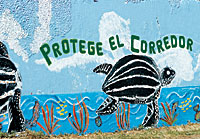
From the beach where we stand talking, the shoreline curves west to the sites of the proposed developments. Looking inland, we can see shades of green rising all the way up the mountains--each a different type of forest, still intact and connected. Local environmental activists have dubbed the 3,200-acre area along this stretch of coast, just north of the mountainous El Yunque rainforest, the Northeast Ecological Corridor; protecting it is one of their top priorities. "If we allow development here," says Horta, "it won't end until they have a five-star hotel on top of the rainforest." Like the rest of the island, the area is at a crossroads, torn between being American and Caribbean, between development and conservation, between having too little and wanting too much.
MANY RESIDENTS REMARK that the Commonwealth of Puerto Rico has a "continental mentality," an all-American expansionist view that's unsuitable for an island its size. With 3.9 million people in less than 3,500 square miles, Puerto Rico has a higher population density than Japan. If the United States were as densely populated, it would have 4 billion instead of 298 million people.
The island holds other dubious distinctions: It generates more solid waste per capita than almost any U.S. state and packs in more roads per square mile than any country in the world. With public transportation limited to a slow and schedule-less "system" of públicos--private vehicles that transport people between cities, leaving whenever they're full--Puerto Rico is almost completely car dependent.
"People complain about traffic jams, but they see congestion as a sign of progress," says Father Henry Beauchamp, a passionate advocate for protecting the Northeast Ecological Corridor. Once one of the poorest places in the Caribbean, Puerto Rico was transformed after World War II when the U.S. government began a campaign to encourage economic development by replacing agriculture with manufacturing and tourism. Businesses are still drawn to the island by its tax incentives and low wages. (Until this year, U.S. companies paid no federal tax on profit earned in the commonwealth, whose three branches of government operate independently under the U.S. Constitution. While Puerto Rico functions in many ways like a state, its residents can't cast a ballot for president, and their sole representative to Congress can't vote on legislation.) With a per-capita income of $17,700, Puerto Ricans are poorer than Mississippians but richer than almost any other group in the Caribbean. Companies such as J. C. Penney have some of their most profitable stores in the world here, and strip malls and SUVs are as ubiquitous as in the 50 states.
"Many Latin American countries have a desire to plug into a development model that causes great damage to the environment," Beauchamp says. A large man with a trim beard graying at the chin, the priest has a soothing manner. His hands move gracefully as he talks, but his commentary packs a punch. "Puerto Ricans often feel insecure when they compare themselves to the United States, but there's no way we can justify a lifestyle where everyone plugs into the American dream. Anyone who has eyes can see there's a price."
After decades of rapid development, Puerto Rico is 14 percent urban, compared with 2.6 percent of the U.S. landmass. While developed areas are growing three to four times faster than the population, urban density is decreasing, leaving huge numbers of abandoned buildings. Three-fourths of the island's construction projects are granted zoning exemptions, and government support is usually obvious even prior to the hearings and public-comment period. (The agencies that are supposed to be enforcing U.S. laws on the island are often too far away to be very influential--the EPA, for example, oversees Puerto Rico out of its Manhattan office.) "The fast-tracking of many projects makes community groups suffer a kind of fatigue," says Beauchamp. "People will say, 'What's the use? If the government wants it, there's nothing to be done.'"
That attitude, however, is slowly changing, and the commonwealth government has responded with plans to nearly double the percentage of protected land. (It's currently only about 5 percent, half the average for Latin America and the Caribbean and far less than Costa Rica, Panama, and the Dominican Republic.) In 2001, the government established a national park system. "Environmental awareness has grown as the pressure of development carries to people's doors," says Ramon Luis Nieves, who oversees the new parks. "The park system would not have been accepted a decade ago."
Parroquia Santiago Apóstol, the Fajardo church Beauchamp presided over until he was transferred to Rome last year, is one center of that changing attitude. Though the church's home is a quiet square surrounded by a shuttered theater and struggling stores, Beauchamp's activism helped invigorate the community in opposition to the resort-construction plans in the Northeast Ecological Corridor, which begins just outside town. With new developments clustered around the highway, and few of them locally owned, the prosperity they promised has largely passed this small town by.
Much of Beauchamp's work was done among the ramshackle cluster of seaside dwellings where the town was founded in the 1700s. It's been a fishing area for hundreds of years, and at least a third of the neighborhood's residents still make their living at sea. Miguel "Chan" Dávila is a fisherman, like his father before him, though he now spends more time at his small fish market than on a boat because of health problems. Never an easy life, his occupation has gotten more difficult in recent years as coastal developments have infringed on longtime fishing grounds. "Every day we have to go farther out. You might leave at 4 p.m. and come back at 8 a.m.," Dávila says. "There are fewer fish in the coastal areas because of contamination, and we can't go near the new marinas, where there is deeper water, because people say we're bothering their boats. We have to load and unload from a small muddy beach instead of the pier."
Dávila is a small, shy man, who looks down at his hands or out to sea as he speaks. But as a community leader, he has stood up to developers in court--winning a case against one for trying to build a new marina right in front of his shop, and challenging another for chaining off the beach to block access and threatening the fishermen when they complained to the government. Though Puerto Ricans were guaranteed the right-of-way to coastal areas when Spain ceded the island to the United States in 1898, developers have continually found ways to circumvent the law. "Fajardo is a coastal town, but it's being left without coasts," Dávila says. "Only little pieces are left for the public."
In an effort to protect these fishing grounds and the forests that rise behind them, Dávila and other residents--including de Ju and Berríos, who head environmental groups in their neighborhoods--have joined forces with the Sierra Club's Puerto Rico Chapter, Environmental Defense, the National Wildlife Federation, the Surfrider Foundation, and the Waterkeeper Alliance. While building local support through family picnics and beach-cleanup days, the coalition has taken its case against the Marriott development all the way to the Puerto Rican Supreme Court. A lawsuit by its members led the U.S. Fish and Wildlife Service to reconsider its stance that the Four Seasons project would not harm sea turtles; a coalition-supported bill under consideration in the Puerto Rican legislature would designate the whole corridor as a nature reserve. This would almost connect the already protected northeastern tip of the island, where the three promontories of Las Cabezas de San Juan jut into the Atlantic, with El Yunque.
FUTURE HIKERS WHO TRAVERSE the hoped-for expanse of protected areas would follow in historic footsteps. The Taíno Indians, who came to the island a thousand years ago, considered El Yunque the sacred home of the world's creator. In a ritual journey, they navigated small rivers from the coast just west of Las Cabezas to El Yunque's cloud-shrouded summits. The Taíno word yuque, meaning "white land," gave the forest its name. When the clouds enveloped them, the Taíno felt they were in the presence of their god. Taking cohoba, a snufflike powder ground from the seeds of a local tree and used to induce visions, heightened the heavenly feeling.
Though much of El Yunque would still be familiar to the Taíno, today's travelers can be forgiven for finding the approach to the rainforest a bit less inspiring. On the traffic-clogged road out of San Juan, panaderías jostle with Papa John's and Pizza Hut, while McDonald's advertises its "McMenú del Dólar" and a gas station offers "desayuno on the run." The trip from the capital is only 25 miles, but there's plenty of time to look around: All of Puerto Rico's 2.4 million cars seem to be on Route 3 at once, and it's not even rush hour. Soon, though, garishly colored fast-food franchises and sparkling car dealerships give way to weathered signs and garbage-strewn lots. Patches of buildings are scattered amid the greenery, instead of the other way around. Cattle egrets circle over a mangy field, and the rainforest's peaks begin to appear in the distance. Once off the main road, the landscape quickly becomes rural. The sun shines through the trees, dappling the grassy fields. One plot just before the visitor center bears a telltale sign: Se vende. For sale.
"In the early 1900s, all you could see from here to the coast was sugarcane," says Pablo Cruz, El Yunque's affable forest supervisor. But in the 1970s, after the island's economy had boomed and industrialized, cane growers began selling off their land to developers. A huge Westin hotel with condos and two golf courses looms across the highway from the rainforest entrance. Shopping malls and luxury homes are springing up rapidly, and even more-modest habitations bring problems. With homes getting closer to the forest, stray dogs and cats are menacing native birds--including the Puerto Rican emerald, green mango, whippoorwill, and Puerto Rican parrot--and other indigenous animals that dwell in the oldest established forest reserve in the Western Hemisphere.
"We want to maintain a little piece of Puerto Rico as it was before European exploration," Cruz says. Once a visitor enters the forest, the modern world indeed seems far away. Trumpet trees curve overhead, their large, rounded leaves shading the trail. Dwarf orchids smaller than your pinky fingernail--one of 50 native orchid species in the forest--grow amid moss on a tree trunk. Small stems of bamboo and reddish-orange bulbs of ginger peek out from the foliage, which includes 250 tree species and about 150 types of ferns. The red-throated Puerto Rican tody--a relict bird that once lived throughout Mexico, the United States, and the Caribbean but is now found only on the island--flits from tree to tree like a hummingbird.
Originally set aside in 1876 by King Alfonso XII of Spain, El Yunque is the only tropical rainforest in the U.S. Forest Service system. Legislation passed by the U.S. Congress last December will protect almost a third of its 29,000 acres as El Toro Wilderness. While both Spanish and American overseers of the island have recognized the importance of this place, the reign of tourism and development may leave little to enjoy. Already, concrete "heat islands" have decreased rainfall around the forest, says Ariel Lugo, director of the Forest Service's International Institute of Tropical Forestry in Río Piedras. Unchecked urbanization could leave El Yunque, which provides water for 20 percent of the island's population, as thirsty as the residents of Luquillo. But Puerto Rico's ecosystems, like its people, are resilient.
"After Hurricane Hugo came through in 1989, El Yunque looked like a fire had gone through it," says Lugo. "That four-hour event destroyed almost everything." But like fires in temperate zones, hurricanes are renewal agents in the tropics, clearing out older trees that were more susceptible to disease and opening up dense canopies that blocked access to light for smaller plants. A few years after Hugo, flowers, bushes, and ferns that hadn't been seen for decades were flourishing. "It's part of the blessing we have here that nature returns with such force," Lugo says. "But ecosystems need space and resources too. You have to give nature the chance to come back."