The Magazine of The Sierra Club
Profile: The Rainmaker
A Hopi leader champions clean power in Indian Country
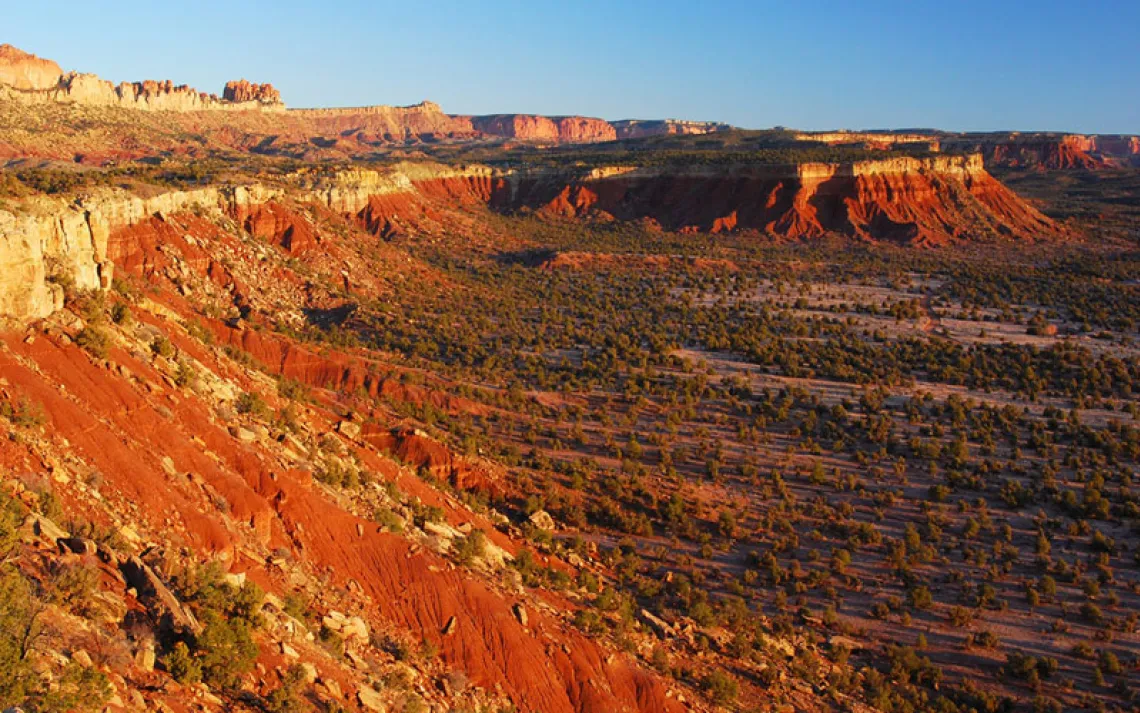
THE STRIATED CLIFFS OF BLACK MESA jut thousands of feet into the pale blue heavens, breaking up the tufted grasslands of the Colorado Plateau. Seen from the air, the 2,000-square-mile mesa, one of Arizona's largest geologic wonders, looks like a hand. Over millennia, ephemeral streams have cut deep washes into Black Mesa's southern escarpment. Many Hopi Indian villages, including the oldest continually inhabited settlement in the United States, are strung in the spaces between the fingerlike prongs. Why anyone would choose to settle in this inhospitable, semiarid landscape, which receives only 6 to 14 inches of rain annually, is a mystery to outsiders. Yet it has been home to desert dwellers like the Hopi and their ancestors for thousands of years.
Archaeologists have found corn harvested around the time of Christ's birth on the Colorado Plateau, and agriculture has continued here through the ages. Nearly 40 years ago, my family drove through Many Farms, an incongruously verdant section of the plateau, where I was first introduced to the miracle of Hopi dry-farming techniques, in which crops are watered only by rain and runoff. Those young sprouts of green seemed a wonder to my child's mind, and when I look at the photograph my father took that day--enlarged and framed on my wall--I get the same sense of awe that anyone could coax life-sustaining corn from such desiccated and clumpy red ground.
Vernon Masayesva and his family have been corn growers, sheepherders, and miracle workers for generations. He says there's really nothing extraordinary about desert survival; it's just a matter of common sense and respect. "When you are a farmer in a waterless world, you get to know water's power," says Masayesva, 67. "You never waste water. If you do, the rains are going to stop coming." In creation stories, the Hopi people emerge from water to make a covenant with Masaw--the caretaker, guardian, and protector of Earth--to carry on the stewardship role in their new home. If they fail to honor the covenant, they will be punished. "It's not a theory," Masayesva says. "It's Masaw's law."
We are sitting in Masayesva's comfortable home at the base of Third Mesa, one of the fingers of the southern escarpment. His father still grows corn farther up the slope near Hotevilla, where Masayesva and his eight younger siblings help with planting each year. They don't employ modern techniques, preferring instead to sometimes soften the seeds in their mouths before using a planting stick to create a hole. "Every planting is special," says Masayesva. "You plant deep to reach the moisture; you carefully cover the seed, making a little dam around it so the rains puddle up." The corn is eaten, but it's also an essential ingredient in religious rites and ceremonies, weddings, and other cultural events. The lack of it affects what families can contribute to the vitality of community life.
Dusk and cooling air have invigorated the birds in the palo verde tree outside Masayesva's window; this is a gentling time of day, when the desert's intemperate heat abates and its inhabitants begin to stir. I'm wondering when he's going to turn on the lights so that I can see the notes I'm taking at his paper-strewn dining-room table, but he doesn't seem to notice my predicament. Or he notices and is smiling. I can't see well enough to tell.
Masayesva is a member of the Coyote Clan. He is slight, with sculpted cheekbones and a countenance drawn down by gravity. He maintains that face, which appears to be frowning, even when joking to a stranger. (He had greeted me through his screen door with no more than a deadpan "Come on in, too-tall lady.") The discomfort produced by not quite knowing what to make of him seems to amuse the man.
That ability to take people out of their comfort zones--to gain an advantage and perhaps force consideration of different points of view--has been a hallmark of Masayesva's eclectic career. "The jobs I've taken were ones where I had to do something different, not just carry on in the same old way." He corrects himself, adding, "They weren't jobs, really, but more like passions." In the 1970s, after he became the principal of his alma mater, Hotevilla Day School, he proceeded to dust off government regulations and use them to transfer control of the school from the Bureau of Indian Affairs, which he felt was underserving the students, to the students' parents.
No sooner had he joined the Hopi Tribal Council as a representative in the mid-1980s than he began questioning its coziness with an operation he believed had unfair access to Black Mesa's coal and water. Since 1969, Peabody Coal Company had been stripmining on the mesa--most of the area is owned by the Hopi, though part of the northern mesa and strip mine is on Navajo tribal lands as well. In 1970, Peabody began using Black Mesa water to push the coal through a 273-mile slurry pipe to the Mohave Generating Station in southern Nevada. Passing homes that lack running water and electricity, the water in that pipe was purchased for $1.67 per acre-foot (325,851 gallons), the amount a family of five uses in a year. (University of Colorado law professor Charles Wilkinson later discovered that the lawyer the Hopi had used to help negotiate the water deal had been secretly working for Peabody.)
"I had a lot of anger simmering in me since high school, since '59 or '60, when I'd listen to Hopi elders talk about this rumor that a coal mine was coming," Masayesva says. "They were concerned. The men talked and talked about whether coal mining fit with Hopi prophecy about how our land should be used. In the end, they decided that development had to be done 'in the right way, at the right time, for the right purpose' and came out against permitting the mine." No one listened, he says, including the tribal council, which approved the coal deal. Lawsuits brought on the elders' behalf to stop the mine were summarily dismissed. Masayesva jokes that Peabody drove him into politics--at one point, he looks at the ceiling, raises his hands, and says, "Thank you, Peabody, for waking me up!"
Masayesva's rise to the chairmanship of the Hopi Tribal Council in 1990 only made him more outspoken against Peabody--a not wholly popular stand given that revenue from the company's Black Mesa venture has been the Hopi Tribe's largest single source of income. Peabody also employed hundreds of Navajo and Hopi in some of the highest-paying jobs on either reservation.
Frustrated by pro-Peabody council members and what he viewed as the political constraints of his job, Masayesva decided not to campaign again for chair. In 1998, he founded the Black Mesa Trust, a feisty grassroots organization. "People either really admire Vernon or despise him because of his leadership abilities," says the Sierra Club's Andy Bessler, who has worked closely with Masayesva through the Club's Environmental Partnerships Program. Regardless, Masayesva's outspokenness and activism--as well as the vital work of other Hopi, Navajo, and environmental groups nationwide--succeeded in loosening Peabody's grip on tribal resources in ways almost no one could have foreseen.
A HAND IS THE LOGO for Masayesva's group. For the Hopi, Black Mesa's hand holds and protects resource treasures. Beneath the mesa's surface, in one of the world's richest deposits, coal seams are up to 18 feet thick. The Navajo Aquifer, which rests partly under the mesa, contains water so pure that it meets the EPA's drinking-water standards, and so soft that it's difficult to rinse soap off your body or shampoo out of your hair. The N-Aquifer, as it's commonly called, provides all the municipal water for the Hopi Tribe and for much of the vast Navajo Nation. Peabody's shareholders and electricity customers in Southern California and Nevada have benefited most from Black Mesa's resources, however. Since Peabody's pumping operation began, the majority of the aquifer's water--an average of 1.2 billion gallons annually, or nearly 200 gallons every time you take a breath--has been used for the slurry line, so that Southern California Edison could produce coal-fired electricity to power a million homes a year at one of the lowest prices in the nation.
Springs fed by the N-Aquifer have long been places of worship for the Hopi. Something's out of balance on Black Mesa, though, because those springs have been drying up. Peabody insists that the culprit is drought. Already a land of little rain, the area has seen overall precipitation trend downward for most of the past 20 years. Moreover, the company has produced a series of studies showing that its long-term water use "will not pose any permanent or significant impacts to the aquifer or other water users." Many Hopi and Navajo, as well as environmental groups such as the Sierra Club and the Natural Resources Defense Council, insist that the problem is Peabody's profligate pumping. Prior to the company's presence on Black Mesa, industrial pumping was minimal and springs ran continuously, but since 1971, Peabody has been sucking up water every year--and wells tested during this period by the U.S. Geological Survey show a median water-level decrease of more than 17 feet. Masayesva is impatient with the dueling scientific studies and conclusions. He refers to them as "virtual reality," having little to do with what he observes every day out his door. "Western science studies things in bits and pieces," Masayesva says. "Indigenous cultures look at the whole picture." He knows that the disappearance of water--in the skies above and in the ground below his ancestral home--is the result of the broken covenant he wants to help mend.
THE FIRST MAJOR STEP toward this end was achieved on New Year's Eve 2005 when the Mohave Generating Station, the West's most polluting power plant, shut down--the result of a long-fought battle to clean up Western skies. In 1999, after the Sierra Club, the Grand Canyon Trust, and the National Parks Conservation Association sued Mohave's owners for Clean Air Act violations, the parties agreed that the plant had to either install modern pollution-control equipment or close by the end of 2005. The facility ran hard and dirty for the intervening six years and then went quiet rather than spend the estimated $1.2 billion for cleanup. When Mohave closed, Peabody had no buyer for its Black Mesa coal and so shut down its operation as well.
The Black Mesa Trust, in coordination with grassroots organizations in the Navajo Nation and elsewhere, had been pushing for the closure of both operations on environmental, cultural, and social-justice grounds. "Coal acts like a filter; it filters water, and that's good. But when you dig it out and burn it, all that junk goes up into the air, and you cause health and environmental problems," Masayesva says. He adds that "everyone is concerned about global warming," but he interprets the source of the problem from a uniquely Hopi perspective. He sees the disrespectful use of Black Mesa water as part of the broken covenant with Masaw. The water's disappearance from sacred springs, as well as global warming, is punishment for this transgression. Where science deduces that climate change is causing a reduction in available Western water, Hopi spirituality concludes that the careless use of water is causing climate change.
Modern rule-making being what it is, even the shuttering of Mohave did not constrain its profit potential. Federal regulations allow owners who reduce or eliminate smokestack emissions to sell credits for those emissions to other polluters. Southern California Edison, the majority owner of the plant, became immediately eligible under the Clean Air Act for a portion of those credits worth up to $52 million a year--because 40,000 tons of sulfur dioxide and other pollutants were no longer being emitted.
Masayesva and other members of what has come to be known as the Just Transition Coalition believe that the Hopi and Navajo people are entitled to those funds. After all, their cheap coal and water had kept costs down and profits high for both Peabody and Southern California Edison for decades. Last January, the coalition asked the California Public Utilities Commission (CPUC) to deposit Edison's share of Mohave's pollution-credit sales into a Hopi and Navajo trust fund. (The account would close in 2026, the year Mohave might have had to shut down anyway due to its loss of rights to Colorado River water, which it was also using in copious amounts to run the plant.) The first-of-its-kind fund, say coalition members, would be a form of restitution used for Hopi and Navajo development, "but in the right way, at the right time, for the right purpose," Masayesva adds.
According to the coalition's proposal, a percentage of the money would be used to help train the displaced Navajo and Hopi Peabody employees and to help ease the closure's broader economic impact on communities. (Even before Mohave shut down, the Hopi reservation had a 40 to 50 percent unemployment rate.) Most of the money, however, would fund renewable energy development on Native lands specifically to benefit tribes.
Stirling Energy Systems, a national leader in solar-power technology, contributed to the feasibility section of the Just Transition proposal. The company's executive vice president and general manager, Robert Liden, testified before the CPUC in 2004, after Masayesva had approached him and presented a vision of a solar-powered future on Hopi and Navajo lands. "He was both impressive and convincing," says Liden of Masayesva. Stirling ran the numbers and concluded that such a project was economically and technologically feasible--and would net the Hopi Tribe upwards of $8 million per year in revenues from a 500-megawatt solar-powered generating station, more than compensating for the revenues lost by Peabody's closure. "We even talked about the feasibility of raising the solar dishes so livestock could graze beneath them--they'd provide both power and shade," says Liden. "Vernon was excited about that prospect."
"Crazy idea, right?" Masayesva asks with a semblance of a grin. "The people who pointed fingers at the Black Mesa Trust as architects of an economic meltdown out here just laughed when we proposed this alternative." Neither the Hopi nor Navajo Tribal Council has backed the proposal. According to George Hardeen, spokesperson for Navajo Nation president Joe Shirley Jr., "It's not that the Navajo Nation is against Just Transition; it's just not for it, at least not yet." Hardeen adds that "employment is a critical issue" and that the nation's first choice would be to "reopen the Black Mesa mine."
The CPUC didn't laugh or ignore the idea, however. First it required Southern California Edison to record all pollution-credit profits from Mohave. Then the commission ordered the company to report back by January 1, 2007, on how it plans to spend the gathered funds. While the power company works to maintain control of the funds, Just Transition members, including the Indigenous Environmental Network and To' Nizhoni Ani (Navajo for "beautiful water speaks"), have taken the lead in gaining local support for the proposal. All coalition members are determined to challenge Edison if renewable energy development on tribal lands isn't a big part of its plan.
"When we take control of our resources and begin to develop them our way, there's no need for poverty here," says Masayesva.
AT SUNRISE EARLY LAST MARCH, Masayesva and a group of Hopi runners gathered for a water-blessing ceremony at Moencopi Springs, on the western edge of Hopi tribal lands. They were about to participate in a 2,000-mile, 14-day relay from Arizona to Mexico City, passing a gourd of sacred springwater from one runner to the next, delivering a message about the need to protect and conserve it to the World Water Forum in the Mexican capital. The idea had been Masayesva's. Though he traveled with the runners by van in the beginning, he had to return to the reservation because of a family emergency.
Thirty miles from his home, it began snowing. It rained and snowed for three days, snapping the area's longest recorded dry spell--though Arizona remains in a drought. "To me, it happened for a reason," he says. "It's the runners that made it happen." The organizers and athletes, who were upholding a Hopi tradition by running, were shut out of the forum--which focused mainly on management and privatization. They were welcomed, however, by the city's mayor and leaders from Mexico's Native communities. "Our traditions, our beliefs, aren't dead," Masayesva told those gathered for the ceremonies. "We are rain people trying to convey water's message."