 The Magazine of The Sierra Club
California State Parks Are Bringing Native History to the Forefront
As the Trump administration seeks to erase history on public lands, these parks are offering a fuller picture
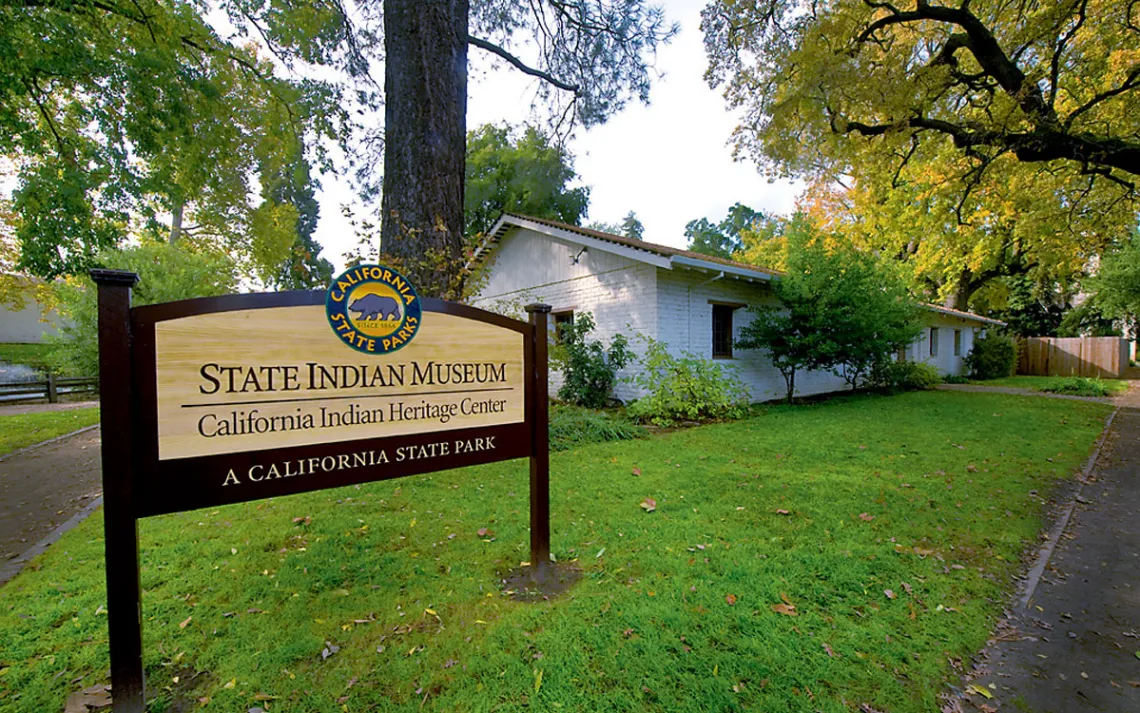
Photo courtesy of California State Parks, 2026
When Taylor Moore was a child, she and her mom sometimes visited a white-painted adobe brick building in a park in midtown Sacramento, California. Inside the State Indian Museum’s store, Moore’s grandmother worked behind a counter. She would offer Moore gifts like a beaded bracelet or a turtle figurine. Despite the museum’s dark history as a monument to settler-colonialism, Moore’s grandma and other Indigenous community members made it a welcoming space for Native American visitors.
Now in her early thirties, Moore works with that same museum as its first Native curator. Part of the California State Parks system, the white building that seemed cavernous to Moore as a kid is actually a humble, one-story structure. Its lights are kept low to protect photographs and displays of cultural belongings woven from grass, carved from wood, or sewn from hide. But the work unfolding at the museum—and at other state parks—is far more expansive than she could have imagined as a child. It also runs counter to the regressive changes unfolding across much of the national park system.
In 2017, Moore, who is Miwok and Nisenan, began helping the museum care for and interpret cultural belongings as well as assisting with returning them to tribes in accordance with the federal Native American Graves Protection and Repatriation Act.
Then, in 2020, police brutality against Black people fueled anti-racist protests across the nation. The public pressure led California State Parks to launch its ambitious Reexamining Our Past Initiative. One of its goals is to fully contextualize California history in state park interpretive displays with input from the public, cultural organizations, and tribal nations.
California’s work to better interpret its history stands in stark contrast to the National Park Service’s current priorities.
Moore is now helping to fill the museum’s glass cases with more-inclusive displays of contemporary Native art celebrating tribal partners. The focus is a far cry from that of the museum when it opened in 1940 to display Native belongings stolen from graves, looted, or sold under duress. “It’s flipping that narrative to being Native-first,” Moore said.
As part of the park system’s new priorities, the state is building the California Indian Heritage Center a few miles away, in West Sacramento, with direction from several tribes. The center will eventually serve as a place for contemporary Native art displays, events, research, and collections storage. Back in midtown, the fate of that old adobe building is undecided.
California’s work to better interpret its history stands in stark contrast to the National Park Service’s current priorities. In March 2025, President Donald Trump signed an executive order pushing federal interpretive sites to whitewash American history. Parks and museums across the country have complied, removing from public view information about Native peoples, people of color, climate change, and other topics.
At Wyoming’s Grand Teton National Park, for example, employees removed a sign revealing explorer Gustavus Cheyney Doane’s pride in participating in the 1870 Marias Massacre, where he and his companions murdered more than 170 Piegan Blackfeet—mostly women, children, and elderly people. Workers at Fort Sumter and Fort Moultrie National Historical Park, on islands in Charleston Harbor, South Carolina, removed explanations of sea level rise and climate change—despite Fort Sumter’s likely inundation by century’s end.
Earlier this year, a coalition of organizations, including the National Parks Conservation Association, sued the Trump administration, alleging that its actions amount, in part, to censorship. “Nobody that I’m aware of is suggesting that the Park Service got the interpretive facts wrong,” said Alan Spears, the association’s senior director of cultural resources. “It’s a political decision.”
To Spears, who is Black, the removal of signage portends something dangerous. “We know what happens when you erase people’s history,” he observed. “That’s the first step that you take before erasing people.”
As a historian, Spears is well aware that the Trump administration’s campaign to rewrite history hearkens back to Reconstruction, in the latter half of the 19th century. During that period, Black people were written out of US history, said Spears: “No, we didn’t fight for the Union. We didn’t serve in the military. The American Civil War was not about slavery.”
What gives Spears hope is the interpretive work being done at the local level. “Maybe that’s the remedy,” he said. “If some national parks are required by this administration to soften, sanitize, erase history—maybe one of the backstops is interpretation at the state, local, or private level.”
Back in California, the work of more honestly grappling with history is no small feat. There are 280 state parks, ranging from tidepools to redwood forests. One of the more challenging sites sits just up a grassy hill from the State Indian Museum, where high white walls surround Sutter’s Fort State Historic Park. Until recently, docents and staff dressed in mid-1800s period clothing and celebrated the history of white settlers, baking bread and forging horseshoes while minimizing the brutality—from enslavement to genocide—that the fort wreaked upon Native communities. After pressure from regional Indigenous nations, the state park system is updating how it tells the fort’s history, including creating new interpretative materials and inviting input from tribes, some of whom have expressed doubts about the endeavor.
“I’m looking forward to the new era the fort is entering,” said Moore, who also curates collections there. “It seems almost radical.”