Vertigo
The Grand Canyon under glass
By Dev Das
WHEN IT CAME TIME TO POSE for the shot that would eventually serve as the poster for Grand Canyon West, Wilfred Whatoname went with his gut. With feathers and abalone shells hanging from his braid, he turned to the horizon, closed his eyes, and whispered a prayer. This moment was for his people, for his children, a private expression of hope that this massive project in the desert would be worth all the fuss ... snap.
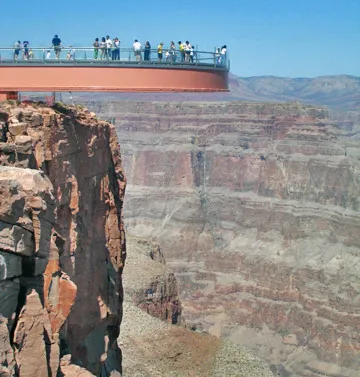
Today Whatoname smiles at the sight of his own mug, blown up against a promotional background and plastered on the side of a tour bus. His portrait has been cut and pasted so that he stares at various attractions of Grand Canyon West, the new and improved way to experience America's grandest national treasure. In one bus mural, he faces a Hummer parked by the Colorado River, a group of tourists smiling in a raft, a helicopter flying through the canyon, and at the top, looming over the entire scene, a steel-enforced, glass-bottomed walkway floating over the abyss.
"I'm kinda the poster boy around here," Whatoname says. He's standing in front of us, shells, feathers, and all, ready to show us around. My friend Bora Karaca and I are first-timers to the canyon. We want to see what all the fuss is about here at Eagle Point, Arizona, site of the Grand Canyon Skywalk. As they get off the bus, eager travelers from all over the world mutter oohs and aahs in a jambalaya of languages and accents. They've come a long way to walk across the sky. We've come a long way to talk to Whatoname.
I HAD NEVER BOUGHT INTO the myth. The Grand Canyon has been hailed as a place of pilgrimage for the U.S. tourist, a fantasy for Mom and Dad to visit with their 2.5 children during summer vacation. In a station wagon. It was another brand name packaged to appeal to the limitless appetite of a country that's never full (except when immigrants try to get in). I had never been there, and it wasn't on my list--until I read about the controversy over plans to build what sounded like a very strange structure.
Private investors had brought the idea of building a horseshoe-shaped perch over the canyon to the Hualapai Tribal Council in 1996. The tribe entered into a joint venture partnership, and in 2004 workers began constructing a $30 million installation that lets visitors walk 4,000 feet above the Colorado River ... on glass. Most environmental organizations, including the Sierra Club, did not take a position on the Skywalk, acknowledging that this swath of the national treasure belongs to the Hualapai. But plenty of people nationwide expressed horror at the prospect of another structure on the canyon's rim. The Hualapai knew that building such a thing on sacred tribal land would have its costs. And benefits. The Skywalk would lure caravans of station-wagon folk and anyone else willing to shell out $29.95, and that money, along with income from a lodge and other ventures, would be reinvested in the Hualapai community. The money, says Ted Quasula, chair of the board of directors for Grand Canyon West, might take some time to trickle down to the reservation and its people. "I wish I could say that the Skywalk was making us filthy rich off the bat, but that's just not the case," he says. "We had to build from scratch the entire infrastructure, and we're in some debt. But the most significant uplift I see is that Hualapai people who didn't have jobs before are now able to work."
WHEN WE GET TO THE HUALAPAI CITY of Peach Springs, Arizona, the streets are empty. Many of the buildings we pass are wooden skeletons surrounded by old appliances. Abandoned refrigerators, vacuum cleaners, and automobiles disintegrate in front yards. Dogs scuttle across the pavement. We pull over to talk to some twentysomething locals in a Chevy Trailblazer. They invite us to cruise and drink with them around town. Tarron Honga, a resident of the reservation, enjoys getting the Skywalk subject off his chest. "Yeah, I went on the Skywalk when it first opened. It was flipped out 'cuz I was hung- over. You're not going to put that in there, are you?"
I tell him I'm writing it down.
"You don't have to, but it's true."
We're standing outside the Hualapai Lodge. He smiles and laughs a lot. Scars and homemade tattoos cover his forearms. "The Skywalk's making money, but ... look around, nothing's changed. Uplift? It's all bunk."
He points out some of the highlights of Peach Springs--the post office, the general store, the railroad. "You see why everybody's always getting messed up over here? There's nothing else to do." He mentions a dirt road from Peach Springs, the only road that leads to the banks of the Colorado River. He laughs when he looks at my car. "You'll need a truck; it's real rocky."
We don't have a truck, so we'll have to make do. Even at 20 miles per hour, rocks fire into the underbelly of my Honda Civic like bullets on a trespasser. In every direction rock sentinels stretch out and up, reaching for the sky. Thorny plants swarm the landscape. We're taking a water break when a jackrabbit the size of a Doberman explodes out of the rocks and gallops across the rolling floor of the canyon.
After 20 painful miles, we hit a stream flowing across the road. Time to start walking. We follow the water until we hear exuberant voices. There on the banks of the Colorado, a group of travelers lounges on a deflating raft. Coming off the river after an 18-day trip, they glow with accomplishment--or maybe sunburn. I try flirting with a redhead when a woman in a ranger uniform informs me that we need a permit to use the road.
"Oh, well, we're writers. With a magazine."
"You still need a permit."
Rachelle Mahone is not actually a park ranger but an employee of Grand Canyon West. She's an "outdoor tourism concierge" who lives on the reservation.
"The elders said the Skywalk's messing with nature itself, the sacred land," she says. "Being Native American, we take pride in our land. It was created this way, and we take it this way."
Mahone pauses before saying how she feels about it personally.
"I was real hesitant about them putting it out there, but after getting to see it.... At least it's not another casino." Back in Peach Springs, pavement offers relief to the wreck that was my car. Rolling back to the lodge, we run into one of the elders, Melinda Majenty Powskey, who has just returned from a potluck. For 30 years she taught kids how to read and write the Hualapai language at the reservation's public school. Now she's an ethnobotanist who organizes feasts done the old way, from the time before fry bread.
"The Skywalk is just the beginning," she says. "They're not finished over there at Grand Canyon West.... Things have really changed, and there's not much I can do about it. As an elder, my duty is to my people, but I'm not sure what that means anymore. I see us standing out there, looking down, asking where do we go from here?"
TO GET TO THE SKYWALK, you start at Grand Canyon West Airport. By the time we arrive, dust coats my face, clothes, and the inside of my car. We pick up our tickets and join the herd of tourists now crossing through a gauntlet of helicopters about to ferry them into the canyon on aerial tours. Nearby, big buses roll up to shuttle the lines of visitors to Eagle Point, and we fall in.
The bus driver gets on the mike and shares some tidbits about the area, not forgetting to mention all the ways one can spend money at Grand Canyon West, where differently priced packages offer options: pay less and view the Skywalk from a distance, pay more and get a helicopter tour and complimentary champagne. Travelers can trot along the trails on horseback, troll the Colorado River in motor rafts, bump over the gravel in Hummers, or find some shade in a tepee at the Indian Village attraction.
When we get off the bus, we see Whatoname standing there, dressed in denim, sporting sunglasses and those feathers and abalone shells. He doesn't waste time. We shake hands, and we're off on a walk.
"This is a very spiritual and powerful place for us; we don't keep it for ourselves." He points out the towering rock formation from which Eagle Point gets its name. It looks like an eagle with its wings outstretched, flying up. "In our culture it's the eagle who carries prayers to heaven--Eagle Point is one of the reasons this area of the canyon is so sacred."
Before we head to the Skywalk, Whatoname walks us toward the edge of the canyon's rim, an area off-limits to most visitors. "Over at the national park, there's guardrails everywhere, and they're always having accidents. Over here, people don't fall because they know not to try anything funny. There's no rails anywhere; they would ruin the natural beauty."
As we approach the precipice, my friend Karaca looks calm, at least for a man crippled by a fear of heights. On the inside he's surely dry-heaving, but, no matter, something keeps us moving forward, like a couple of doomed gnats dying to know what lurks inside a yawning mouth. Whatoname can't hide his smirk as I try not to let on that I'm on the wrong side of a freak-out. I scan the list of my body's warning mechanisms: palms damp, heart galloping, feeling dizzy, fierce urge to pee--OK, it's just a big hole, just stay cool.
And there it is, the great mouth agape, her warm, sweet-smelling breath drawing me in from all directions. My toes breach the edge, pushing innocent pebbles into oblivion. No guardrail. Maybe a thousand feet down, the wind carries a couple of clouds across the canyon. Winged specks catch thermals and lift in a slow, vertical spiral, looking for a bite. I force my neck to stretch over the edge. Now I can see over the rock, straight down to the canyon floor. I can hear the abyss's challenge. Come closer ... I dare you.
Snap out of it, man.
I admit it--maybe I sized up the Grand Canyon prematurely. I now understand the grandeur of the Skywalk's purpose: to allow us to stare down the gullet of an unfathomable descent and stroll over it like it's just another walk in the park, an act of metaphysical rebellion without any risk of physical harm.
We hop over to the Skywalk terminal and unload our gear into lockers. Absolutely no guns, no cameras. We're moving through the concourse.
"You're almost there," one sign says.
"Are you ready?" asks another.
"Get ready!"
I put on my complimentary cotton booties so that my shoes don't scratch the glass. A big curtain opens. One step forward and I can see inside the earth. A bird glides under my feet. I drop to my hands and knees and lower my body until my face presses against the glass. Far below and all around, the labyrinth of geologic incisions jags and winds, as if some giant hand had dragged a hot-blooded finger through the rock and carved its signature onto the curvature of the earth, an unreadable name taking credit for the completion of the world.
The adrenaline forces me to laugh out loud. My outburst earns me a look from one of the employees.
"Just try not to spook the other Skywalkers."
He glances at a woman inching her way forward while hyperventilating. By the sound of her panic noises, she might be from Scandinavia. Whatoname doesn't say a word. He puts her hand on his arm and holds it there as both of them shuffle away from the abyss.
I'm ready to whisper my own hopes to the sky and watch them get sucked into whirlwinds, off with the rest of them on the prayer conveyor belt run by the eagles. I'm ready to pat Whatoname on the back and say kudos to the Hualapai for tapping the American dream. Then I hear a distant buzz. In the middle of the canyon, a helicopter full of tourists makes its way to the pretty spots.
"It's all about balance," says Whatoname. "When the idea for the Skywalk was proposed, I rejected it at first because I was concerned for the land. But look at the potential this has for our community. We need to embrace changes while still keeping the land beautiful."
I hope Whatoname is right--that it's possible for Grand Canyon West to keep things pretty while maximizing profits. But the changes Whatoname's talking about could spoil things. In the works is an airport expansion to increase air tourism, meaning more small planes and helicopters flying through the vistas. An IMAX theater and a restaurant may be built atop the Skywalk terminal. As it stands now, all the water used at the complex gets trucked in, but the tribal council is talking about tapping the Colorado and piping water 4,000 feet up to the resort to meet tourists' needs.
Whatoname doesn't look worried. "This is the dream of our people," he says. "We want to share our community with the world, bring back our sense of pride."
I ask if there wasn't a sense of pride before.
Whatoname takes a moment. Through his sunglasses I can see he's looking me in the eye. "We've got problems. There's poverty, there's addiction--these are still real issues for us, and in some way we're going to have to figure out those problems on our own, as a people. But now we have a reason to restore our community, because the whole world is watching us, coming to see us. We have to be ready to meet them."
When I first met Whatoname, I thought I was shaking hands with a walking brochure, but somehow he pulls off his style without looking like a phony. He knows that no dream is perfect, that a sense of pride doesn't come cheap in the grandest nation on the planet, but he's got a gut feeling that everything's going to work out just fine, that all the fear and doubt were worth it to have the Skywalk here at Eagle Point. I don't know yet if I believe him, but I know I want to.
Dev Das, a 2007 graduate of Occidental College, is a freelance writer and activist currently living in Detroit.