 The Magazine of The Sierra Club
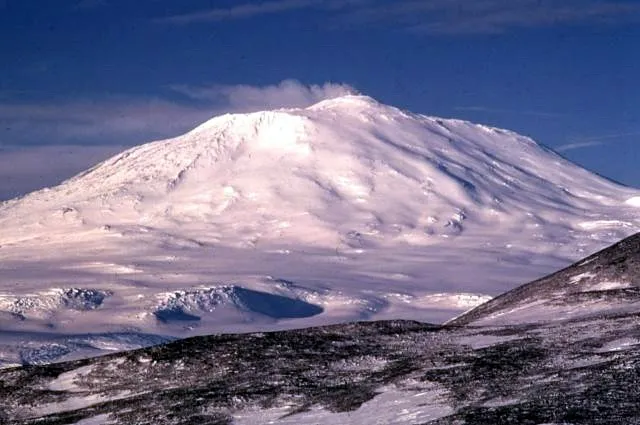
Mt. Erebus
Antarctica's most active volcano
"From there to here,
and here to there,
funny things
are everywhere."
—Dr. Seuss
A biting wind pummels my body as I brace myself on the crater rim of Mt. Erebus, Antarctica's most active volcano. Just a few minutes' exposure to the minus-30-degree Fahrenheit air earns my climbing partner a frostbitten nose. Safely swaddled beneath a facemask, my own nose sniffs the acrid sulfur wafting from the lava lake smoking and heaving in the caldera 300 feet below.
The molten lake has burped out rocks the size of automobiles, and we've been warned not to duck if we hear an explosion. Instead, we should look up and try to dodge the volcanic bombs. I'm thankful that today the mountain is quiet.
Just below us on the volcano's flank, white mist rises from three-story-high towers shaped like upended ice-cream cones. Climbing into a steaming hole in the side of one, I enter an underground world of sparkling ice. Hexagonal crystals cover the walls of solidified lava, reflecting points of light from my headlamp like constellations in the night sky. I stop, stunned, when I see a perfect human handprint melted into the frozen wall. In a gesture as old as humanity, I sear my own handprint into the ice to say I was here too.
Crouched inside the tower, I hear hissing like the breath of a giant dragon. It's gas escaping from the volcano, water vapor flavored with a little carbon dioxide. This warm gas vents through fumaroles, holes in the mountainside. When exposed to the subzero air, the vapor instantly freezes onto existing ice and lava structures, growing into fantastical shapes. The wind then contributes its own sculpting, whistling as it works.
Back in my tent on a snowfield two miles above McMurdo Station, I pause and listen. No sounds at all. As my brain adjusts to the silence, I begin to hear a throbbing beat. The sounds of my internal pumps. The blood rushing through my carotid artery, breaking into turbulence, and keeping time to the rhythm of my heart. —Paul Doherty