 The Magazine of The Sierra Club
It’s Not Your Imagination. Seaweed Is Everywhere.
Here’s why
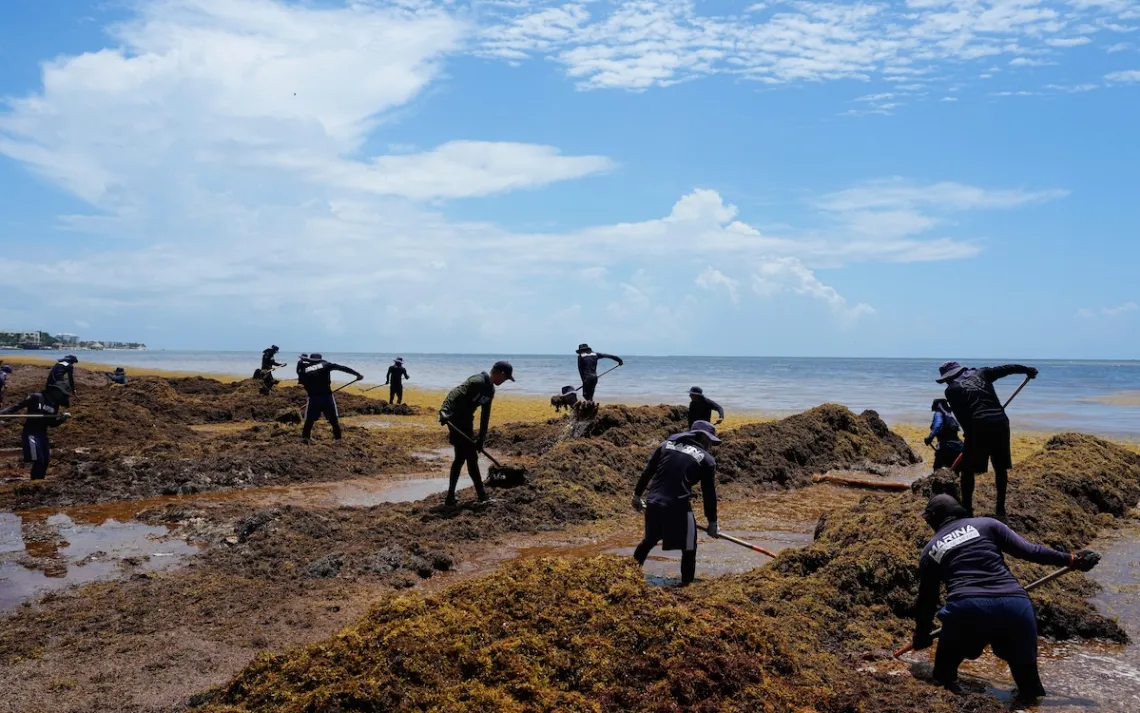
Members of the Mexican navy remove sargassum along the shore of Puerto Morelos in July. | Photo by Fernando Llano/AP
Wildfires, smoke, floods, and deadly heat waves have dominated the headlines this summer. Meanwhile, beachgoers have witnessed another consequence of rising temperatures: Seaweed is everywhere.
Sandy beaches from Florida to the Caribbean and Mexico have been covered in massive stinking mounds of sargassum, along with thick “green tides” of sea lettuce (Ulva) off China, Korea, and elsewhere. Harmful algal blooms are also proving particularly rough on Australia.
Seaweeds, like our forests on land, are both exploding and declining. There are over 12,000 species of seaweed, 30 of which are kelp. Some valued seaweeds—the world’s kelp forests—are being displaced by urchin barrens and turf algae largely due to the growing presence of marine heat waves.
In the United States, massive piles of sargassum hit Florida beaches, releasing hydrogen sulfide, which smells like rotten eggs. Governor Rick Scott at first resisted calls to announce a state of emergency, but then changed course and did so in a number of counties, including Palm Beach, where “guacamole thick” blue-green algae blooms smelling like sewage have become common.
Mexican President Claudia Sheinbaum announced a $115 million plan to combat the growing mounds of sargassum seaweed that are impacting her nation’s tourist industry. The Mexican navy is installing offshore barriers and two big trawlers to collect it before the seaweed hits the beaches.
Meanwhile, Australia has experienced its worst and longest-lasting harmful algal bloom in history, which, over the last year, has had a deadly impact on marine life along one-third of its southern coastline, also known as the Great Southern Reef.
And in China, with most of this year’s sea lettuce bloom floating just offshore (in the past it has covered hundreds of miles of beaches), local media is highlighting new efforts using harvesting ships and land-based processing of the emerald-green seaweed in the hope of converting it to agricultural bio-fertilizer.
What’s behind the “dead zone”
The consequences of these seaweed and algal bloom outbreaks extend far beyond the ability to enjoy a day at the beach.
An annual report released on this summer’s 1,332-square-mile dead zone in the Gulf of Mexico pointed out that a massive algal bloom was in part responsible for the phenomenon. The Midwest’s agricultural runoff down the Mississippi River feeds the algal bloom with nutrients and then, as the algae sinks, it is in turn fed on by bacteria. This process sucks all the oxygen out of the water, killing whatever life can’t flee fast enough (including crabs, clams, and brittle stars). This nutrient-generated dead zone has been growing and morphing since at least the 1970s, sometimes to the size of New Jersey.
Algae, along with cyanobacteria, is one of the basic building blocks of life on Earth. Along with generating the oxygen in our atmosphere during the Great Oxidation Event 2.5 billion years ago, a billion years ago, multicelled algae evolved into seaweed, marking the beginning of complex life. Today, however, algae and seaweed are expanding, blooming, turning toxic, and decaying within decades, years, sometimes even days due to human influences on the ocean.
The common denominator among all this activity is marine heat waves—extended periods of unusually high ocean temperatures. July broke an all-time temperature record for the entire ocean, as did June with “severe” marine heat waves in the Atlantic, Pacific, and western Mediterranean. NOAA reported 2025 as having the hottest global ocean surface temperature on record, a grim milestone likely to be broken again this year. This trend has been long predicted by scientists. The ocean absorbs about 90 percent of all human-caused atmospheric heating due to the burning of fossil fuels.
Nutrients from synthetic fertilizers also run off into oceans and are super-charging seaweed and other algal growth.
As a result, today’s sargassum blooms are being fed by a combination of warming waters and increased nitrogen and phosphate flowing into the ocean from multiple sources. This year’s sargassum bloom so far weighs in at a total of 37.5 million metric tons. That, along with the 2025 bloom, is the largest recorded since monitoring began in 2011.
Can anything be done?
Ocean temperatures need to cool down. Over the long term, that will require the rapid transition off planet-warming fossil fuels and a reduction of our dependence on nitrogen-rich fertilizers for agriculture. There are a range of more immediate actions that can help.
A growing number of farmers are discovering that most of the fertilizer runoff from their fields (that also pollutes local drinking water) is wasted product that wasn’t taken up by their crops’ root systems. With more selective application, including use of GPS, more organic plantings, and other tools and techniques, they’re able to both reduce the runoff and save money on their crop inputs.
At the same time, a number of municipalities have restricted the fertilizing of lawns and golf courses to certain times and seasons to further reduce pollution of marine ecosystems. Some cities such as Tampa, San Francisco, Singapore, and Stockholm are also investing in upgrading their wastewater treatment plants and stormwater runoff systems to reduce nutrient pollution.
Efforts now taking place in California, Korea, Portugal, South Africa, and elsewhere to fully protect and restore kelp forests have also been highly effective at reducing both aquatic nutrient levels and ocean acidification.
Until these kinds of choices are significantly scaled up, however, there will be continued loss of kelp forests and increased algal blooms, including the harmful kind threatening the world’s communities, both human and wild.