Beware the Blue Angel
These mollusks go with the flow but aren’t easygoing
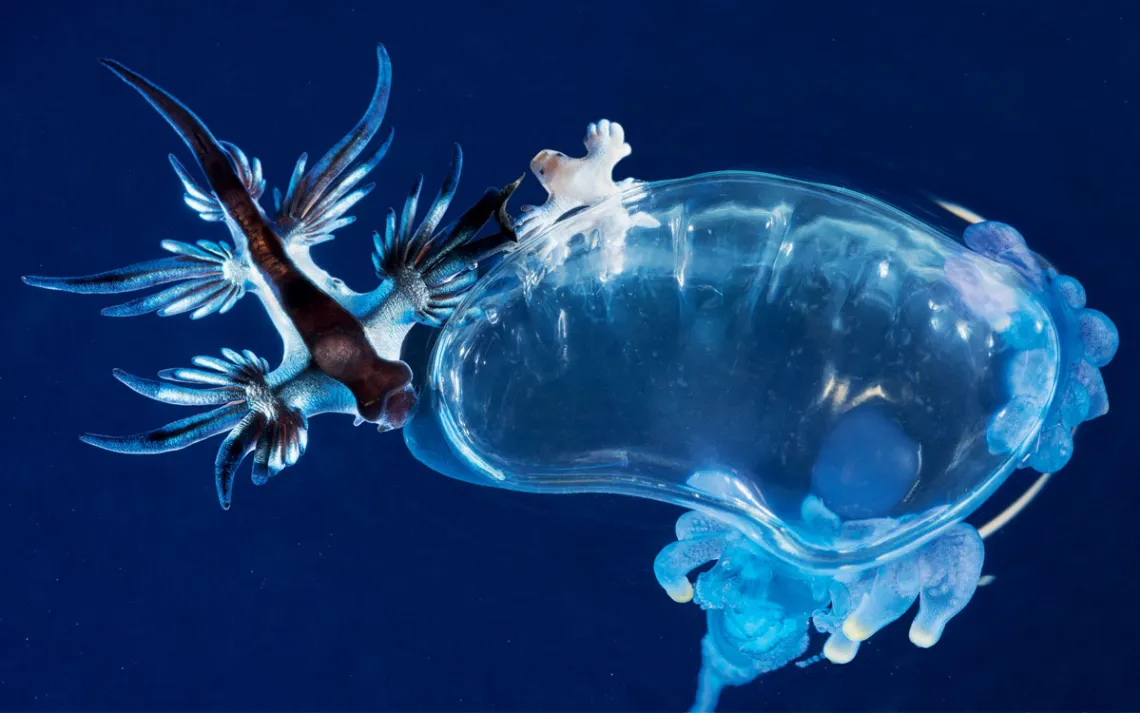
Photo by Doug Perrine/NPL
“This is incredibly dangerous, even for a professional, but I’m gonna show you guys exactly how this works,” says wildlife handler Julian Obayd as he submerges his hand among blue angel sea slugs in a now infamous TikTok video. The dazzling creatures float to his fingers. “They’re chill,” he can be heard saying.
The video then cuts to a hospital bed, where Obayd turns the camera on himself. In a much more subdued tone, he says, “It was, in fact, not chill.”
These sea slugs are nudibranchs (“naked gills”) belonging to an order of mollusk that has evolved to swap the security of a shell for a sting, one of the ocean’s most effective defenses. On other nudibranchs, stinging appendages called cerata are arranged on their backs, but on the blue angel (Glaucus atlanticus), they spread from its sides like feathered wings, earning it the nicknames blue dragon, dragon slug, and sea swallow.
Found in tropical and temperate waters in the Atlantic, Pacific, and Indian Oceans, this mollusk drifts upside down. It sucks air into its belly to float upward, but the water’s surface tension is enough to stop it breaking through—the blue angel’s muscular foot clings to the underside of this delicate border where water meets air. Blue on one side and silvery on the other, this master of countershading is nearly invisible to predators both above and below.
It would make for a spicy mouthful anyway. The little killer, only about an inch long, snacks on some of the ocean’s deadliest animals and devours predators many times its size, such as Portuguese man-of-wars. When it eats stinging prey, it usurps their nematocysts—explosive stinging cell organelles—and stores them in its own tissue. Since the cells are much more concentrated in the sea slug, it can deliver an even more powerful sting than the animal it robbed.
Not all of the blue angel’s powers are stolen. Its own radula—the mollusk version of a tongue—is lined with serrated teeth, and together with a strong jaw, they help the slug gnaw away at anemones and jellyfish. A digestive system built like an insect’s exoskeleton armors it against internal stings. The air the blue angel uses to float escapes when it eats. Dinner is a noisy affair.
Although they live for only about a year, nudibranchs respond quickly to environmental pressures, so they’ve been helpful for tracing the effects of climate change. Glaucus atlanticus, historically found in the tropics, has expanded its range as waters warm. Now fiery flotillas of these mollusks, known as blue fleets, are on the move.
Also ...
Scientists on the 1872 HMS Challenger expedition preserved a blue angel in glycerin; it’s now at the Natural History Museum in London.
Blue angels are hermaphrodites, and they’ve evolved long, hooked penises—the better to avoid their partners’ venomous cerata.
Beachcombers, beware: The blue angel’s sting stays potent even after it dies.