Will Osprey Chick Deaths Inspire Conservation Action on Menhaden?
Groups are calling for an end to industrial fishing of this vital forage fish in the Chesapeake Bay
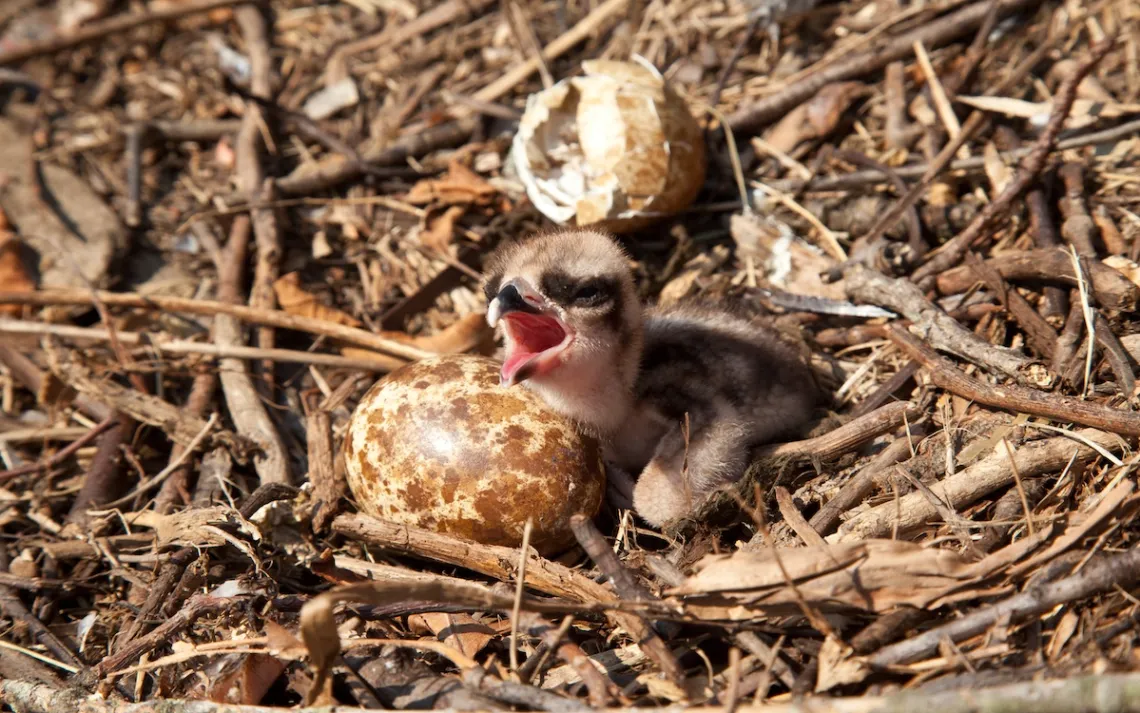
Osprey hatchling. | Photo courtesy of Bryan Watts
Every spring, Roberta Kellam looks forward to watching osprey pairs raise their chicks along the banks of the Nassawadox Creek—a tributary that flows into the Chesapeake Bay near her home on the Eastern Shore of Virginia. But about seven years ago, she noticed a change: Their chicks weren’t surviving.
“In the third week of April, everything looks great. As birds are fishing, they're thriving,” said Kellam, a retired environmental lawyer and president of Birding Eastern Shore. “All of a sudden, a month later, it's like a bomb went off and there's nothing. No adults. No chicks. Chicks are dead in the nest; eggs are abandoned.”
Kellam, other private homeowners, and many bay fishermen alerted Bryan Watts, director of the Center for Conservation Biology at William & Mary College, about their concerns. Watts and his team, who’d been working with ospreys since 1970, started to compile breeding results across the bay’s salinity gradient for nesting pairs throughout the 2024 and 2025 seasons. The tidal bay is an estuary with a higher salinity where it meets the Atlantic Ocean near Virginia Beach.
According to Watts’s findings, throughout the 2025 breeding season, many of the chicks were starving, and some of the female ospreys weren’t even laying eggs—likely due to nutrition deficiency. In fact, 74 percent of the pairs nesting in higher salinity waters “failed to produce any young.” The osprey population in the more saline section of the bay is reproducing at an average of only 0.33 young/pair, a rate too low to sustain its population. If the females did lay eggs, the researchers documented some pairs abandoning viable clutches.
In the last few years, they’re also observing asymmetrical broods developing. When the parents don’t deliver enough food to multiple chicks, a dominant chick usually emerges to monopolize what’s delivered. The weaker chicks usually starve to death. The lower Chesapeake area also had more single-chick broods, an indicator of food stress, the report says.
So why are osprey parents struggling in the more saline waters of the bay?
Overfishing of a keystone species, menhaden, is to blame, according to the Chesapeake Bay Foundation, many other conservation-focused nonprofits, and several local sportfishermen’s groups. Menhaden are “foundational to marine food webs,” says foundation campaign manager Will Poston. The oily fish—also called fatback, bunker, pogie, and mossback—are calorie-rich and an essential part of an osprey chick’s diet in higher saline waters.
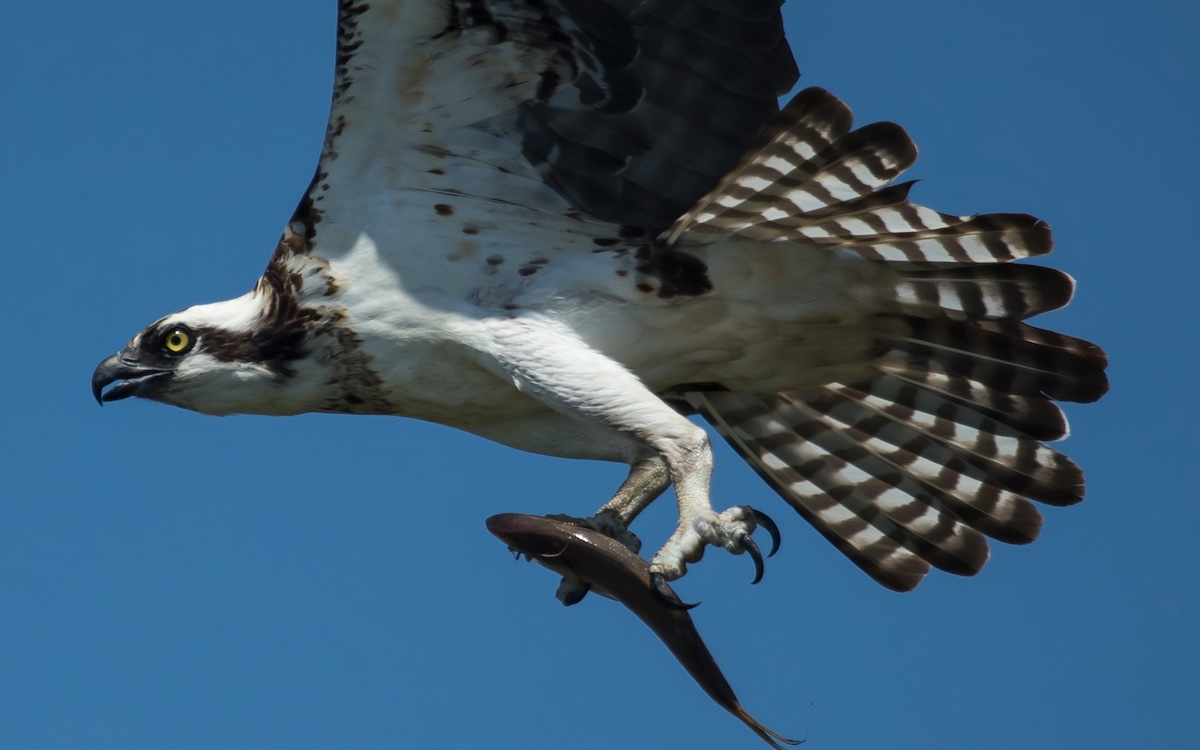
Osprey with menhaden. | Photo courtesy of Bryan Watts
“Osprey should be seen as an indicator of the broader consumer community,” says Watts, “not just their population, but the broader ecosystem, and that's what our main concern is.” A broad coalition of sportfishing, birdwatching, and other conservation groups are sounding the alarm.
One of the biggest customers for industrial menhaden fishing is Omega Protein, a reduction fishery plant on the bay in Reedville, Virginia, that’s owned by Cooke, Inc., a Canadian company. The factory—which grinds down menhaden for use in aquaculture feed, dog food, and fish oil supplements—is the only one of its kind left in the mid-Atlantic. Ocean Harvesters, which catches menhaden for Omega Protein in the bay and beyond, uses spotter planes and large purse seine nets that are banned in Maryland, New Jersey, and Delaware waters, but legal in Virginia. Ocean Harvesters range on the Atlantic coast as far as northern New Jersey, according to NOAA.
“Menhaden are really the energy changers within the marine food chain,” explained Watts. As filter feeders, they consume the energy of the bay’s abundant plankton and “make that energy available to higher consumers.”
The fish have been a key part of the diet for striped bass, dolphins, humpback whales (who winter at the mouth of the bay), and many other types of birds. Watts also points out that the “bay has been the most important nursery for Atlantic menhaden. When you look up the Atlantic coast, up into New England, there simply is no replacement for the Chesapeake Bay that could serve that nursery function.”
The Atlantic States Fisheries Management Commission (ASFMC)—which manages the Atlantic coastline waters—claims that menhaden are not overfished. Both Omega Protein and Ocean Harvesters tout that finding as support for their industrial fishing. A recent study, though, showed that the commission had been using what the Chesapeake Bay Foundation refers to as “faulty science” that “inaccurately estimated” the menhaden’s natural mortality, thus overestimating the menhaden stock size.
Last October, the ASFMC lowered the allowable menhaden catch along the East Coast by 20 percent for the coming season. However, many conservationists and scientists are calling for deeper cuts—as much as 50 percent—to protect the local ecosystem in the face of warning signs, such as the osprey reproductive failures, the decreasing number of menhaden baitfish catches by smaller operators in both Maryland and Virginia, and the low spawning success for the striped bass population. The bay also acts as a nursery for striped bass, which have also experienced below-average reproduction for the last six years.
Many Atlantic and Chesapeake–area sports fishermen side with the conservationists—including the Virginia Saltwater Sports Fishing Association. “Our view is that the last thing the Chesapeake Bay needs is a large-scale industrial fishery operating in its fragile waters,” says Steve Atkinson, the organization’s chairman of the board.
Menhaden regulation is also supported by the Theodore Roosevelt Conservation Partnership, which advocates for hunters and fisherman. That organization’s former president and CEO, Whit Fosburgh, who also worked at Trout Unlimited, is co-launching a new nonprofit that will directly address the issue of forage fish depletion, called the Forage Fish Campaign, with the mission of ending industrial fishing on the forage base.
The Chesapeake Bay Foundation launched a campaign using Watts’s data about the chick deaths as their hook to alert stakeholders and concerned citizens. The nonprofit accuses Omega Protein of “monopolizing this public resource.” They also conducted bipartisan polling across Virginia, which found that 79 percent of voters from both parties “support ending large-scale commercial menhaden fishing in the bay until science can show what fishing level is compatible with a healthy ecosystem.”
In a recent email, Virginia House delegate Betsy Carr explained she is “focused on funding a study of the menhaden ecology and any impacts from the reduction fishery in the Chesapeake Bay. No critical decisions can be made until reliable scientific data is available.”
In 2023, the Virginia Institute of Marine Science (VIMS) designed such a study to analyze the bay’s menhaden population, but over the past three years, the industry and its lobbyists have objected to and successfully blocked Virginia legislatures from funding that study or any similar ones.
This year, the ASMFC agreed to consider reducing the menhaden fishery cap by 50 percent and also possibly creating quota periods that could distribute the harvest more evenly through the fishing season. A final decision likely won’t be made until the fall, though. Newly sworn-in Virginia governor Abigail Spanberger will have the say in reappointing new members of the Virginia Marine Resources Commission (VMRC) this summer.
In the meantime, Omega Protein has been a weighty political donor to Virginia politicians in both parties, according to the Virginia Public Access Project. Their most recent donation was $50,000 to the Spanberger Inaugural Committee 2026.
“The industry is dug in hard,” says Atkinson, who has written several op-eds in support of curbing the industrial menhaden harvests. “A responsible company operating in the 21st century would listen to stakeholders and they'd say, ‘Wow, we need to adapt here. We're going to voluntarily reduce our harvest in the bay.’”
Some professional and sport fishermen have banded together to even appeal to President Trump. They created a “Make America Fish Again” video, which asks him to ban industrial fishing for menhaden in both the Chesapeake Bay and the “Gulf of America.” In July of 2025, Trump posted the video on Truth Social.
Health-conscious consumers who take omega-3 supplements may inadvertently support industrial menhaden fishing. Avoid buying fish oil that contains Atlantic menhaden and check your label. Some fish oil companies—including those that look natural or wild caught—tout menhaden as a nutritionally superior kind of fish oil because it includes beneficial DPA (docosapentaenoic acid) that not all fish oils contain. Alternative sources of DPA include salmon, cod liver oil, and algae-derived supplements (for vegetarians and vegans).
“Menhaden have always been a politically charged issue, so that's a big mess,” says Watts. “But, to me, the true broker, the honest broker in this is osprey. They don't have a political agenda. They just come up here to do their thing, and they're not making it currently. A lot of noise going on, but if I had to listen to one of those voices, it would be osprey.”
Kellam witnesses the osprey loss in the three nest stands she sees from her yard. Growing up in Buffalo, she witnessed the horrors of the Love Canal chemical pollution that inspired her to become an environmental lawyer. She can’t believe the government isn’t intervening now, like it finally did with Love Canal.
“It's like something catastrophic has happened here,” Kellam said. “There aren't even cormorants. The [osprey is] the canary in the coal mine. They’re telling us what's going on. They fish every day. If they're not finding fish, there's something seriously wrong.”
What You Can Do
Contact the Atlantic States Fisheries Management Commission and the Virginia Marine Resources Commission to ask that more studies be conducted into how best to support the osprey.