Rewilding El Paso
Locals celebrate Texas Parks and Wildlife's reintroduction of bighorn sheep
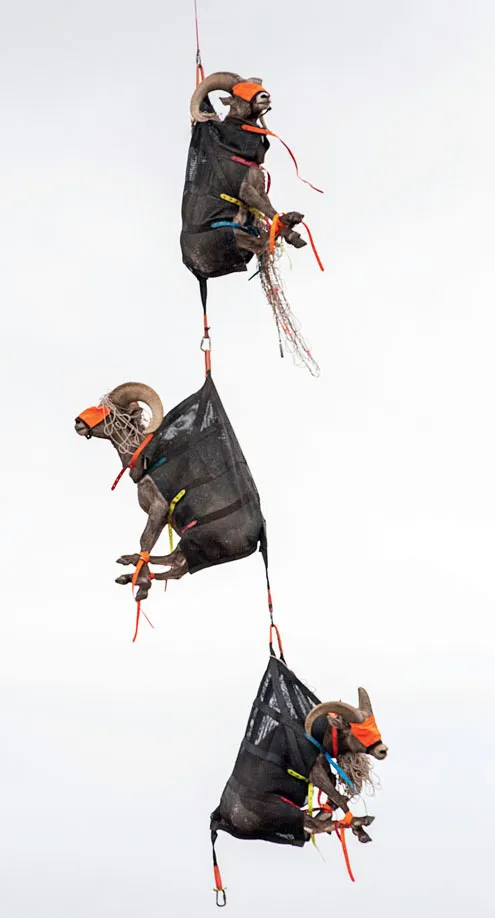
Bighorn sheep were airlifted to the base of the Franklin Mountains for health checks. | Photo by Chase Fountain/Texas Parks and Wildlife Department
On a Wednesday afternoon in early December, a large crowd was growing in the mountains above downtown El Paso, Texas. Families spread out picnic blankets on the rocky ground, while photographers set up tripods and local news broadcasters rehearsed their scripts. Conversations in English and Spanish filled the air; drones buzzed overhead.
At around 4 p.m., five trailers rumbled into the campground at Franklin Mountains State Park, sending an excited hush through the hundreds now gathered. Inside the trailers were nearly 80 desert bighorn sheep, animals that once roamed these cacti-studded hills, until they were extirpated in the middle of the 20th century by overzealous hunters.
“Never in my lifetime did I think we would be taking sheep back to the Franklins,” said Froylán Hernández, who has served as the desert bighorn sheep program leader for the Texas Parks and Wildlife Department (TPWD) for the past 15 years. The biologist believes that the future of the state’s bighorns—which are crucial to a healthy desert ecosystem—may rely on this popular 27,000-acre park located entirely within the city limits of El Paso.
“It gives me goose bumps. Good goose bumps,” Hernández said. “You’ll be out in your front yard and you’ll be able to see a bighorn. It’s a monumental thing.” Never in the state’s history has a charismatic megafauna been reintroduced into such an urbanized area.
For millennia, seeing a bighorn in Texas was hardly monumental. Ancient petroglyphs of bighorn sheep scattered across the Trans-Pecos region—the rugged, mountainous western heel of the state—indicate the significant role the animals played in Indigenous culture. Biologists guess that about 3,000 of the curly-horned ungulates were hoofing around 15 ranges in West Texas in the late 1800s. By the 1950s, they were nearly wiped out.
“The countryside is peeled, and I mean peeled.”
In 1957, the TPWD started trapping bighorns in Arizona and reintroducing them into Texas. The agency was successful in establishing a few fledgling wild populations, including one in the Elephant Mountain Wildlife Management Area, about 250 miles southeast of El Paso. In the roughly 20 states and provinces that are home to bighorn sheep, it’s rare to have a population like the TPWD has at Elephant Mountain—a naturally reproducing and healthy population. “It’s the only clean basket of eggs we have,” Hernández said.
When Hernández joined the sheep program in 2009, the state was planning a new, ambitious restoration effort using the clean brood stock at Elephant Mountain to establish hearty, resilient populations across the Trans-Pecos. Up through 2020, the TPWD team moved almost 500 sheep and established three new herds, which at first appeared to be doing well. “Five years ago, I was dancing,” Hernández said.
But the good times did not last. “I wish I could say those populations took hold, but all three populations are struggling,” the sheep biologist said. “It’s a dire situation we’re in.”
Ironically, it’s a situation of the TPWD’s own making. In the middle of the last century, the department began importing aoudad, an African sheep species, hoping to replace the hunting revenue that disappeared with the bighorns. Over the past 75 years, the aoudad, which reproduce easily and need much less water than bighorns, have thrived, eating everything in sight.
“The countryside is peeled, and I mean peeled,” Hernández said.
Worse, a 2018 survey revealed that many of the aoudad were carrying Mycoplasma ovipneumoniae, or M. ovi, a bacterium that seems to have little effect on the aoudad but causes pneumonia in bighorn sheep. The discovery was gutting, Hernández said. “We were caught completely off guard.”
But the growing aoudad population—now hovering somewhere north of 25,000—is a problem without an immediate solution. Texans love hunting the animals, and landowners love making money off the hunters. In a state that’s getting too hot for cattle, some ranchers are making a living by opening their land to aoudad hunting. Still, a broader strategy will be necessary to control numbers.
In 2020, the desert bighorn sheep program endured another heart-wrenching setback. Three veterans of the effort, two biologists and a veterinarian, were killed when their helicopter went down during a sheep survey in the Big Bend region. Meanwhile, bighorn sheep populations in Texas have continued to dwindle. Now they stand at an unsteady 700—a number that could be severely reduced by an inclement year or an especially virulent disease outbreak.
To protect their “only clean basket of eggs” at Elephant Mountain from M. ovi, Hernández and his colleagues devised a strategy: Create a new population with brood stock from Elephant Mountain, this time in the Franklin Mountains. Surrounded by the cities of El Paso and Juárez, Mexico, the new herd might not be able to expand, but the aoudad—and disease—won’t be able to invade either.
“It’s very defensible,” said TPWD superintendent Cesar Mendez, who has seen only a couple of aoudad in Franklin Mountains State Park during his many years on the job. “That was the big factor in selecting the Franklin Mountains. They are now critically important to bighorn sheep restoration.” That’s because eventually—assuming officials figure out how to control aoudad numbers—individuals from the Franklin Mountains will be used for future restoration efforts in other parts of the state. Mendez guesses the park can hold about 120 sheep. Once the population hits that milestone, “we’ll start moving them around,” he said.
On that Wednesday in December, after the last of the bighorns—including 40 pregnant females—bounded out of a trailer and into the hills above El Paso, Mendez and Hernández shared an embrace as the crowd around them cheered.
Mendez is hopeful that a year from now, visitors to the Franklins will be able to spot “sheep roaming in the mountains, getting habituated, and being happy,” he said. “And a bunch of lambs.”