Is a Perfect (Fire) Storm Brewing for 2026?
Wildfire season is here. What does it mean for people who live in the West?
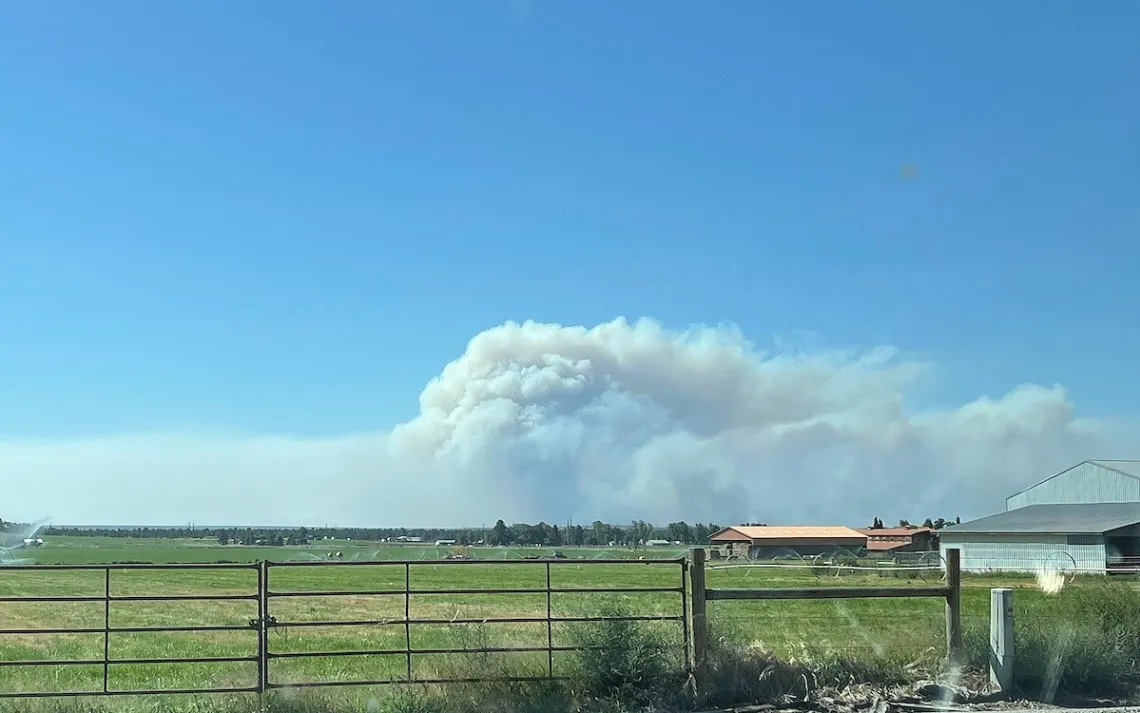
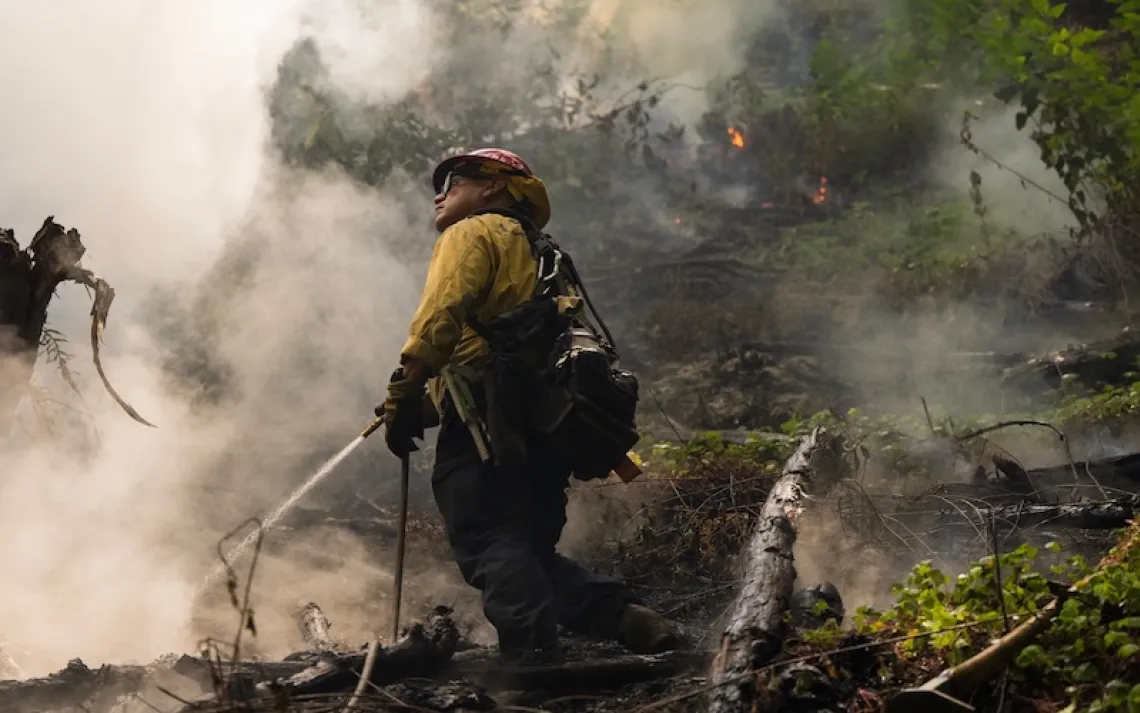
A 2025 wildfire in Jefferson County, Oregon. | Photo by Deschutes County Sheriff's Office/AP
People in Western states don’t need reports or predictive models to tell them what they already know. Mountain peaks are bare of snow. The forest floor is already crunchy. Drought and drier conditions are setting in.
The Northwest Interagency Coordination Center forecasts the potential for significant fires across most of the region by July. After two relatively mild years, many fear this year’s wildfire season could be epic.
David Way, assistant division manager for operations at the Washington Department of Natural Resources, says these predictions don’t change how they get ready for fire season.
“We have to prepare for a bad year every year because we never really know how the lightning's going to come in or what the long-term climate's going to bring,” says Way.
Wildfire response is complex and coordinated. Fire doesn’t care about boundaries between federal, state, and private land, and agencies are used to working with each other. Way says his agency is often first on scene to fight fires in the wildland urban interface—the zone between homes and neighborhoods and forest and undeveloped land.
“We use a ‘closest force’ model, where it doesn't matter what agency, what color truck is responding to new starts,” says Way. They also send crews to fires in other parts of the country—that is, until June or July, when they need all their resources close to home.
Now, the 2026 fire season is unfolding just as the United States’ federal resources for monitoring and tackling wildfires are being shaken up.
Federal wildfire resources under fire
The Trump administration has been in the process of stripping down the US Forest Service and creating an entirely new Wildland Fire Service while gutting scientific research related to forests, fire, and climate. The agency, which employs thousands of seasonal firefighters, is being so radically restructured under Trump that some experts fear it could hamstring a robust response to a wildfire crisis.
In early 2025, the so-called Department of Government Efficiency began chain-sawing through federal agencies. The Forest Service lost at least 6,000 employees. There are fewer personnel who can be called up to fight fires when demand is high.
“It was horrific,” says Tim Ingalsbee, the executive director of Firefighters United for Safety, Ethics, and Ecology. “The federal purging of the wildland fire workforce includes not just firefighters, but across the board—dispatch officers and supply, those who run the fire cache, all kinds of planners and fire scientists.”
Climate and meteorology are also taking a hit because of funding cuts and the loss of institutional knowledge.
Now, the Forest Service is undergoing a massive reorganization, which calls for moving the headquarters to Utah and shuttering 57 of 77 research stations, which support important long-term studies on fire, forests, and climate change.
The agency claims the actual research will continue, but affected employees will have to relocate to do it. Given the Trump administration’s hostility toward both federal employees and science, the atmosphere of uncertainty will likely prompt many employees, especially those close to retirement, to quit. Trump’s budget request reduces funding for Forest Service research to zero.
Way says he is seeing incremental changes as the new federal Wildland Fire Service rolls out.
“It's all the same people that I'm working with, and we're working through all the same challenges that we always do,” he says. “It's interesting times for sure.”
Two sides of the same coin
Wildfire is a two-sided coin, with firefighting capacity on one side and mitigation on the other. Mitigation can be hyper-local or on the scale of an entire landscape. It includes everything from “hardening” homes and removing flammable vegetation around buildings to cutting firebreaks and purposely setting fires to consume small trees, brush, and duff on the forest floor.
There’s a huge backlog of mitigation work in Western forests owing to the legacy of past management (and mismanagement) coupled with the removal of fire. In parts of southwest Oregon, for example, aggressive logging and fire suppression have transformed old-growth sugar pine forests into mixed-conifer stands choked with dying white firs.
Restoring forests like these requires thoughtful thinning, followed by prescribed burning, and importantly, maintenance through the regular application of fire.
“There is a lack of will at the very top, especially in this administration. It's part of an ideology to make prescribed burning impossible so it makes commercial logging inevitable.”
As the entity responsible for more acres of forest than any other in the nation, the Forest Service oversees a lot of mitigation. Two Biden-era bills, the Infrastructure and Jobs Act and the Inflation Reduction Act, boosted funding for this work.
Late last year, a group of US senators sent a letter to Forest Service chief Tom Schultz, expressing concern over a steep decline in “hazardous fuels reduction” in 2025. According to a recent NPR analysis, rates of vegetation removal and prescribed burning in national forests plummeted by 1.5 million acres last year. The agency claims the drop occurred because staff were busy fighting fires and because “environmental conditions” in the Southeast, where much of this work takes place, were not conducive to burning.
But some worry the trend reflects the mentality of an administration that wants to return to an era of extraction and create an army of firefighters engaged in a “forever war.”
“There is a lack of will at the very top, especially in this administration,” says Ingalsbee. “It's part of an ideology to make prescribed burning impossible so it makes commercial logging inevitable.”
Meanwhile, on the ground, the Forest Service is a vital partner in collaborative efforts to reduce wildfire devastation and improve the health of forests.
The multipartner California Wildfire and Forest Resiliency Task Force is fast-tracking projects to protect communities, forests, and other resources across the state. The idea started with conversations between the Forest Service and Cal Fire, the state’s fire agency, about how to ramp up fuels treatment in a coordinated way.
“Our strategy is trying to take an eraser to the boundary between state and federal lands,” says Jason Kuiken, district supervisor at the Stanislaus National Forest in the central Sierra Nevada.
They use models to show where homes, power lines, and communication sites are most at risk, and to figure out what type of treatment will most effectively lower that risk.
In Kuiken’s district, collaboration is starting to pay off. A group of partners called Yosemite Stanislaus Solutions has been working on large landscape projects that number in the tens of thousands of acres and involve a suite of strategies: thinning and piling by hand and machine, mastication, prescribed burning, and some timber harvest.
“It’s pretty awesome; you can see [the results] on Google Earth,” says Kuiken. Kuiken says funding and workforce capacity are bottlenecks that slow down the pace of work. The task force is addressing both and is looking at innovative ways to stretch funding dollars—for example, turning forest slash into usable products such as biochar. Kuiken declined to address Forest Service cuts and changes.
A climate of uncertainty
Drought and devastating wildfires punished the West in 2020 and 2021, and Western states responded by pouring money into mitigation and preparedness. California recently announced another $70 million in wildfire prevention projects. Since 2021, Washington state has funded an account that supports firefighting, forest restoration, and community resilience, adding over 100 year-round firefighters and ramping up prescribed burns. Power companies are clearing vegetation along power easements and de-energizing lines when risk is high. On the local level, prescribed burn associations are helping landowners learn how to work with fire to reduce risk on and adjacent to their land.
Collectively, these “all lands, all hands” approaches to wildfire mitigation empower the people who live in places where risk is high and leverage funding from multiple sources. But states require a strong federal partner, along with the science and expertise to guide strategy in a rapidly changing climate.
Following a dismal snow year, most of the West, with the exception of Southern California, is now facing drought. El Niño is developing, throwing more uncertainty into the mix. What is certain is that climate change is making fire seasons worse. A NOAA-supported study shows that climate change, in particular droughts and heat waves, are driving fire weather in the West.
Hot, dry air sucks the moisture out of grass, fallen pine needles, and everything else. When fuel is tinder-dry, almost anything, even an errant spark from a dragging chain, can ignite a fire that balloons quickly and dangerously. These are the conditions that make conflagrations possible, like the kind that spawn “firenadoes” and pyrocumulonimbus clouds that stretch into the stratosphere and spit embers miles ahead of themselves.
Climate change is also extending fire season, In Washington state, Way says, they are seeing active fire conditions earlier in spring and later in fall. For much of California, fire season is year-round.
As the window for prescribed burning narrows, it’s easy to get caught in the “firefighter trap,” says Ingalsbee.
“We're so busy chasing fires, we can't ever get out ahead of it and make some investments into mitigating and preventing fires,” says Ingalsbee. “Somehow we've got to make that paradigm shift from reactive to proactive, from a combative to regenerative relationship with fire.”