Could Reclassifying Bison as Wildlife Reshape Conservation in the West?
A tribal leader considers what it will take to restore the “functionally extinct” species
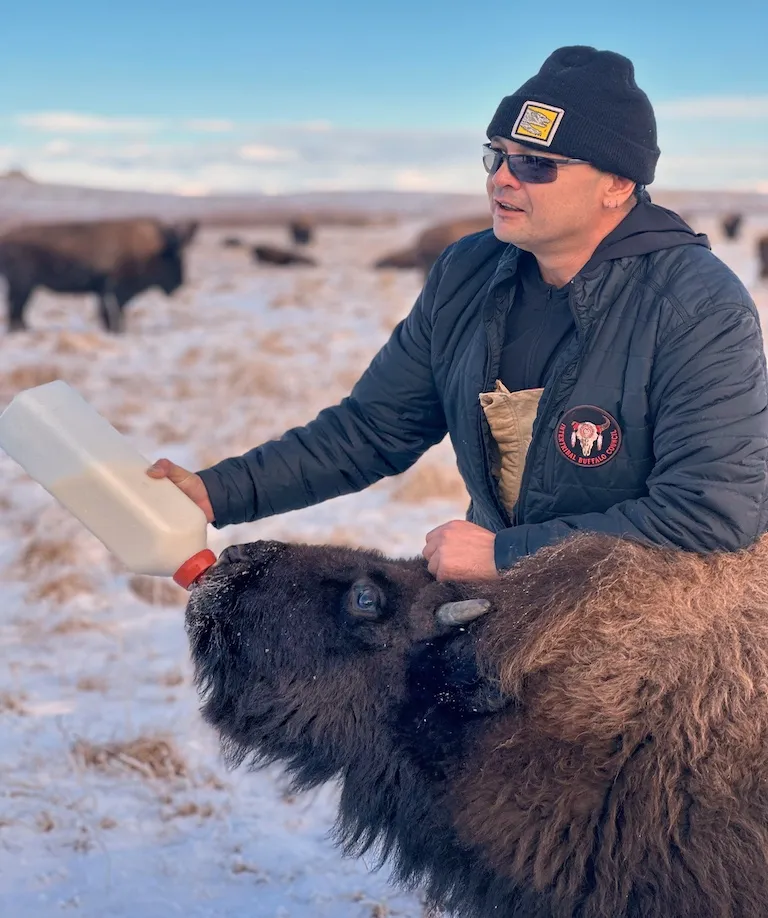
Photos courtesy of Jason Baldes
On the Wind River Reservation in Wyoming, the nearly 300 resident bison are not considered livestock. Neither are they commodities, climate tools, nor charismatic megafauna poised for a splashy comeback.
“They are our relatives,” says Jason Baldes, who calls Wind River, to Eastern Shoshone and Northern Arapaho people, home. Baldes serves as vice president of the InterTribal Buffalo Council (ITBC), a nonprofit coalition of 80+ federally chartered coalition of 89 tribes, whose members coordinate and execute the transfer of surplus bison from federal conservation herds to tribal lands. “To bring buffalo back is to bring back a long-lost family member.”
Across the American West, bison are increasingly celebrated as a nature-based climate solution, and for good reason. The herbivorous ungulates have a proven track record of improving soil health, boosting biodiversity, storing carbon in grasslands, and even creating temporary wet reservoirs in dry landscapes. (The latter is credited to their frequent wallowing; in other words, rolling, wriggling, and bathing in prairies’ dust.)
In an era defined by ever-intensifying drought, fire, and ecological instability, the species’ resilience has captured national attention, morphing the humble bison into something of a darling among ecosystem engineers. For tribal leaders like Baldes, however, bison restoration is about remembering what already worked—and repairing the damage wreaked by colonization, broken treaties, and ecological collapse. From where he sits—both geographically and politically—the recent surge of bison restoration zeal feels overdue.
“It’s good to see momentum,” Baldes, who also serves as founder and executive director of the Wind River Tribal Buffalo Initiative, told Sierra. “But tribes have been working to restore buffalo for over 30 years. This moment is a long time coming.”
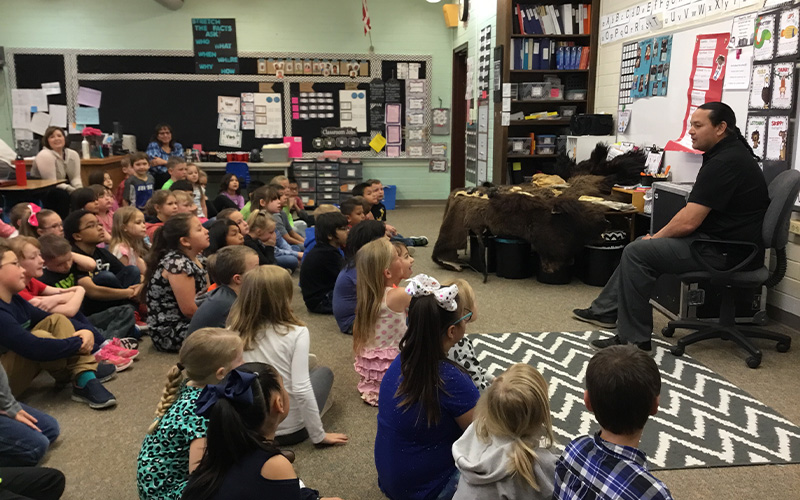
Jason Baldes in the classroom.
“That history isn’t widely understood. And that’s a problem.”
A keystone species—and a cultural one
Prior to the late 19th century, an estimated 90 million bison migrated across North America, forming the largest land-based animal population in recorded history. The species' near-eradication was no accident—the mass slaughter of buffalo was a deliberate strategy to dispossess Indigenous nations, destroy food systems, and force assimilation.
“That history isn’t widely understood,” Baldes told Sierra. “And that’s a problem.”
Today, roughly 400,000 bison exist in North America, but most are privately owned and managed as livestock. Ecologically speaking, Baldes says, the species remains “functionally extinct.” He explains, “Only five conservation herds number more than 1,000 animals—the minimum threshold needed to maintain long-term genetic diversity—and all are confined to limited landscapes.”
The ITBC represents one of the few ways in which the federal government is fulfilling its trust responsibility to tribes: The program is a federally chartered nonprofit, started in 1992, through which surplus bison from federal conservation herds—such as those at Yellowstone, Wind Cave, and Fort Niobrara—are transferred to tribes seeking to restore buffalo on their lands. (As of 2020, ITBC is also working closely with The Nature Conservancy, which manages thousands of bison on its network of preserves. As those herds grow, TNC has, to date, worked with ITBC to transfer nearly 2,200 bison back to Indigenous communities.)
Still, the system is fragile.
“We’re still operating in silos,” says Baldes, who explains that as a Tribal organization supporting member Tribes with federal funds, ITBC has to lobby for federal support anew each year. “Nothing is guaranteed; federal agencies, states, and Tribes aren’t aligned in a way that allows buffalo to exist as wildlife across large landscapes.”
Indigenous-led climate resilience
Reservation land bases were dramatically reduced through allotment and forced sales, and remaining lands were often reshaped by federal policy to prioritize cattle ranching. As a result, many tribes today lack the space and/or resources to manage large buffalo herds.
Compared with cattle, however, bison are more resilient and less destructive to soil. Having evolved on the Great Plains and Intermountain West over millennia—where they had to adapt to temperature extremes, drought, and variable forage—they’re also much better suited to a changing climate. Their dense coats, second only to musk oxen's, allow the animals to withstand severe cold. Their metabolism enables them to survive on lower-quality forage in harsh conditions. Their grazing behavior behooves plant diversity, as the animals favor grasses over wildflowers, thus supporting birds and pollinators. As previously mentioned, their wallows create micro-depressions that capture water and disperse seeds.
“So why wouldn’t we choose the animal that evolved here?” asks Baldes.
Yet many bison restoration efforts still prioritize commercialization—raising bison as premium meat, a healthier alternative to beef—over ecological function. For Baldes and many tribes, that approach misses the point.
“At Wind River, we’ve protected buffalo as wildlife under tribal law,” he said. “That allows us to manage them based on ecology, not economics.”
That distinction matters. Because given the option to manage buffalo as wildlife, tribes open up opportunities to prioritize habitat connectivity, genetic diversity, and long-term resilience rather than short-term profit.
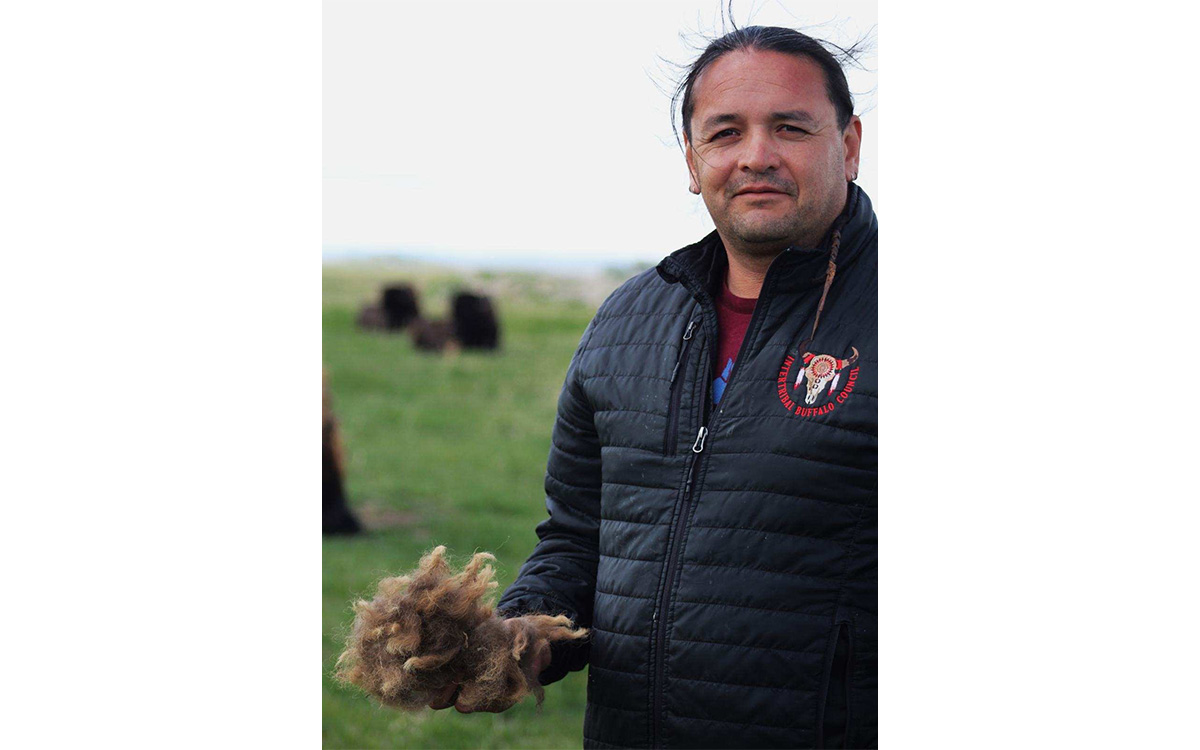
Jason Baldes
Food sovereignty over profit
Ironically, Baldes says, it can be easier to sell buffalo commercially than to distribute it locally. He explains that even when buffalo are present, regulatory barriers often prevent tribes from feeding buffalo meat to their own communities. Food-safety laws preclude traditional Indigenous harvesting practices—which commonly involve field slaughter and ceremonial elements rather than slaughterhouse processing—and very few USDA-inspected slaughter facilities exist on or near tribal lands, making the inclusion of local bison in school lunch menus and community food programs a bureaucratic and expensive road.
“Our communities are impoverished,” Baldes says. “People can’t afford buffalo meat. So selling it doesn’t solve the problem.”
He adds that Native communities experience disproportionately high rates of diet-related diseases, including diabetes—a crisis Baldes says is directly linked to the loss of traditional foods such as bison. Reintroducing buffalo into school lunch programs, elder meals, and community harvests, he ways, represents an act of cultural restoration, as well as a public health intervention. “If we can feed our people buffalo again,” he says, “that’s a success story.”
Youth, sovereignty, and the future
For Baldes, the most important component of bison restoration isn’t the animal itself—it’s the people who will carry the restoration work forward.
“Our next leader is probably sitting in kindergarten right now,” he told Sierra. “If they don’t know who they are—if their language, values, and relationship to the land are gone—then sovereignty doesn’t survive.”
The Wind River Tribal Buffalo Initiative runs youth camps, school programs, and cultural activities that connect young people—Native and non-Native alike—to buffalo, land stewardship, and history. The goal is to cultivate future leaders who understand conservation not through the lens of extraction or management, but as an inherent responsibility.
“That’s governance,” Baldes says. “That’s sovereignty.”
“If we don’t challenge what was done to us, then colonization worked.”
A fragile moment
Under secretarial order from the Biden administration’s Department of the Interior, tribes and federal agencies in 2024 collaborated on a shared stewardship strategy for bison conservation—a long-term vision for restoring buffalo across jurisdictions. The Bison Shared Stewardship Plan, coauthored by tribal leaders and federal officials, was designed to guide conservation over the next 20 to 50 years.
Rather than prescriptive actions, that plan lays out a vision and framework for partnership-driven ecocultural restoration of bison—meaning restoration that honors both ecological function and cultural relationships between Indigenous people and buffalo.
And progress, Baldes says, remains precarious. “At the whim of an administration, all that can be undone.”
For now, he says, the bison working group behind the strategy is keeping a low profile, hoping to preserve hard-won gains. The broader question, Baldes suggests, is whether the United States is willing to follow tribal leadership—and not just celebrate it rhetorically.
“If we don’t challenge what was done to us,” he said, “then colonization worked.”
Restoring buffalo, in this sense, is not about nostalgia. It is climate adaptation rooted in Indigenous knowledge. It is ecological repair paired with cultural survival. And it is a reminder that the future of conservation may depend less on new ideas than on honoring the ones that worked—before they were nearly erased.