Rochester’s Inner Loop Meets Its End
The city looks to revitalize its core by filling in the highway that destroyed it
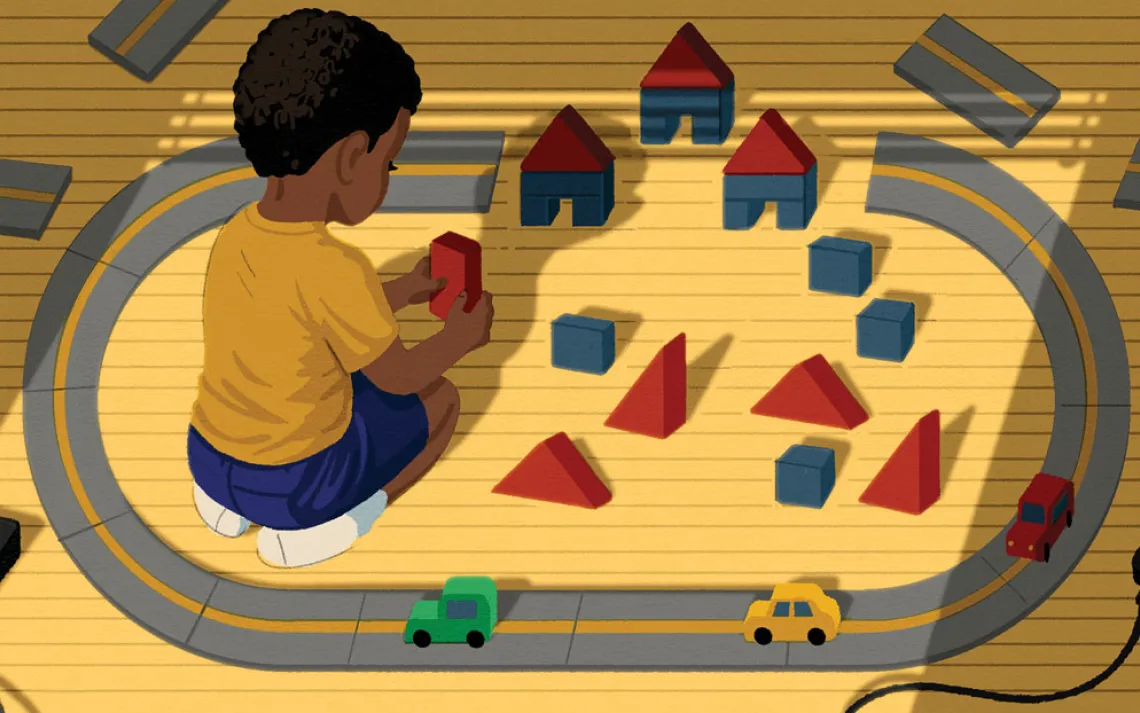
Illustration by Pete Ryan
Martin Pedraza has lived near Rochester, New York’s Inner Loop highway for most of his life. When he was a teenager in the mid-1960s, city leaders celebrated the completion of the thoroughfare near his house as a sign of progress. Pedraza later purchased an American foursquare with cream siding and burgundy shingles in Marketview Heights, just blocks from the highway. His garden provides food for his family and neighbors—one harvest last summer yielded over 200 pounds of produce.
Yet Pedraza’s house stands out in a community upended by the sunken highway. “I remember on Scio Street, where the bridge is, there used to be homes all around there,” he said.
Hundreds of houses, businesses, and churches were bulldozed—and families displaced—to make way for the Inner Loop North. Vacant lots, vast parking lots, and the moat-like asphalt artery replaced shops, trolley tracks, and even the Waverly House, an upscale hotel. The highway lopped off half of Franklin Square, a park designed by Frederick Law Olmsted. Ultimately, the city’s downtown core and Marketview Heights neighborhood—a working-class community of primarily Black and Latino people—were rebuilt for cars.
Now, with federal and state government support, Rochester has an opportunity for a do-over.
In 2020, city officials began looking at how they could fill in the Inner Loop North and replace it with a street grid. The New York State Department of Transportation agreed to provide $123 million for the project in 2022. And in January 2025, the Biden administration kicked in another $100 million as part of the US Department of Transportation’s Reconnecting Communities Pilot Program.
The removal of the Inner Loop North is part of a larger effort that began with the filling in of the Inner Loop East in 2017. Dismantling the whole Inner Loop system, totaling just over two miles, is intended to reinvigorate the downtown area and save millions in highway maintenance costs.
For residents near the highway, the rebuild offers a chance to prioritize pedestrians and, over time, to promote generational wealth through homeownership. “This is a long-awaited opportunity to rectify some historical injustices that have happened, that have fostered inequities,” said Gladys Pedraza-Burgos, who helps lead the community group Marketview Heights Collective Action Project with Pedraza, her brother. “It’ll give us a chance to flourish as a neighborhood.”
The Inner Loop was part of a wave of highways built through low-income neighborhoods and communities of color across the United States in the mid-20th century. While the roadways brought convenience, research has since shown that living near them can increase rates of cancer and asthma. Studies have also found that property values can fall near major roadways, due to added pollution and noise. The highways also eliminated green spaces and acted as physical barriers between communities. These projects were guided by a narrow aim—creating easier access for cars—without considering the residents of neighborhoods that were razed or divided.
In recent years, some cities have tried to right this wrong. Mallory Baches, the president of the Congress for the New Urbanism, a nonprofit that tracks and supports urban-renewal projects, said nearly two dozen cities are planning to remove highways or are already jackhammering pavement. But many are still in the early stages and have not received the level of funding that Rochester has.
Suzanne Mayer and Shawn Dunwoody represent opposite sides of the Inner Loop North. Mayer is white and lives in Grove Place, just south of the highway. With its tree-lined streets, architecturally rich homes, and proximity to arts centers and the Eastman School of Music, Grove Place has been insulated from some of the decline seen elsewhere in the city. Dunwoody is Black and grew up in Marketview Heights. Together, they formed Hinge Neighbors in 2018 to help connect residents on both sides of the highway.
“It was important to us that it wasn’t just agencies or people who represented others, but making sure that the neighbors were able to say, ‘We’re here,’” Mayer said.
In July, that goal was on full display at a community meeting led by Pedraza and Pedraza-Burgos. They celebrated Pedraza’s summer crop yield, then beat cops rattled off crime stats and announced a recruitment program. But the most anticipated speakers were the seven representatives from the City of Rochester.
Residents were worried about what would replace the highway. They fretted about what would be built on residential streets, preferring traditional-style homes over modern boxes. And they wanted to ensure that investors wouldn’t buy up lots and inflate housing costs.
David Riley, the city’s principal transportation specialist, was one of the first to address the crowd. He said his team is focusing on infrastructure planning, including street widths, intersection connections, and bike lane placement. “We want to make sure development is in the context of the neighborhoods around it, that it fits the surrounding neighborhoods, that it reflects the input that we’ve been getting during the public outreach process,” he said.
Erik Frisch, Rochester’s deputy commissioner of neighborhood and business development, told the crowd that while the city can’t dictate what contractors build, it can factor in residents’ preferences by setting parameters for developers. In the fall, his team completed a land-use planning framework that will help the city map out the mix of green spaces, commercial real estate, and residential buildings. Renderings of early concepts show commercial buildings along busier main roads and residential buildings lining smaller streets. An eight-acre green space will be included behind a school, and a 40-acre state park will hug the Genesee River, offering prime views of the waterfalls.
While many residents of Marketview Heights favor single-family homes to revive the community feel, some organizers are advocating for mixed-use multiunit buildings. Two areas that could handle this kind of density are High Falls, next to the city’s baseball stadium, and Upper Falls, home to Rochester’s historic post office and Amtrak station, where the city is planning a revamped transportation hub.
Among the proponents of multi-use development is Cody Donahue, the co-executive director of Reconnect Rochester, a nonprofit that advocates for increased public transportation. “We like to see a lot of active uses on the ground floor so that there’s street life and people are going in and out of cafes, cafe seating at restaurants, limited parking lots,” Donahue said.
If all goes as planned, Riley expects the city to break ground in early 2028.
Walking through Marketview Heights weeks after the meeting, Dunwoody contemplated what the redevelopment would mean for his community. He welcomes the prospect of fewer cars and more people. More than anything, he hopes it will improve the quality of life for current residents. “I could see it . . . connecting neighborhoods and bringing vitality back to downtown and to the neighborhood itself because now you’ve got a flow—more people living there, which will create more retail, which creates more businesses, which creates entrepreneurship,” Dunwoody said. “To bring that back to the city would be completing the loop of what a city is all about.”
Editor's note: This feature was produced in collaboration with and support from the Wake Forest University Environmental and Epistemic Justice Initiative.