 The Magazine of The Sierra Club
An Ambitious Plan for Sea Level Rise Keeps Stalling. Can It Get to Higher Ground?
Managed retreat awaits funding and support in Warren, Rhode Island
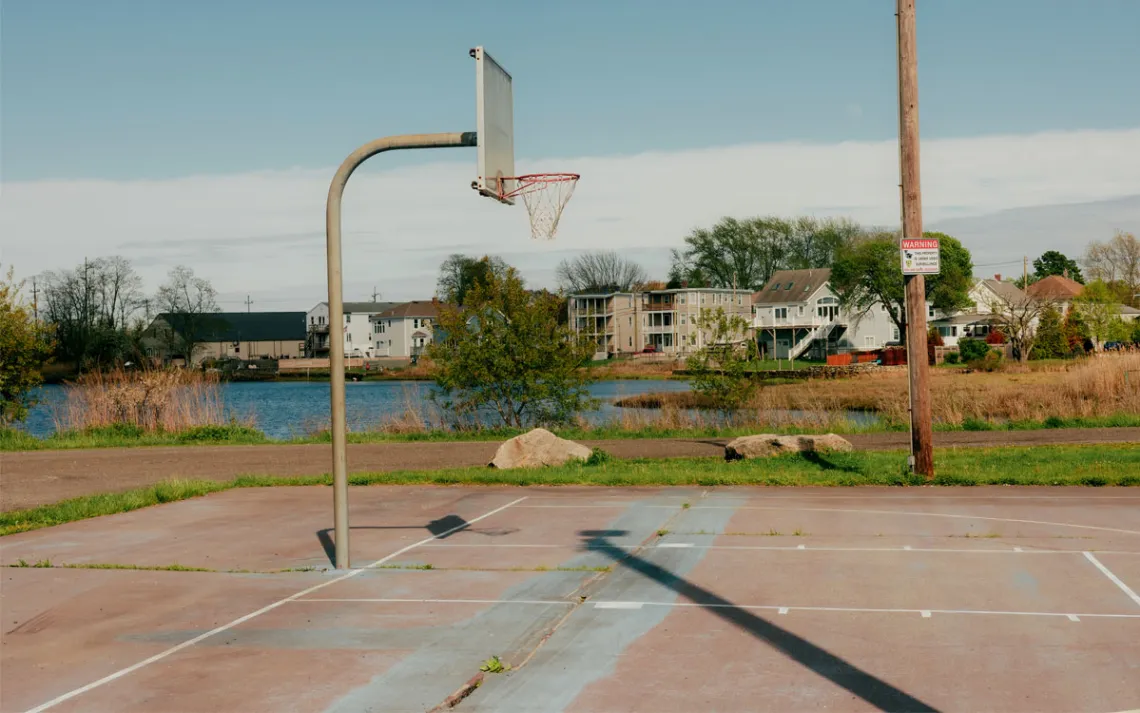
I met Bob Rulli on a cold, rainy morning at Jamiel Park in Warren, Rhode Island. Wearing a yellow raincoat and duck boots, he walked me around “ground zero” for the town’s flooding problems.
The park’s baseball fields and basketball courts abut Belcher Cove; its marshy shoreline blends in with the grassy yards behind a string of houses. During major storms and king tides, those yards become “an infinity pool,” Rulli said. The road that runs through the park often ends up completely underwater. And Market Street, adjacent to the park, floods out at least once a month. “This is a ticking time bomb,” he said. “People are going to be displaced. Where are they going to go?”
According to the Federal Emergency Management Agency and the National Oceanic and Atmospheric Administration, this whole area will be under at least three inches of water within 45 years. In 75 years, Jamiel Park could be under a foot of water. And that’s on normal days. If a 100-year storm were to hit Warren today, seawater and stormwater would quickly flood most of the town, costing it nearly $9 million. As the planet warms—driven largely by human activity in the form of burning fossil fuels, deforestation, and industrial agriculture—rising seas are slowly coming for coastal communities like Warren.
While he was Warren’s town planner from 2017 to 2023, Rulli took on the challenge. He was the brains behind an ambitious proposal called Market to Metacom, a form of managed retreat—the planned relocation of buildings and communities at risk from sea level rise. If the project were implemented, the town would buy out the homes and businesses lining Market Street in phases, beginning with those most at risk, and eventually empty and demolish all 400 structures in the flood zone. The land would then be returned to its natural state to support ecosystems while protecting the rest of the community from flooding.

Homes and businesses along Belcher Cove in Warren, Rhode Island, face increased flooding.
The plan also calls for developing new affordable housing on higher ground along Metacom Avenue to the south, currently dominated by nondescript strip malls, and offering those units to displaced residents. “Probably the two most difficult topics to talk about in this environment right now are climate change and housing,” said Rulli. It’s what makes Market to Metacom different: Few, if any, managed retreat plans have tried to tackle both issues at once.
Experts on managed retreat give the idea high marks. But it’s still only a plan on paper. Market to Metacom is stalled for a lack of money and leadership. Many residents feel they haven’t been properly consulted, and many have grown restless, whether from impatience or outright opposition.
Mario Canario has lived on Market Street his entire life and grew up in a two-story house on Belcher Cove. His father, a Portuguese immigrant who was used to living by the ocean, built the house on a concrete foundation and constructed a stone wall facing the water. Once Canario had money of his own, he purchased a house directly next door to his father’s.
For a longtime coastal resident like Canario, there is no question that seas are rising. He has a front-row seat to a changing climate. Photos on his phone capture scenes from around his neighborhood at different times of day, each telling a version of the same story: flooding. In one image, a patch of lush grass in his backyard is indistinguishable from seawater, which, during king tides and big storms, flows right up to the bottom step of his deck. In the photo, only the fence around his concrete patio and the pole holding an American flag poke above it. Even on sunny days, the water comes inches away from his yard. Canario’s family never dealt with this kind of flooding when he was growing up.
If Warren takes no action, studies show, the town will lose 57 housing units to the tides, displacing 86 people, within the next decade at a cost of about $8 million. Market Street, one of three evacuation routes out of Warren, will begin to flood daily. Child Street, one of the other evacuation routes, will follow suit. By 2050, 121 units will disappear. By 2100, most of the buildings along the Market Street corridor will be damaged and the cost will balloon to $85.8 million. More than 800 residents will be left adrift.
The town stands to lose tax revenue if nothing is done. There are 700 homes and 30 businesses in the area, including a few restaurants, an auto body shop, and a dry cleaner. Few of them are elevated; most have basements. Many have been in the same family for generations and are not covered by flood insurance. The premiums are simply unaffordable.
It’s also far more expensive to pay for emergency services for flooded buildings than to implement a strategic, proactive plan that progressively relocates those buildings and their residents to higher ground. Flooded buildings mean dealing with mold and chemical leaks at a time when contractor costs for emergency services are climbing.
Canario hasn’t been waiting for the city to act. He built shelves in his basement so that nothing sits on the ground, and he raised his washer and dryer a foot off the floor. He moved his furnace and electrical system into first-floor closets and installed both a sump pump to get water out quickly and a water alarm that notifies him if there’s a flood. He plans to buy a camera that will face his yard so that he can check remotely if water is encroaching on his property.
These are what he calls “pregame” modifications to prepare for a changing climate. They aren’t cheap. “Pregame costs money. Not everybody has that extra buck,” Canario said.
Canario is a couple of years away from retirement. He’s not sure if he wants to stay in his house or leave for higher ground. He already had to sell his childhood home, his father’s “castle,” because the flood insurance got too expensive. “I think of my kids,” he said. “Do I leave them a house that’s going to be taken away?”
Under Market to Metacom, at-risk residents would be offered voluntary buyouts in phases over 50 to 70 years, with the goal of purchasing 383 properties by 2100. The estimated cost for the buyouts is $138 million. Most streets and utility infrastructure would also eventually be removed, not just the housing structures. This approach would, in theory, prevent “checkerboarding,” when some people leave and some stay, making it harder to provide services to those who remain. After the buyouts, the land would be converted to wetlands, allowing it to absorb water and help protect the higher parts of the town.
Meanwhile, the displaced residents would need a community to receive them. On Metacom Avenue—a four-lane highway—an Ocean State Job Lot discount store sits at the back of a massive parking lot with significant redevelopment potential. Part of Rulli’s plan involves changing the zoning of that area so development is guided by building use and neighborhood character rather than constrained by residential or commercial classifications.
The plan aims to boost density and affordability while also creating a desirable neighborhood to live in. Architecture firm Union Studio Architecture & Community Design drew up renderings that envision a new performing arts center on the Job Lot parcel, with open public spaces alongside multistory mixed-use buildings. The community would be walkable and include better stormwater infrastructure and a safer road design.
Kate Michaud, who was Warren’s town manager when Market to Metacom was conceived, worked with Rulli on the concept of pairing flood response with the redevelopment of Metacom Avenue. The town, their thinking went, would recoup some of the money spent on buyouts through higher tax revenue; a redeveloped Metacom Avenue could generate an extra $1.2 million a year. “We were really thinking, ‘What makes Warren a wonderful place?’ ” Michaud said. The aim was to hold on to that. “We didn’t even want to talk about taking something away without adding something that could help to mitigate the social impacts.”
Rulli and Michaud searched the country for models of how towns were responding to sea level rise—other places that had bought residents out of dangerous areas and offered them a new place to live. There were few examples. They realized that their plan was unique.
A.R. Siders, co-director of the Climate Change Science and Policy Hub at the University of Delaware, said that in convincing people to move out of a flood-prone area, there are “push and pull factors.” The Market Street buyout is the push; redeveloping Metacom Avenue is, potentially, the pull: “You can push people out—say, ‘Don’t live here.’ You can also pull people out—say, ‘Hey, this new place has an amazing walkable neighborhood. It has a cool park.’ ”
To help fund the buyout program, Rulli applied for a grant from the Environmental Protection Agency’s Southeast New England Program in early 2020. SNEP loved the proposal, seeing it as something that, if successful, could be replicated in other places, and awarded the project $90,000. The grant money helped turn an idea into an actual plan.
But the scope and ambition of the project have proved challenging to implement, as has the process of getting residents to buy in. A botched rollout didn’t help.
Soliciting community input from the get-go is crucial to the success of a major climate-adaptation plan like Market to Metacom. That’s not what happened in Warren. Rulli publicly launched the plan in February 2020, just as community-engagement events moved to Zoom after Covid hit. Rulli admitted outreach efforts were “anemic.” Residents who were later surveyed said they felt left out. Many complained that they learned about how Market to Metacom was developing only from news reports.
Others have simply rejected the plan. Steven Pimentel owns an auto repair shop directly across from Jamiel Park. “I’m totally against [Market to Metacom]. I’m not going anywhere,” he said. He believes the plan is cover for an effort to force people out of their homes via eminent domain.
Even those sympathetic to the plan have their doubts. In November 2024, at one of Warren’s monthly Health Equity Zone meetings for people concerned about climate change, multiple attendees told me that Market to Metacom wasn’t popular. They were worried about the current effects of climate change: What does the plan have to offer them if it has a 50-year horizon? What about fixing roads that have been eaten away by floods and fortifying against the tides with seawalls now? What about renters, who make up about 40 percent of Warren residents? What happens to them if their landlords take buyouts?
Louis Rego, a Warren Town Council member, said at the meeting that he was “very concerned” about Market to Metacom. The waterfront area is already flooding, he noted. Grants haven’t come through. He addressed the room with a rhetorical question to which no one had the answer: “What is option B?”
Last year, the University of Rhode Island began partnering with Warren and two other low-lying communities—one near Dover, Delaware, and another on Edisto Island, South Carolina—on their plans for sea level rise. The university team plans to offer Warren leaders tools for generating more community engagement. It will also survey residents to find out what flood-mitigation strategies they prefer and what they’re willing to pay for.
The idea is to give each community concrete tools to guide its decisions on how to deal with a changing climate. What Warren residents have already made clear, said Emi Uchida, chair of the university’s Environmental and Natural Resource Economics Department and the principal investigator for the project, is that they “do not want another study of a study.”
Ideally, the University of Rhode Island project will keep the issue of flooding top of mind for Warren residents while Market to Metacom is on hold.
Rulli and Michaud had hoped that Market to Metacom would attract more funding. That hasn’t panned out yet. Warren did receive a $155,000 state grant to analyze existing infrastructure around Metacom Avenue. But it failed to secure an $18 million grant from the National Oceanic and Atmospheric Administration, which would have allowed town leaders to start setting up the buyouts for Market Street. Nor did it get a grant from the Department of Agriculture to address storm and tidal flooding.
If Warren leaders wanted to move forward, they could rezone Metacom to spur private development or set up the bones of a buyout program. But there’s currently a leadership vacuum: The town has gone without a town planner since late 2024.
Market to Metacom will require residents and their leaders to act collectively and plan for the future. Whether they will, especially before the next major storm strikes, is unclear. Politicians aren’t typically rewarded for plans that don’t come to fruition until years or decades after they’re in office.
Still, Market to Metacom has inspired other plans like it. Michaud has received calls from town planners and officials from outside Rhode Island. “The smallest town in the smallest county in the smallest state,” she said, “and people are reaching out to us to find out what we are doing.”