 The Magazine of The Sierra Club
Building Community Out in the Open
This nonprofit is helping strengthen rural queer communities in Vermont and Maine
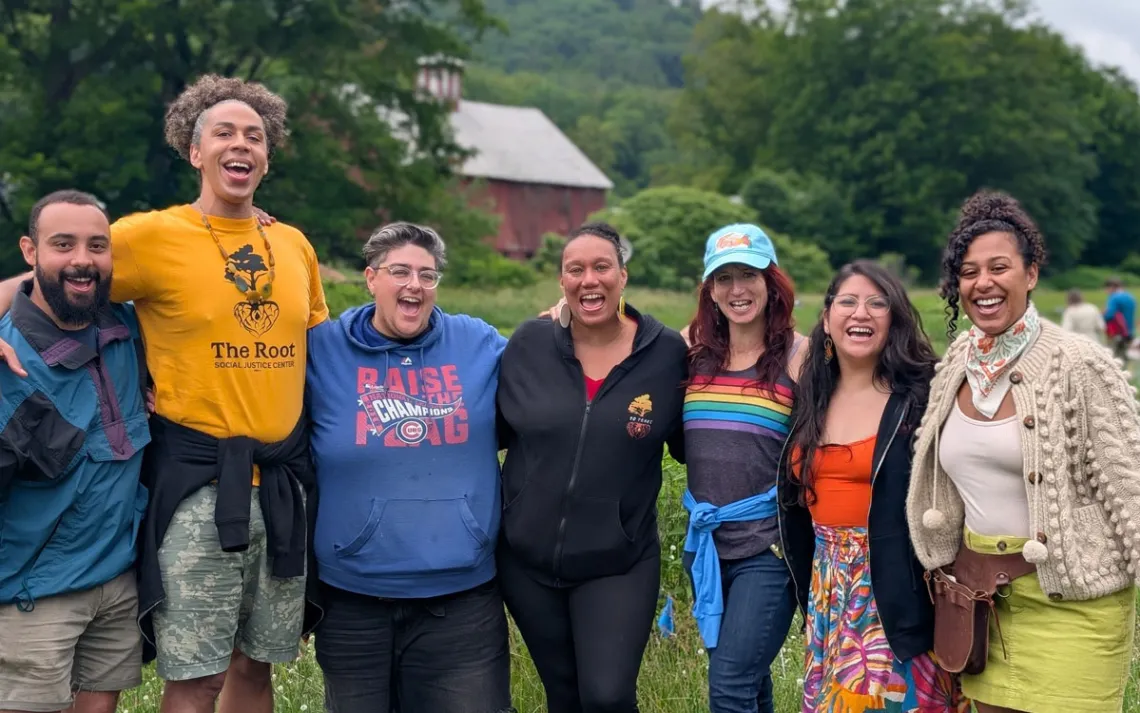
Pride Family Potluck 2025. | Photo courtesy of Out in the Open, The Root Social Justice Center, and Susu CommUNITY Farm in Vermont
HB Lozito grew up in the woods in central Maine, a place where they made friends with pine trees and critters around them. Their childhood left them in awe of the natural world and served as a compass later in life. After attending college and living in major cities along the West Coast, Lozito, who is queer, returned to Maine, seeking solace and nostalgia in nature. They were met with comfort and familiarity, but it was also disorienting.
They remembered their connection to the outdoors, “the calm and peacefulness and spark of curiosity that connection with the natural world helps create.” But living in a rural area brought a distinct challenge. “I still wanted and needed queer and trans community around me,” they said, and they weren’t sure how to get it.
Then Lozito learned about a fledgling organization called Green Mountain Crossroads, which was created in 2012 in response to funding cuts to rural AIDS and HIV programs. They eventually became the executive director and helped shepherd it to what it is today, an organization called Out in the Open that serves as a hub for the queer community in Vermont and Maine. Over the past year, staff with the organization have supported more than 500 individuals with LGBTQ-related questions through one-to-one text support, emails, and phone calls. They assisted 50 trans people with updating documents to the appropriate gender. And they hosted rural skills workshops, nature-based summits, potlucks, and more.
Rural queer people are “a fact of existence,” said Grace Johnston-Fennell, a Mainer who works as a program director for Out in the Open. “We've existed publicly, privately, for the history of humankind.” These folks don’t want to choose between the healing balm of nature and living their full queer lives. They want both. Numerous studies find that time spent in nature has myriad health benefits, and practitioners from Folx, a LGBTQ health company, say that it has “profound mental health benefits for LGBTQ people.” In a 2025 applied sociological study of queer Southerners during the Covid pandemic, the authors found that turning to nature as a place to engage in physical movement and to stay connected to people was “medicine for the soul.”
Still, cities are, by many measures, more welcoming to queer people—more likely to have explicit nondiscrimination legal protections as well as gathering spaces like LGBTQ community centers and gay bars. But the authors of a 2019 report by Movement Advancement Project pointed out that while societal stereotypes and pop culture portrayals of queer people suggest that they live solely in urban settings, the numbers tell a different story. According to the 2019 report, between 2.9 and 3.8 million LGBTQ people live in rural America. That’s between 3 percent and 5 percent of the country’s rural population, consistent with estimates for the percentage of the total US adult population that identifies as LGBTQ. Queer people can live fulfilling lives close to nature, they just face certain challenges: social isolation, fewer services, and less protection from the law.
Out in the Open is making the nature connection more accessible by eliminating many of these barriers. The organization’s programs provide ways for people to gather as themselves and live their rural lives fully—whether through nature-themed drag shows, butchery classes, natural dye workshops, sharing a meal in the woods, or learning rural survival skills. Johnston-Fennell said that Out in the Open prioritizes accessibility by providing food at events when possible, knowing that queer and trans people are more likely to be unhoused or experience poverty than the population at large.
Elizabeth Sekera found their way to Out in the Open in a similar way to Lozito. They grew up in Maine and spent much of their adult life in Oakland, California. When they moved back to Bangor with their family, they relished the access to nature. But being queer, it wasn’t so simple.
“It is both healing … to have such immediate access to rivers and mountains, but it's also been incredibly isolating.” Sekera, who learned about Out in the Open from a friend, said, “One reason why I really love Out in the Open is it's like finding those radical queers in the woods. It really feels like home in that way.”
Sekera attended an Out in the Open writing retreat on the coast of Maine, which included optional polar plunges and outings for hikes. They were struck by the natural beauty, and also the impact that the space had on other participants.
“There were a lot of young … trans or gender queer folks, where that was their first time experiencing that type of safe space and that type of community … It's just something in rural environments that I think is really lacking.”
Out in the Open staff understand that there are mixed experiences around safety for queer people in rural areas. Johnston-Fennell lives in a town of 900 people, and when she started inquiring about public spaces for Out in the Open programming, she was unsure of the responses she would get. But she said there was almost always an opening for connection. Someone would say to her, “Oh my gosh, my daughter is gay, and she's a teacher in the next town over.”
“The positive stories that our work has brought forth when I've done outreach have given me a sense of safety and security,” Johnston-Fennell said. “And I feel like I'm able to bring that into our work.”
One Out in the Open event called Stop the Bleed was a practical skills share for treating gunshot wounds during hunting season. Johnston-Fennell said that these kinds of rural living skills should be accessible to all, and if queer people know they’ll be in an accepting environment, they’re more likely to go.
In 2024, Out in the Open purchased a three-acre piece of land in the woods and built an open-air, timber frame structure. With this plot of land, Lozito, Sekera, and Johnston-Fennell all have access to nature every day, even if simply a night sky without light pollution, or a view of the trees.
“That's the pace of the world outside my window right now,” said Johnston-Fennell, referring to the openness and the trees. “And how soothing that is to my nervous system.”