 The Magazine of The Sierra Club
Zen and the Art of Canoeing With the Kids
Reflections on a summer paddle adventure
Lyndell was trying to tell us about her dream from the night before but could barely get the story out. She was giggling too hard.
Her sister, Hazel, finally had enough. “I’m going to swim five times today!” she declared.
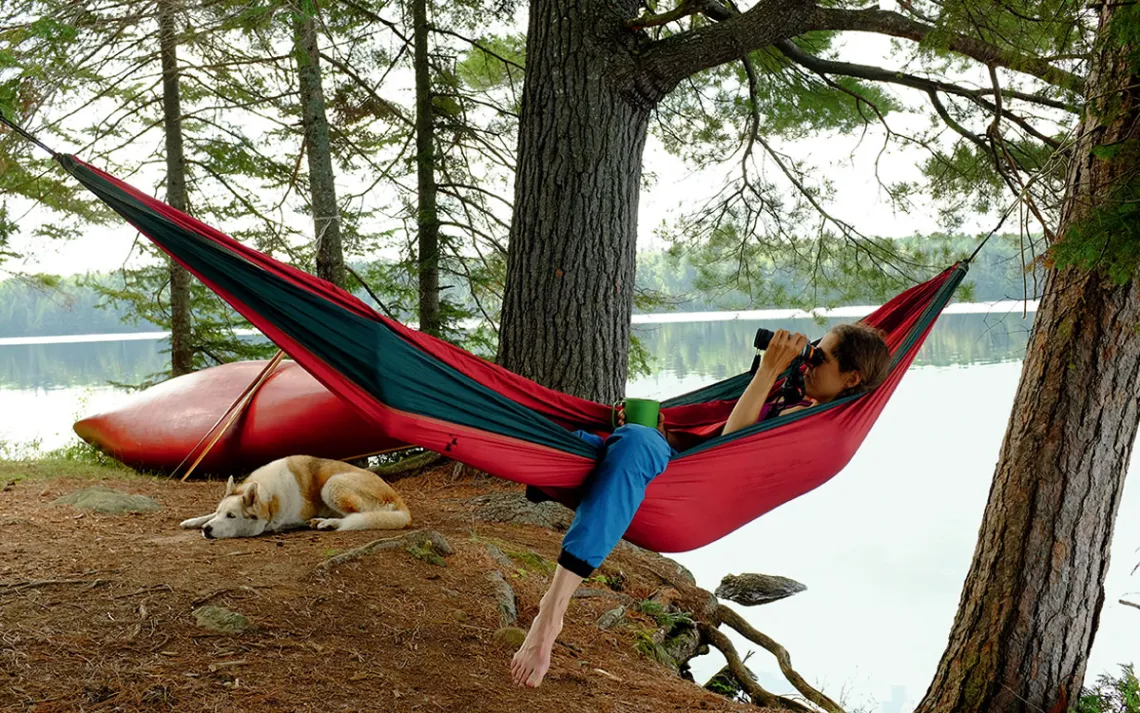
We were in Algonquin Provincial Park in Ontario—one of Canada’s most popular outdoor destinations—and it was a perfect morning. Sunlight filtered through tall pine trees, and it shimmered like diamonds on a band of mist hovering over Burnt Island Lake. A loon’s wail echoed across the water. I felt the cool air on my cheeks as Lyndell and Hazel descended on a breakfast of champions: mountains of dried fruit and chocolate atop a few tablespoons of oatmeal.
This was day four of a summer canoe trip with my partner Kate’s whole family. For them, trips like this were a tradition. Growing up, Kate spent summers in the backcountry, paddling across deep blue lakes and camping within emerald forests. Now her two nieces, six-year-old Lyndell and nine-year-old Hazel, were doing the same.
As the sun continued to rise, we gathered in a circle around a small cooking fire. Earlier, Hazel had helped set it up in the proper way. She had placed a ring of stones as a protective base, then assembled dry kindling into a cone shape. Now she carefully fed small twigs into the flames. A pail of coffee was brought to a boil and then passed around. Kate poured a cup and then handed the pail to her sister, Colleen, who in turn passed it to her partner, Amanda. After the coffee got to Kate’s parents, they offered it to me. I gladly accepted it with both hands.
The morning chores were ahead of us: smothering the fire, cleaning up the dishes, packing up our tents, and moving our canoes to the next campsite. But the kids were focused on one thing—the Gorp Store.
When I was a kid, I used to spend summers with my grandparents at their home on Lake Superior. Swimming and sailing were my favorite things to do, aside from running through the forest and riding my bike. Outside, I could play, dream, go on adventures.
Even at an early age, I had a sense that the wilderness was something special. It seemed endless—far greater than any place I could possibly imagine. But it wasn’t until I was a teenager that I went on my first canoe trip.
Even at an early age, I had a sense that the wilderness was something special. It seemed endless—far greater than any place I could possibly imagine.
My parents weren’t big on camping. Because of that, I discovered outdoor activities like mountain biking and canoeing on my own. I taught myself to paddle. At first, I was a little afraid to go out on the water alone, but over time I got more confident. Eventually, my love of nature became everything to me, and I decided to study conservation in college. Then I built a career guiding wilderness trips, teaching, and writing about the outdoors.
Kate, on the other hand, was raised on outdoor adventures and all the activities that went with them. Her family would paddle together in a honey-colored wooden canoe that her parents made themselves. These outings brought Kate and Colleen closer together as sisters. They learned skills like how to read a map and make a fire, and they became expert paddlers. These experiences inspired them to take on leadership roles when they were teenagers. The sisters guided canoe trips at summer camps. When they were a bit older, they worked for an organization that helped city kids get outdoors.
Now Lyndell and Hazel were growing up in nature too—but with their own unique flare. Once they had helped pack up their sleeping bags and poured water on the campfire, making sure the fire was fully out, it was their turn to be in charge.
“Gorp Store!” they called out, jumping up and down.
We heeded this unusual call of the wild by joining them to look at the store’s offerings.
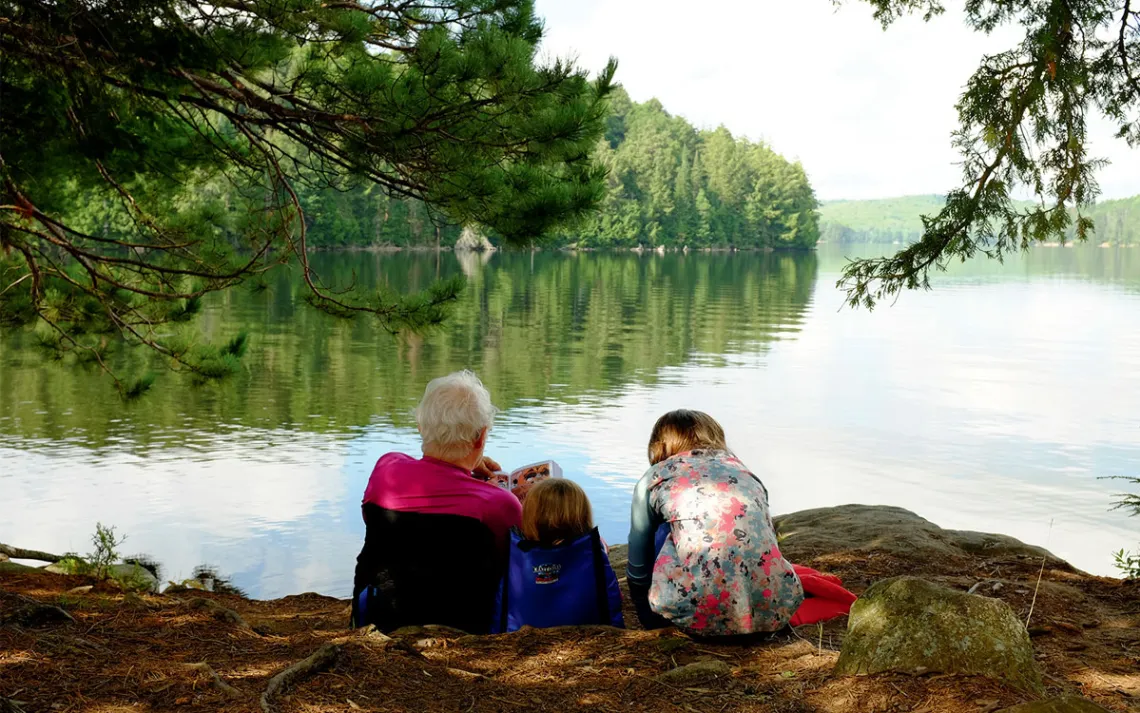
Lyndell and Hazel liked to kick off our daily journeys by preparing snacks for the group. Gorp—short for “good old raisins and peanuts”—is another name for trail mix. They would fill small bowls with heaping handfuls of nuts, dried fruits, chocolates, and other treats, then set them on a log or a few rocks. The adults would survey the bounty and make their selections, paying with a high five. I gravitated toward the chocolate-covered raisins.
As a grown-up, I wasn’t used to joy on repeat being the point of a trip like this. When I’m guiding tours for other people, I still enjoy getting outdoors—camping amid birdsong or floating out on bubbling water—but I often get caught up in the bustle of getting from place to place. Watching Lyndell and Hazel’s excitement over their piles of gorp reminded me that some trips can be pure fun.
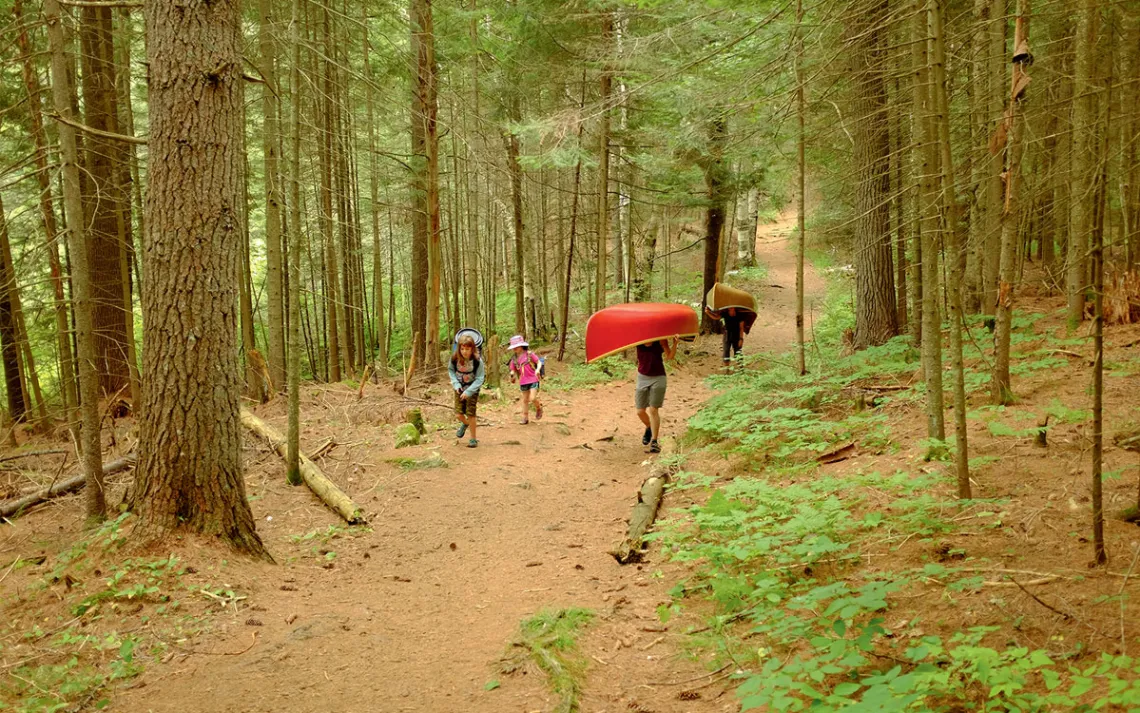
We worked to make sure we left no trace at the campsite, then set off for our first portage of the day—carrying our canoes over land to the next body of water. The adults hoisted boats onto the tops of their heads. Lyndell slung on a backpack, and Hazel grabbed a waterproof food barrel. All of us did our part to carry the collective load.
We reached the next lakeshore, positioned the canoes on the shimmering water, and took off.
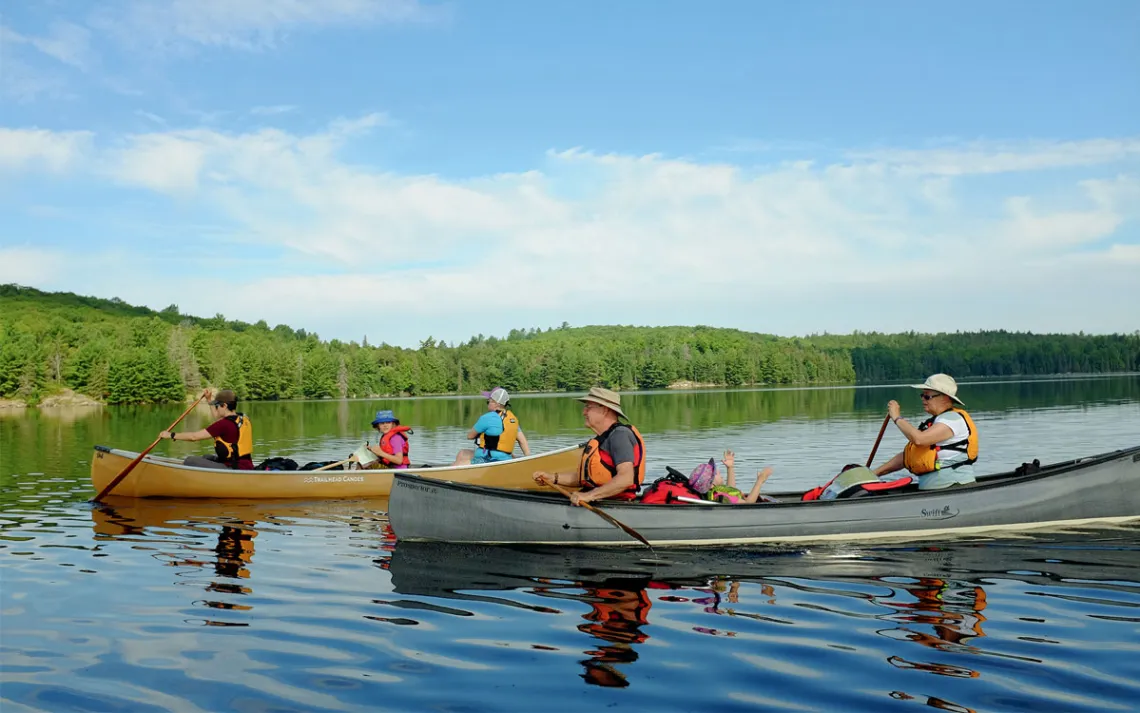
Wispy evergreens and puffy clouds reflected on the surface. It felt like we were flying across the lake. Lyndell and Hazel, in a canoe with their grandparents, dipped paddles in sync with the adults. Lyndell, ever the chatterbox, told a story with pine cones as the main characters.
Kate watched the kids paddle and marveled at how expert they had become. Each year, with every canoe trip, she said, her nieces seemed ready for new challenges: longer trips, deeper in the backcountry, with more paddling and portaging. Soon, she said with confidence, they would be ready to paddle their own canoe.
Later that afternoon, I helped Hazel reach her goal of a fifth swim when we both plunged into deep water off shoreline rocks. I held my breath, opened my eyes underwater, and saw her wriggling around like a porpoise. Hazel laughed when I told her that in my next life, I hope to be a loon.
We were all ready for the challenge of another portage when we reached the far shore. When Kate shouldered her canoe, it looked like she was putting on a giant red hat. Hazel and Lyndell carried their paddles. We followed a path of orange pine needles up and down hills, weaving through the woods.
Finally, the next lake on our journey appeared through the trees. “Look!” Lyndell shouted from beneath her brimmed hat. “We made it!”