4 Must-Read Books for Winter
These stories invite us to see a world in crisis—and our role in it—differently
Photo by avlntn/iStock
At a time when division and polarization define our culture and politics, and climate shocks continue to upend lives, how can we chart a path toward a more compassionate, more sustainable, more partnership-oriented future that serves all life on this planet? Collectively, these four books invite us to begin walking that path by seeing the world differently. In doing so, they suggest, we can take up the blank sheet of history for ourselves and begin filling it with something new.
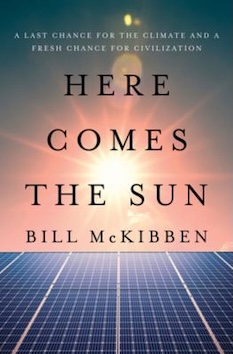
Here Comes the Sun: A Last Chance For the Climate and a Fresh Chance For Civilization by Bill McKibben
Norton, 2025
You’d be forgiven for thinking that renewable energy is on the ropes. In the last few months, the Trump administration has canceled at least a dozen offshore wind projects, scuttled the Solar for All program, and rescinded billions in promised renewable energy funds (despite touting an all-of-the-above energy approach).
Veteran environmentalist Bill McKibben offers readers a different perspective—and reason for hope. In his new book, Here’s Comes the Sun, McKibben makes the case that energy from the sun and wind is booming, whether the federal government is on board or not. Using vignettes from his four decades of activism and anecdotes from a coterie of journalists, researchers, and renewable energy aficionados, McKibben exposes readers to rays of hope from across the globe.
Solar made up half of all new energy produced in 2024. Electric cars are selling at an unprecedented rate, with over half of new vehicle sales in China being cars with plugs. In Europe, Germans are slinging solar panels over balconies. France is installing solar canopies over parking lots.
Even in the petro-loving United States, good news abounds. “In the US, 80 percent of new generating capacity in 2024 came from solar panels and batteries, and most of the rest from wind,” McKibben reports. Toyota is building a battery factory in North Carolina. The largest solar panel manufacturing facility in the Western Hemisphere was built in Georgia. And Oregon recently approved one of the largest solar farms in the country (10,000 acres).
McKibben also swiftly puts to bed fears about range anxiety and reliability. The average electric vehicle can now go more than 300 miles on a single charge, and some manufacturers have decreased charge times down to five minutes. Meanwhile, battery packs, the foundation of any electrified future, ensure that energy from solar and wind continues well beyond when the sun fades or wind fails to blow.
It will be hard, particularly with well-funded opposition, to wean Americans off fossil fuels, McKibben admits. Gas lobbyists, enriched by the profits of long-dead dinosaurs, are waging campaigns to beat back renewables in every town, municipality, and state. But there is reason for clean energy optimism. To render gas usable, companies must find the oil, transport it, refine it, and then ship it to gas stations. Solar, on the other hand, can be converted into energy at its source by simply plugging in.
The reality, made clear in Here Comes the Sun, is that solar and wind produce energy with less pollution, labor, and costs than any oil or gas product. Ultimately, even without the moral obligation to rein in disaster-causing greenhouse gas emissions, the economics make renewable energy far superior to fossil fuels. “Once you’ve built the equipment … then the sun and the wind deliver the energy for free.”
With McKibben's breezy prose, readers will find an uplifting read that can brighten even the gloomiest of spirits. “Our job is to flood the world as fast as possible with electrons from the sun and wind, confident that the very availability of clean, cheap power in bulk will drive the rest.” —Lindsey Botts
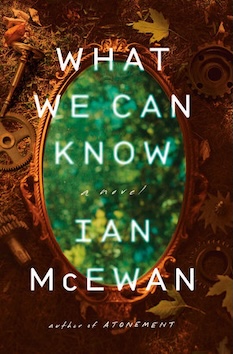
What We Can Know by Ian McEwan
Knopf, 2025
Practically nothing about Ian McEwan’s What We Can Know is what you would expect it to be. The story’s lackadaisical, buttoned-up opening, with its dozy tone and tidy observations about this or that activity or minor inconvenience, is a perfect example.
We open on “warm and tranquil” waters as the scholar Thomas Metcalfe takes an overnight ferry to the Bodleian Snowdonia Library, noting matter-of-factly that sleeping upright on a bench is an ordeal. Once there, he finds his carrel, peruses the stacks, and continues his search for the missing text of what he believes to be one of the greatest poems ever crafted: “A Corona for Vivien,” written by environmental poet Francis Blundy and recited only once at a mysterious dinner party in 2014. The stakes of this story seem anodyne at first blush. But McEwan—author of the classics Atonement, Amsterdam, Saturday, and Nutshell and a master of the macabre, of potent drama that slow-cooks and slow-burns, of building tension and layering it, wave after wave, casually and relentlessly until the bursting point—is just getting started. It turns out there’s nothing “warm and tranquil” at all about the world of this story, or its stakes for us all.
It's the year 2119, and what McEwan refers to as “the empty tranquility of their lives” has been broken since 2016. During that period of 100-plus years, the planet undergoes waves of catastrophic climate change so severe that rising seas have consumed whole swaths of the United Kingdom, turning it into an archipelago, and the United States has been nearly decimated. National leaders briefly consider “climate opportunity” along the way, but they are quickly disabused of the notion. There are more blows to come—more climate shocks and the first “climate war” of 2036. Then, “The long-delayed Third Sino-American War broke out as the inevitable overspill of the Pacific chaos” and “many famous cities were turned to ashes.” Between the time Blundy reads his famous poem in 2014 at a dinner party and 2119, when our present-day scholar Metcalfe is dedicating everything to find it, a full half of the global population has been eviscerated. “But still, in our calmer or moribund, twenty-second century, ‘A Corona for Vivien’ remains precious for those who care, a talisman to the survivors and a promise of a better future.”
As Metcalfe hunts for the poem, occasionally eating protein cake because little else in the way of food exists in this dystopian world, a fling turns into romance and then into betrayal; students stage protests not for the better world that once was, and is about to be totally lost, but for the right to forget one existed in the first place (“We want to talk about now, what we actually have, not what we don’t have, what we can hope for…”); kidnappings, murder, even a thrilling turn toward a hunt for buried treasure, all make this novel a baffling, breathless read.
The quiet genius of McEwan's masterpiece lies in a plot that is as unexpected as you can possibly imagine: Climate dystopia and “empty tranquility” meet in the search for a lost poem, and one scholar’s determination to find it in spite of “The Derangement” of all that is. That search, what it stands for, and where it ultimately leads, could not be a more powerful metaphor for the times in which we are living, and what may soon come to pass should we not change course. As McEwan writes, “A poem has served history well by remaining a blank sheet.” —Jonathan Hahn
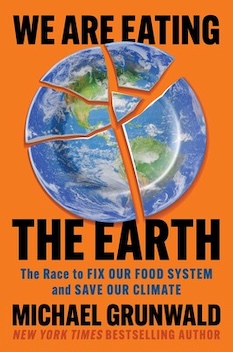
We Are Eating the Earth: The Race to Fix Our Food System and Save Our Climate by Michael Grunwald
Simon & Schuster, 2025
We Are Eating the Earth begins with a measure of good news: Though we haven’t yet managed to lower global greenhouse gas emissions from burning fossil fuels, we basically know what to do—generate renewable energy and electrify everything. Then comes the bad news: We still don’t have a good handle on how to eliminate the remaining one-fourth of emissions produced by agriculture, and most of the solutions we’ve tried so far are bad ones.
Take biofuels. When US corn is used for energy, land elsewhere must be cleared of its carbon-storing vegetation to grow more food. It’s an example of indirect land use change, a key driver of tropical deforestation. We aren’t going to solve agriculture’s climate problem until we stop tearing up those lush jungles, and nature in general. In fact, we need to shrink the amount of land we use for agriculture—farms and pastures already cover two of every five acres of land on Earth—while still somehow producing enough food to feed a population on track to hit 10 billion by midcentury. As Michael Grunwald puts it, we have to figure out how “to feed the world without frying the world.”
Grunwald is a gifted storyteller, turning even the compiling of a 564-page report on how to make food production sustainable into a compelling narrative. There’s a main character, too, a researcher named Tim Searchinger, who’s perpetually sounding the alarm on bad solutions cloaked as good ones. Through his eyes, we come to see how thin science and wistful thinking plague studies on biofuels, biomass, and regenerative agriculture.
We Are Eating the Earth is a maddening tale of false starts and missed opportunities to effectively tackle agricultural emissions. But Grunwald showcases viable solutions too. None are easy—most lack funding and aren’t easily scalable—and you may not like some of them (for example, he argues that hyperefficient factory farms may be more climate friend than foe), but what emerges is a road map of sorts, so we can stop making so many wrong turns. —Wendy Becktold
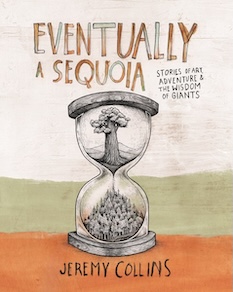
Eventually a Sequoia: Stories of Art, Adventure & the Wisdom of Giants by Jeremy Collins
Mountaineers Books, 2025
At first glance, Jeremy Collins’s Eventually a Sequoia hammers the visual senses almost to bewilderment. There are sketches, illustrations, photographs, and text—set in vintage typewriter font or scribbled by hand. Smears of vibrant watercolors offset line drawings and maps, landscape photos, and portraits. Collins’s graphic memoir is the type of book that catches your eye on a shelf or coffee table, luring you to flip through at random. That’s an enjoyable way to digest Collins’s adventures, to be sure. But for the full experience, I urge you to read it through to appreciate his gift for storytelling.
Collins made a name for himself as an artist and rock climber, producing illustrations for magazines and catalogs. Drawn: The Art of Ascent, Collins’s 2014 account of climbing trips around the world, earned acclaim as a documentary film and graphic book. Céline Cousteau, film director and social and environmental advocate, invited Collins to join her in telling the stories of Indigenous communities deep in the Amazon rainforest. “After a decade of climbing expeditions, the idea of traveling light was immensely compelling to me,” he reflects. “To leave the gizmos and ropes and gear behind and just focus on supporting Céline’s objective with hand-drawn imagery crafted from the experience.”
Collins returned from the Amazon with mind-bending art, stories, and a newfound calling to “observe, find a connection, and draw.” This mantra is repeated throughout the book. Collins journeys to Nepal (where he memorably sketches the Himalayas from a paraglider); rafts a wild river through the Alaska National Wildlife Refuge (with then–Sierra Club Board of Directors president Allison Chin); treks unknown canyons in Utah’s Bears Ears National Monument; and assists on a study of novel ecosystems in the canopy of ancient sequoias in the Sierra Nevada.
Journeying purposefully and making deep connections through art and words, Collins provides a new definition of “two-eyed seeing,” a concept that’s common across many Indigenous cultures. Ultimately, he reminds us that we’re all capable of casting small seeds—stories, art, and inspiration—that can be nurtured into paradigm-shifting ideas that may grow as tall as sequoias. —Conor Mihell