As America Turns 250, Tribal and Japanese American Families Gather to Reclaim Their History
Remembering the Sand Creek Massacre and Amache internment camp, despite the Trump administration’s attempts to scrub history
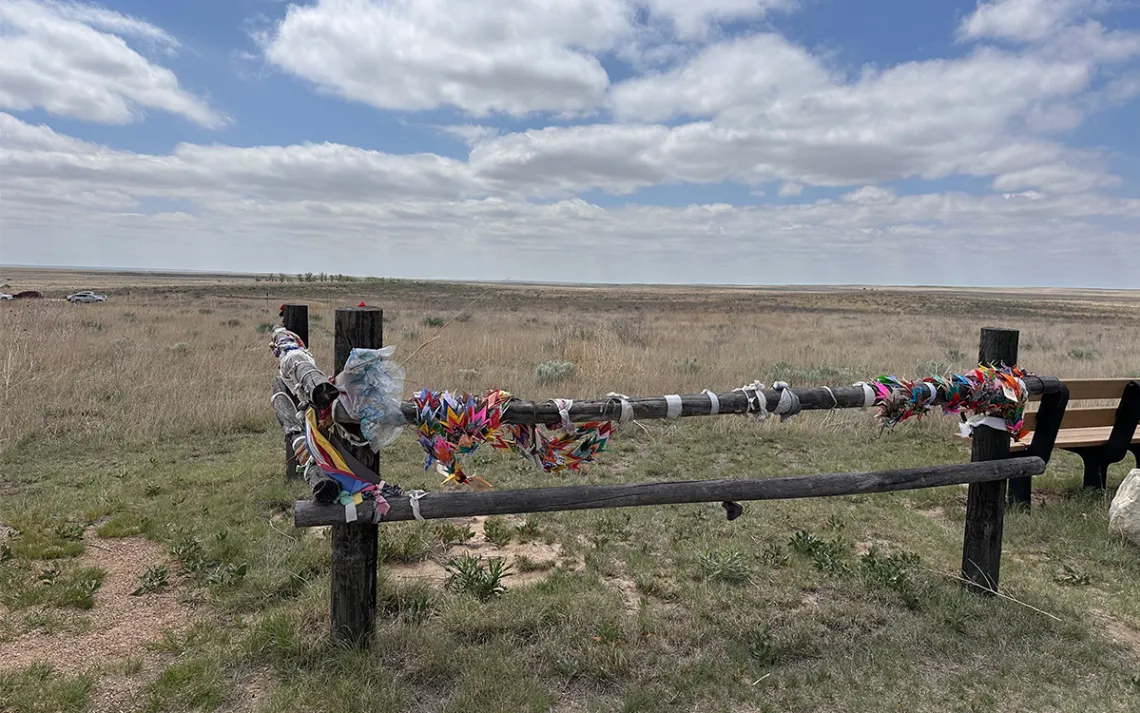
The Sand Creek Massacre National Historic Site.
Cottonwood trees rustled in the wind in May. Cheyenne and Arapaho elder Dale Hamilton coaxed a small flame from cedar chips nestled in an abalone shell just yards from a gully on Colorado’s High Plains—the same location where the US Army massacred his ancestors on the deadliest day in state history.
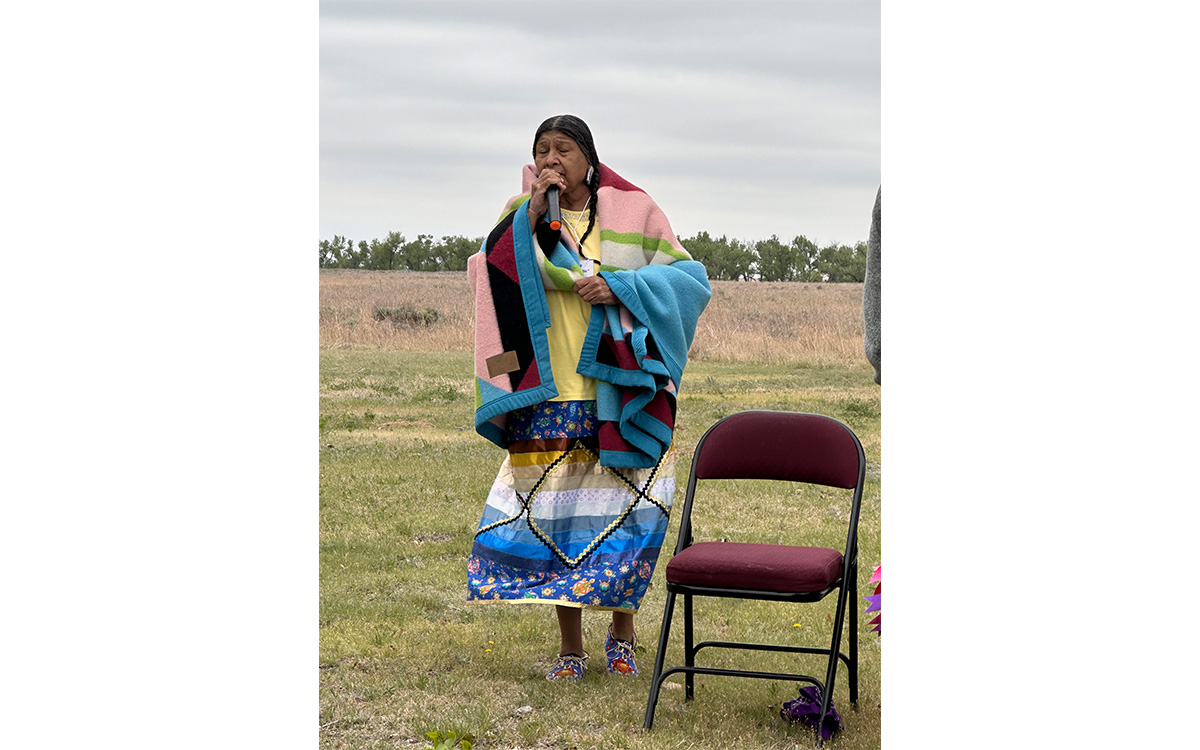
His wife, Bobbie, removed her beaded moccasins and bent to face the iridescent mollusk perched on hallowed ground. She guided tendrils of smoke up and over her colorful skirt, her arms, and her black braids four times.
After she stepped over the ceremonial offering from west to the east, Bobbie turned and issued an invitation to about three dozen onlookers. “We invite each and every one of you to come up and cedar yourself off,” she said. “Cedar is sacred to us—it’s one of the many ways we recognize and honor our ancestors.”
These Cheyenne and Arapaho Tribe members had gathered to remember the ancestors who were ambushed in the Sand Creek Massacre in 1864. They were joined by the descendants of Japanese Americans forcibly relocated during World War II to an internment camp 50 miles to the south.
While standing in line to receive the cedar blessing, participants commiserated about generational impacts of the federal government’s persecution of their ancestors due to their ethnicity or religion, or simply because they wanted their land. These individuals with varied backgrounds found a reverence for spiritual ceremonies and an understanding of how their relatives’ experiences aren’t taught in schools. Unresolved trauma binds them together in the 21st century.
Their efforts to learn from one another and to raise awareness about events that shaped their families’ lives offers insight into what it means to practice democracy at the grassroots level. On the eve of the Declaration of Independence's 250th anniversary, it’s a lesson in using that document's principles to work together across differences to find common ground, both literally and metaphorically.
Tribal and Japanese American descendants reclaim their history on their terms each spring during an annual pilgrimage to the Amache incarceration site on the arid shortgrass prairie 225 miles southeast of Denver. They meet at the Amache National Historic Site and the Sand Creek Massacre National Historic Site. Descendants say the partnership helped to liberate them from the weight of the federal government’s denial of fundamental rights.
“Finding more cultural connections between our groups and our heritage has been really healing,” said Aya Sugiura, during the blustery May cedaring ceremony at Sand Creek. Her grandmother was among 10,000 Japanese Americans imprisoned at Amache between 1942 and 1945.
“The connection between the Amache site and the Sand Creek site is just one of many connections we were able to draw,” added Sugiura, who was among 10 youths who participated in a 2024–25 ambassador cohort assembled by the Amache Alliance, the Sand Creek Massacre Foundation, the National Parks Conservation Association, and the University of Denver Amache Project. “The name Amache was taken from a Cheyenne woman, Amache Prowers, or Walking Woman—her father was (murdered) at Sand Creek,” she said.
The federal government originally called the internment camp—one of 10 in the nation during World War II—the Granada Relocation Center, after a small farming community nearby. The moniker caused confusion with the mail service, prompting internees to rename it after Amache, who is memorialized in the Colorado Women’s Hall of Fame as an “innovative mediator between cultures.” The camp became a National Park Service unit in 2024.
About an hour’s drive north on dusty rural roads lies Big Sandy Creek, an intermittent stream bed where soldiers attacked a peaceful encampment of 750 Cheyenne and Arapaho on November 29, 1864. More than half of the 230 murdered tribal members were women and children.
Bobbie Hamilton recounted the terror her ancestors experienced during the surprise attack as Amache descendants stepped in front of her and her husband during the cedaring ceremony.
“Our ancestor had a child, a little girl, and her name was Red Dress Woman,” she said through tears. “My ancestor took the little girl, her child, along the river. She put Red Dress Woman into the embankment and covered it up with foliage. She told her, ‘No matter what, you don’t come out,’” Hamilton continued, “so Red Dress Woman stayed in the embankment and she fell asleep there until the next day when she heard a man’s voice calling to come out.…These were the survivors.”
The soldiers butchered tribal members and marched with their body parts to Denver, where they displayed them as trophies, Hamilton said. Today, some of these remains have been repatriated and are laid to rest up the hill from where she stood. Following the ceremony, participants walked to that memorial, with an expansive view of miles of untrammeled prairie. Strings of multicolored origami cranes created by Japanese American Amache descendants decorated a split-level fence that marked the site. A tan tag attached to one read: “In solidarity with the people of Sand Creek.”
Nearby stood Laurie Akiyama, who traveled with her daughters from Sacramento to participate in the Amache pilgrimage in honor of her father, who was incarcerated with his siblings and his parents at the relocation camp. Her family visited the internment site the day prior to the Sand Creek ceremony and walked in her father’s footsteps through barracks where he lived and a dining hall in which he ate. It stirred painful memories.
“We were crying,” Akiyama recounted. “My dad was drafted at Amache, and he answered the call with the 442-regimental combat team. He fought while his parents were behind concertina wire.”
Her daughter, Michelle Huey, said her mother decided to come this year in part because “the current administration’s policies are attempting to scrub negative history.”
In response, Akiyama pulled aside her jacket to reveal a black T-shirt from the Japanese American National Museum that read, “Scrub Nothing.” She wore it to protest a laminated sign posted at the entrance to the Sand Creek site that exhorted visitors to provide feedback about “any signs or other information that are negative about either past or living Americans.”
The mother and daughter disagreed with what they viewed as a push by the federal government to sanitize language at national park units.
Huey’s sister, Megan, said that stories of the massacre portrayed on large boards at the site were a revelation for her. They helped her understand how her grandfather’s experience at Amache occurred in the same geographical area as a Civil War–era atrocity against Native Americans.
“There are beautiful commonalities this weekend between people at Amache and Sand Creek,” Megan said. “To hear actual personal stories at Sand Creek—as much as people don’t know about Japanese incarceration, I don’t know about this.”
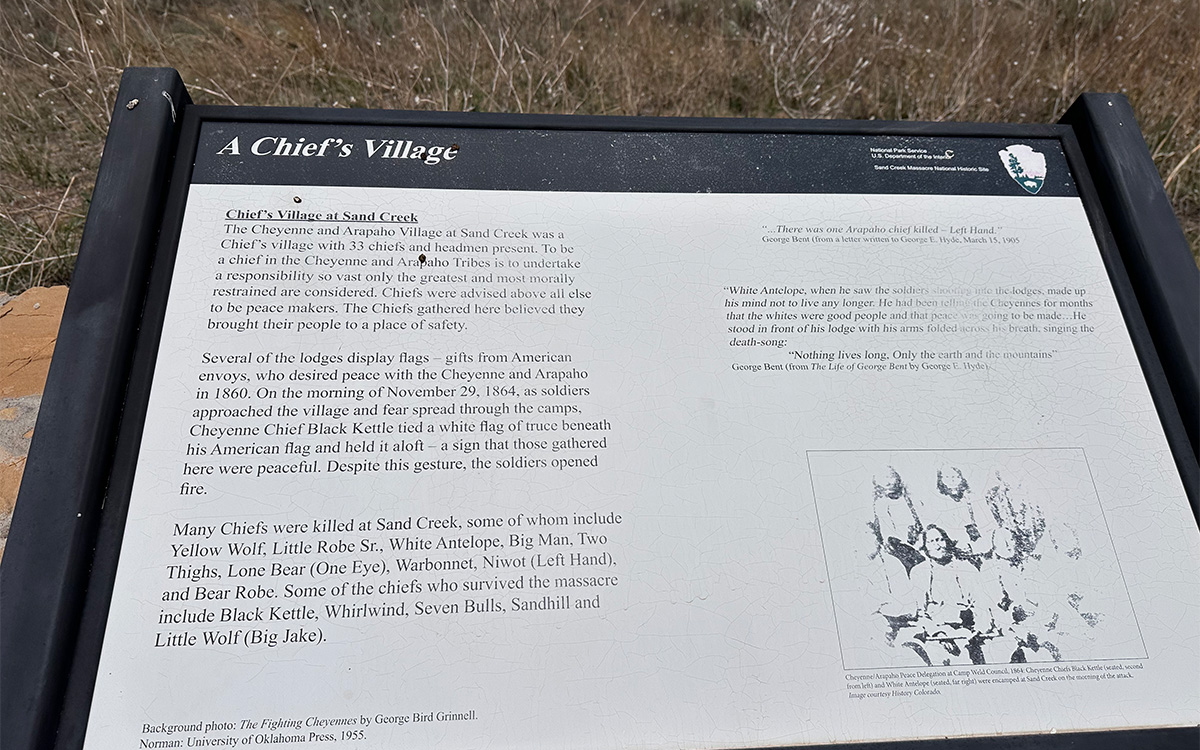
Eric Leonard, superintendent for the National Park Service's High Plains group of parks in Colorado and New Mexico, joined the gathering to say comments registered by visitors are overwhelmingly positive. “All but one were deeply appreciative of the cooperation between the Arapaho and the Cheyenne,” he told the mother and her daughters.
The shared understanding of heartache and healing experienced by descendants of the Sand Creek Massacre and the Amache internment camp is part of a multiyear effort throughout Colorado toward a more honest recounting of history. The state has taken steps toward reconciliation by recasting the Sand Creek Massacre from “a battle” to an atrocity, commemorated in a traveling museum exhibition and establishing a bronze memorial statue and a park.
The Denver City Council voted unanimously in October to name a 10-acre park “Amache Prowers Memorial Park” in recognition of Indigenous history. Mauricio Asino, a direct descendant of Amache Prowers, who is also part of the Amache-Sand Creek youth ambassador program, testified in front of the council in favor of the park.
“It’s very very painful, this history we live with,” said his grandmother, Rosalie Tallbull, during an online presentation featuring youth ambassadors last November. “This park is the first park across the country that is named after a Native woman.”
In May, at the convening at the Sand Creek Massacre National Historic Site, Dale and Bobbie Hamilton echoed Tallbull’s comments and said that correcting the long-standing erasure, or mischaracterization, of their histories in public places is among the goals they share with descendants of the Amache internment camp.
“I urge each of you to do your research on where you came from and who your ancestors are—find those connections,” said Dale. “Because the public school system does not do it justice, so it’s our responsibility to keep that awareness going.”
This story was supported by and co-published with the America’s 250th Project | American Academy of Arts & Sciences.