Antarctica’s Emperor Penguins and Seals Are at the “Pointy End” of Climate Change
A new study offers worrying signs for a warming planet
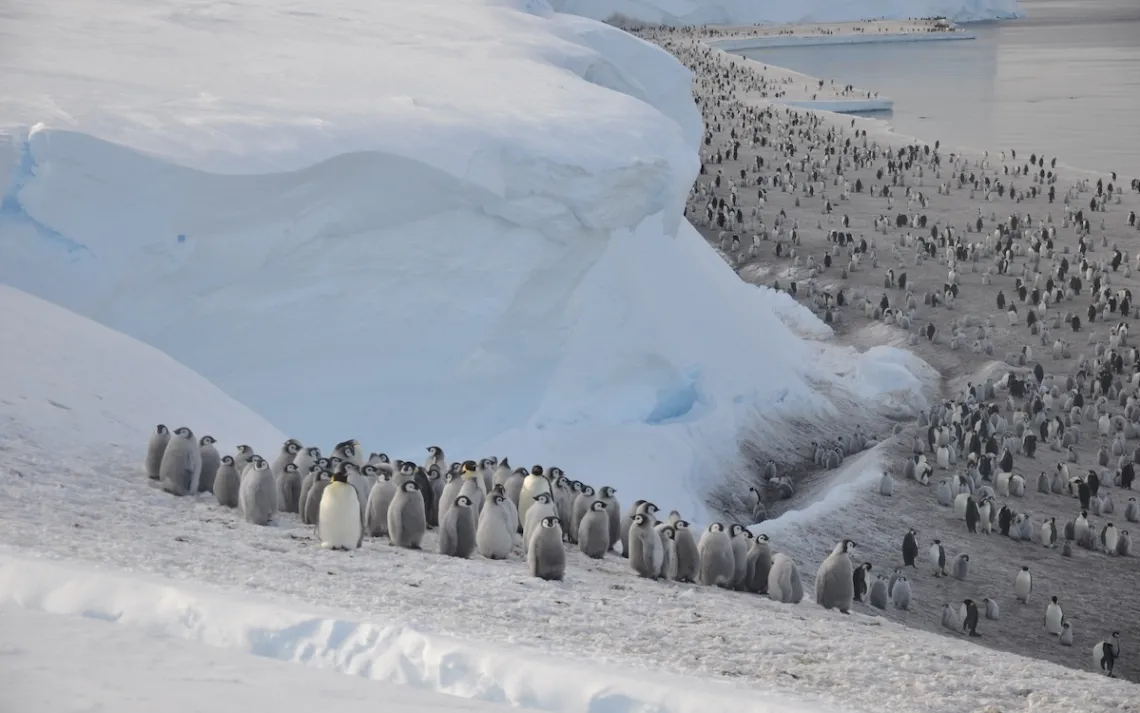
Emperor penguins on the sea ice close to Halley Research Station on the Brunt Ice Shelf. | Photo by Christopher Walton, courtesy of British Antarctic Survey
Emperor penguins might be the most famous of penguins. At just over four feet tall, with black-and-white plumage, yellow patches over the ears, and an orange throat, they are the only penguins that breed in the harshest of winter weather. They incubate their eggs by balancing them on their feet for 65 days, keeping the eggs around 100°F on days when the outside temperature can fall to 75 below 0. They are also the least common penguin in Antarctica, with only 250,000 breeding pairs.
A new study from the British Antarctic Survey shows that the bird’s future is seriously threatened, and a changing climate is the reason why.
The emperor penguin’s population declined by as much as 22 percent from 2009 to 2024, according to the findings. That trend is set to only get much worse should the nation’s top industrial nations continue emitting greenhouse gas emissions unabated. Models suggest that emperor penguin numbers will decline “with almost all breeding sites extinct by 2100 under high greenhouse gas emission scenarios.”
“This is rather depressing news,” said Peter Fretwell, senior geographic and remote sensing scientist in the Mapping and Geographic Information Centre at the British Antarctic Survey. “The emperor penguin is a very clean example of what happens to a species that’s really at the pointy end of climate change,” said Fretwell. “There’s no other thing pressurizing its populations; it’s just climate change.”
Seasonal fast ice—an understudied element of the Antarctic ecosystem—attaches to coastal Antarctica and grounded icebergs, providing crucial mating and fledging platforms for the penguins. Emperor penguins typically produce only one egg per season and have “low juvenile survival rates.” Increasing rainfall, fragile ice, and rapid ice retreats mean that chicks may be lost at sea, or be soaked and frozen to death before their hydrophobic feathers come in.
Fretwell’s study doesn’t cover all of the continent where emperor penguin colonies exist, but it covers an area that is approximately 30 percent of the emperor penguin population, including “fast-changing areas of the West Antarctic Peninsula and Bellingshausen Sea, to areas less affected by climate change, such as Dronning Maud Land and the Weddell Sea.”
If researchers had only analyzed a single penguin colony, said Fretwell, they would have a high margin of error, but with the numbers they have and the representative regions they are studying, they have a “high confidence” of over 90 percent of a “worrying decline in the population.”
Emperor penguins are dynamic and can move as their environment changes, but there are limitations. Not every colony will move or survive, and they all can’t move to the same locations where they’ll compete for space and resources. With a decrease in sea ice, emperor penguins are also seeing a decrease in Antarctic krill. Krill rely on sea ice for protection and reproduction. Less ice means fewer krill and less food availability. Krill are a keystone species for marine mammals and birds.
Across the Weddell Sea at Signy Island in the South Orkney Islands, another study from the British Antarctic Survey is seeing an impact on seals from strong environmental pressures also resulting from sea ice loss. According to the study, “numbers of Antarctic fur seals and Weddell seals declined significantly between 1977 and 2024 by approximately 47 percent and 54 percent, respectively, from a peak in 1994 and 1985, although no significant overall long-term decline in the numbers of southern elephant seals was found.”
This study stands out for its unique longevity—a 48-year period of study from 1977 to 2024.
Signy Island, says study lead Mike Dunn, is a small island in a small island group. “But it’s significant,” he adds, “because it gives us something that’s really quite unusual, which is a really long data set.” Dunn has worked for the British Antarctic Survey for 24 years and has had 13 deployments to the Antarctic, each lasting six to seven months at a time.
According to Dunn, researchers have had the advantage of studying the seals during a temporary cooling period in the region that lasted from 1998 to 2014. This gave them a chance to observe how the seal responded not only to the prevailing trend of sea ice loss but also its reversal.
“This meant that we could test the theories that were there,” said Dunn, “and this cemented our understanding of what to expect in the future.” Weddell seals need the ice to reproduce and pup, while the other two ice-tolerant seals rely on beaches for breeding. During the cooling period, Weddell seals did better and the other two slightly worse.
What does this mean for Antarctica?
“It’s another big alarm bell that all is not well,” said Dunn. This is a small area in the whole of Antarctica, he added, but it’s an area that serves as an “important predictor of what you’d expect on a much bigger scale.”
On the other side of the planet, harp seals rely on ice floes in the Gulf of St. Lawrence as birthing platforms to safely pup away from predators and have access to food sources. That ice is also disappearing quickly and is more fragile than ever before, resulting in high mortality rates for harp seal pups that need at least three to four weeks of stable ice for their fur to shift from their baby white coats to their hydrophobic browns. Collapsing ice has increased seal mortality, and seal mothers who decide to give birth on land now expose their pups to predators. That shift is happening quickly as well.
“It's not so much the emperor penguins that need to adapt,” said Peter Fretwell. “It’s us that need to adapt—to save, not just the emperor penguins ... but possibly thousands of species that are going to come under pressure and face possible extinctions through climate change if we don’t adapt.”