 The Magazine of The Sierra Club
The Financial and Ecological Risks of a Contested Florida Dredging Project
Can the Port Everglades shipping channel project proceed with governmental and environmental costs skyrocketing?
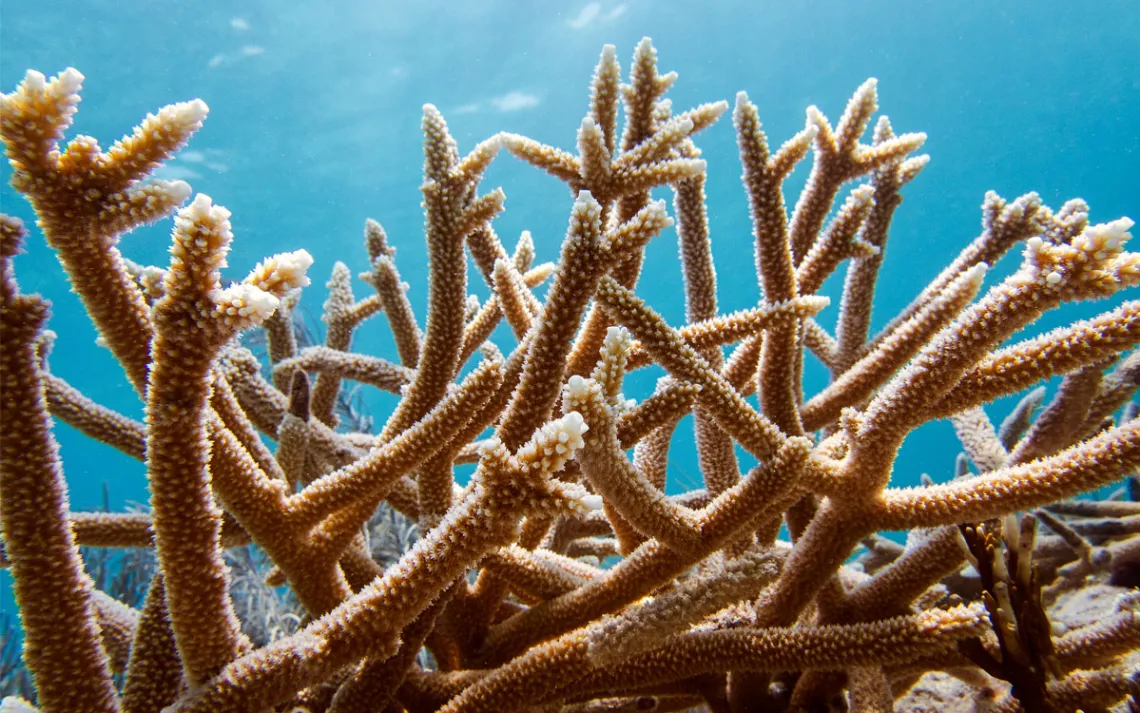
Staghorn coral. | Photo courtesy of Leche Studios for Miami Waterkeeper
In 2014, Ross Cunning, a biologist at Chicago’s Shedd Aquarium, was in Florida, studying coral off the coast of Fort Lauderdale. His work was focused on the seabed right beneath Port Everglades, the economic engine for the region, where a third of Florida’s petroleum products are stored and at least a dozen cruise ships depart daily.
“You could hear it very loudly, and you could feel it in your body—the vibrations from these huge ships going by, sort of disturbingly close,” said Cunning.
Currently, the large ships that trundle in and out daily enter the port at reduced capacity or at high tide to avoid running aground. To help ease traffic and expedite shipping, the state and federal governments are hoping to advance a highly contested dredging project to deepen and widen the Port Everglades shipping channel from 42 to 48 feet.
However, Cunning's work has somewhat thrown a wrench in those plans. Cunning and his team found roughly 10 million corals in the area, including staghorn coral, which is listed as threatened under the Endangered Species Act. And last year, researchers declared the species functionally extinct in Florida, meaning the population no longer plays a role in shaping the ecosystem. The port is also home to the threatened queen conch.
Since the discovery of such imperiled species, regulators and builders are facing a big question, one that humanity will increasingly have to grapple with: Can developers afford to protect and restore ecosystems where projects wreak havoc on the environment? In this case, the US Army Corps of Engineers and local developers Port Everglades and Broward County have promised ambitious environmental mitigations. They plan to restore damaged coral populations, relocate huge numbers of existing corals, and implement a three-month pause on the project while corals spawn. Meanwhile, the cost of these mitigations has skyrocketed, from $300 million to over a billion. And the project’s timeline is now six years, extended from the original two.
“Port Everglades is under the microscope, and this project, over three decades in the making, at a cost that has quadrupled, will be one of the most scrutinized and environmentally sensitive in the country,” a spokesperson from Port Everglades told Sierra.
The project seemed to be moving forward until April 3, 2026, when the Army Corps of Engineers withdrew its permit application to continue dredging. Officials with the port project maintain that it’s still progressing, but the pause is significant—agencies don’t usually pull applications unless something substantial is being reconsidered. Many sources say the withdrawal is likely because the project has become too expensive to justify—the healthy reef below the port means that even more mitigations must be built to offset the environmental impact.
Groups that have been fighting the project since 1996 mark the pause as a fragile win. “I’m feeling cautiously optimistic,” said Rachel Silverstein, executive director of local nonprofit Miami Waterkeeper, who worries that the Army Corps of Engineers will now attempt to approve the project in a piecemeal fashion while minimizing environmental considerations. Miami Waterkeeper has sued the developers of similar projects in the past for violating the Endangered Species Act and the Clean Water Act. Silverstein said her organization is prepared to do so again.
Complicating matters, the Port Everglades dredge stands in the shadows of another controversial dredge at PortMiami in 2015. Miami Waterkeeper claims that 560,000 corals were buried and killed by sediment plumes from the construction of PortMiami. However, other scientists argue that much of the mortality was due to regional coral disease and marine heat waves. Without clear numbers, scientists and developers fear that the Port Everglades project could similarly threaten the marine ecosystem.
It’s tough for people to agree on exactly how much damage was caused in Miami. What is clear is how different the Port Everglades dredge would be, as evidenced by how its price tag continues to climb. As of August 2023, “the cost is close to fifty-fifty, with the environmental activities projected to cost $614 million and the dredging at $683 million,” the Port Everglades spokesperson told Sierra.
“We did learn from Miami that you better do it right,” said Tiffany Grantham, an environmental advocate near the Port Everglades project. “We’ve heard nightmare stories, which is why everybody up here is going to be so careful.”
If the project moves forward, the Army Corps of Engineers and Port Everglades will have to hammer and blast the seafloor 280 times to cut into rock on the channel’s bottom and sides. The sediment will then be removed using an undersea vacuum and pumped onto barges for release in deeper water. Advocates fear that some organic material could fall back into the ocean, where it would suffocate marine life.
The bottom line is that any sort of dredging project in the ocean inherently damages some amount of marine life, Cunning said. To that end, ship operators are prohibited from filling barges completely. This will, in theory, prevent any sediment from spilling back into the sea and creating harmful turbid conditions—a phenomenon aptly named “overflow.”
In 2022, developers on the project promised to relocate 498,646 corals that were in the path of the dredge, but that number has since risen to 723,000. Even though significant strides have been made in the name of protecting the environment, many still don’t find the plan sufficient. “The reef that is directly removed will not ever truly be replaced,” said Brian Walker, a research scientist at Nova Southeastern University.
The dredge, like many proposed construction projects, has left a community divided—despite the project’s strong opposition, other Floridians are interested in the economic gain and restoration the port is proposing. “This would be scaling up nurseries on an industrial scale,” said Beam Furr, a Broward County commissioner. “I don’t think there’s ever been a project like this.”
Broward County representatives assert that it would be the largest coral propagation project in US History. The main hurdle coral restoration faces elsewhere is scalability, meaning a project of this size would be expensive, hence the growing cost. The Army Corps of Engineers and the federal government must decide if these mitigations are a cost they can bear, and if they’re worth the economic influx a deeper channel could provide.
A 2025 fact sheet states that the final environmental impact statement and decision on Port Everglades aren’t expected until November 2026, and the contract solicitation for the project is scheduled for the summer of 2027. Whether the mitigations properly account for the damage is a question that scientists, developers, and the federal government will have to answer.
“I want to see it move forward responsibly,” said Furr. “If you’re going to do the damage, you’re going to have to put things back the way they were as best you can.”