Art That Heals and Reveals
Indigenous artwork is helping tribal members protect themselves from harmful environmental exposures
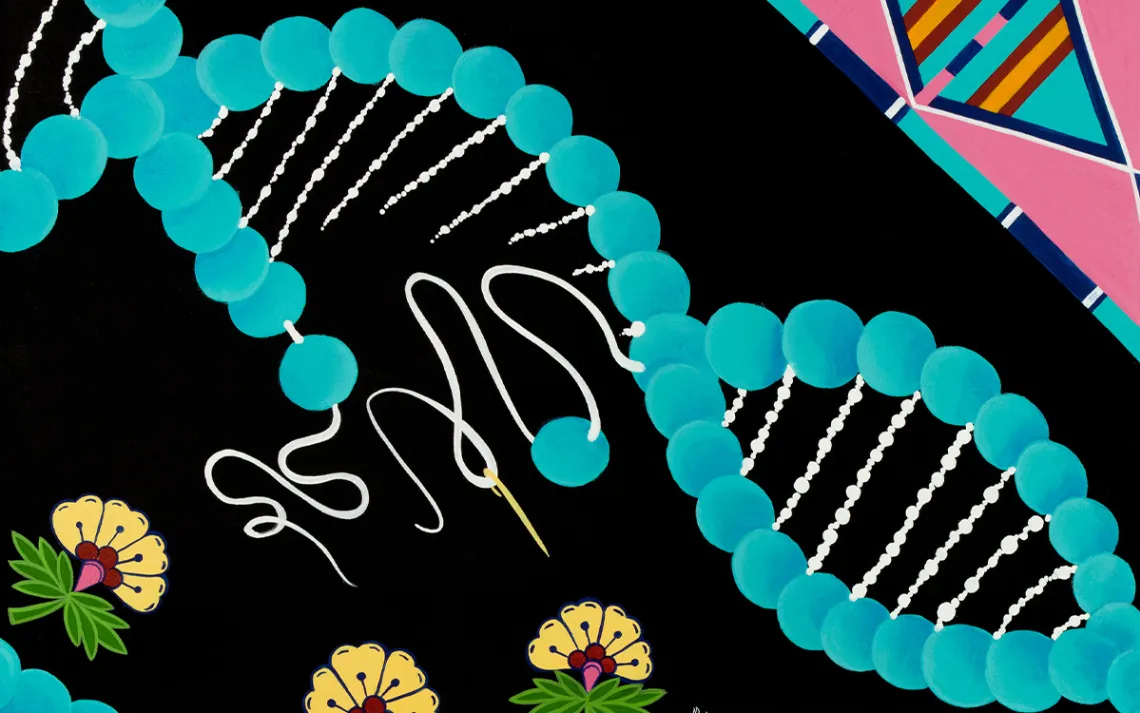
"DNA Repair." 2017. 16 x 20 in. Acrylic on watercolor paper. | Image courtesy of Mallery Quetawki (Zuni Pueblo)
More than 500 abandoned uranium mines lie throughout the American southwest, leaving a legacy of contaminated water and soil from America’s era of nuclear energy. “Indigenous people live closer to the land than we do in Albuquerque … and when the land is contaminated, that creates greater exposure,” says Debra Mackenzie, assistant director of the community environmental health program (CEHP) at the University of New Mexico. Her team works in partnership with tribes throughout the Southwest, including Pueblo, Navajo (Diné), Crow, and Cheyenne River Sioux, to study uranium’s impacts on their health and well-being.
After finding that tribal members living near mines experience higher rates of autoimmunity, liver disease, heart disease, and cancer, Mackenzie’s team wanted to see if zinc supplementation could reduce uranium’s harmful effects. Besides radioactivity, uranium is a heavy metal that displaces zinc in cells, which is essential for repairing damaged DNA. Tribal members often have zinc deficiencies due to low soil levels and lower meat consumption.
But how to approach Native Americans about taking zinc and allowing their blood to be drawn, when historical traumas caused by academic institutions, research centers, and hospitals have left lingering mistrust?
“We’ve got to have some solutions, right?” says Mackenzie—especially with the glacial federal efforts to remediate uranium in the Southwest, not to mention recent plans to reinvigorate domestic uranium mining. “We can't just say, ‘You’re really heavily exposed. Gosh, good luck with that.’”
Through a stroke of serendipity, the CEHP team connected with Zuni Pueblo artist Mallery Quetawki, who now uses Native American symbology to lower barriers to understanding health and science research in a way that honors Indigenous values and culture with CEHP.
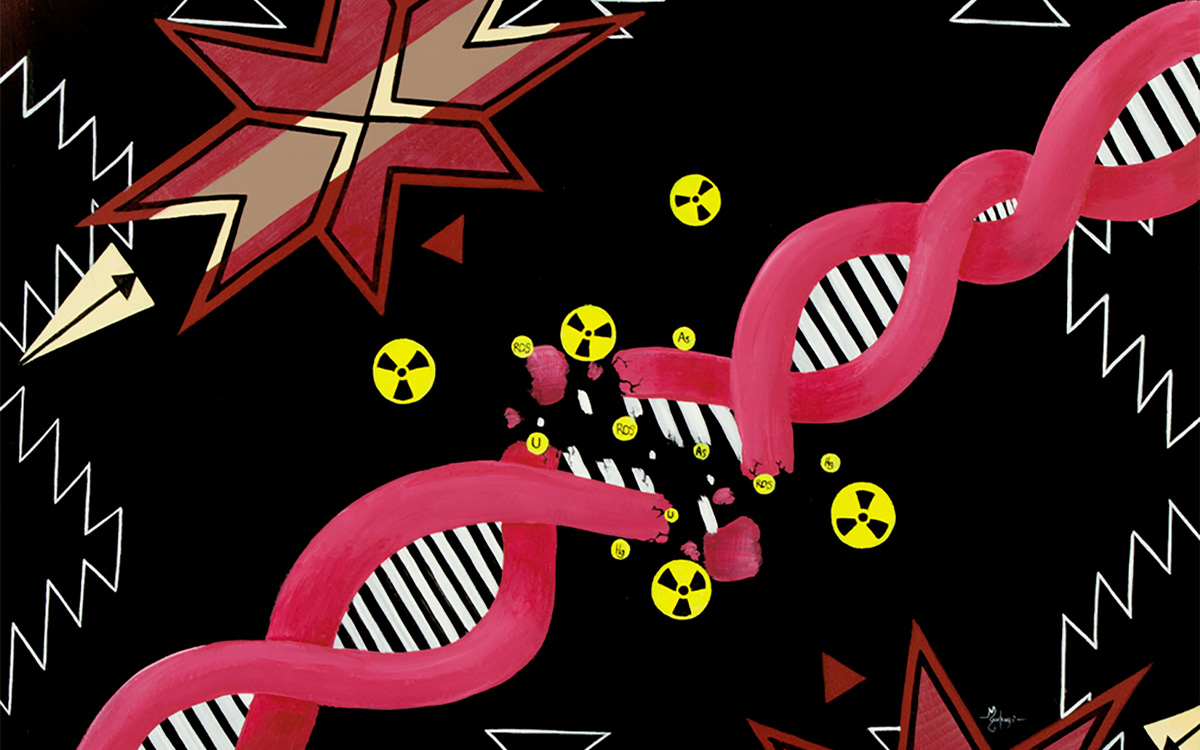
"DNA Damage." 2017. 16 x 20 in. Acrylic on watercolor paper. | Image courtesy of Mallery Quetawki (Zuni Pueblo)
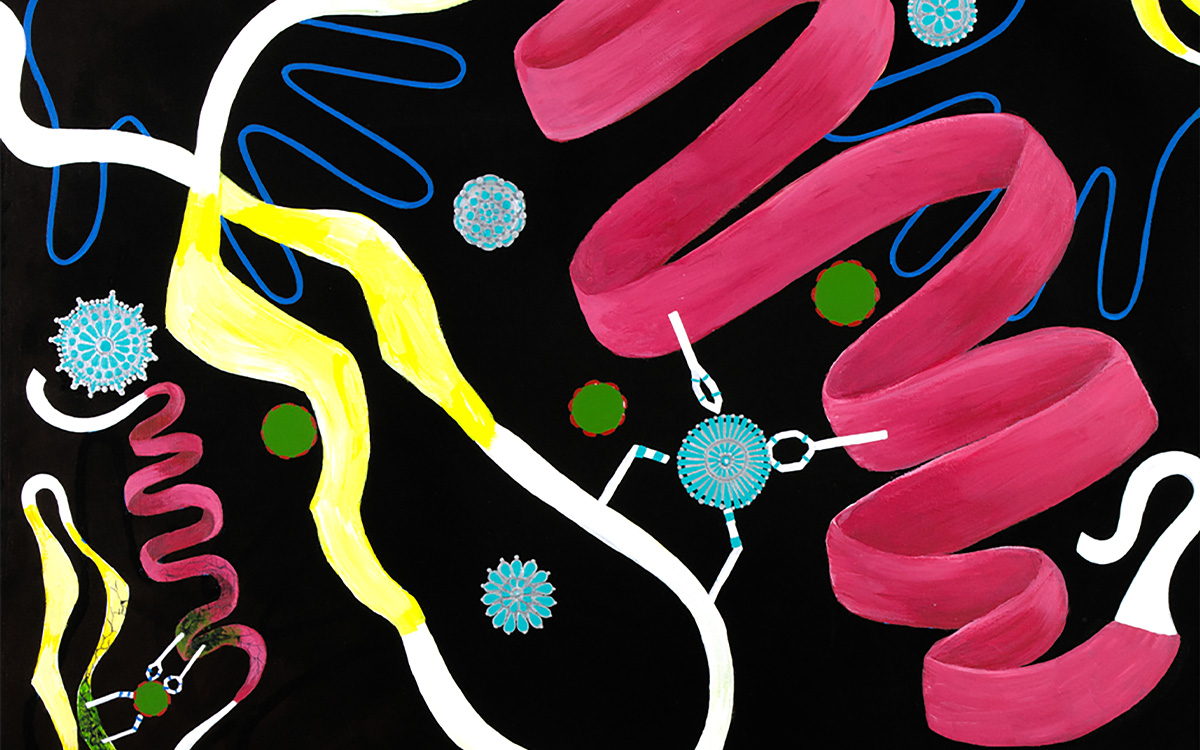
"Zinc Fingers." 2017. 16 x 20 in. Acrylic on watercolor paper. | Image courtesy of Mallery Quetawki (Zuni Pueblo)
Using art to communicate science
A decade ago, when the CEHP team was presenting their research to tribal communities, all the graphs and charts just weren’t resonating. One tribe member asked: Could they use culture or art to conceptualize it? They loved the idea but didn’t know how.
CEHP co-director Johnnye Lewis saw paintings of a heart, lungs, and DNA displayed at the Zuni Comprehensive Care Community Clinic that included Native symbols and thought, “I need to find this person.”
Quetawki had created the paintings for a college class and was working at a nearby health clinic. “We hired her as an artist-in-residence for a short-term piece” in 2016, says Mackenzie. “And now, she's running a whole program. It's been such an amazing transformation [that has] resonated nationally.”
Quetawki’s art has created “a multidirectional way of communicating,” Quetawki told Sierra. Whether using watercolor, acrylic, or a digital illustration, the strategy has “created that dialogue of proactive health care, which is really hard to have with our community.”
The approach’s value crystallized during the Covid pandemic. Quetawki noticed her community, the Zuni Pueblo, was not adhering to distancing, mask-wearing, or vaccine recommendations. When she’d asked why, people told her they didn't know to do that—despite omnipresent posters from the Centers for Disease Control and Prevention. When she pointed them out, “They’d say, ‘Oh, those? Those stick figures have nothing to do with us.’ So I had to create all of that into recognizable imagery,” she says.
Drawing patterns, symbols, and people who resembled them created greater receptivity to the messaging.
“We as scientists get stuck in our ways,” says Mackenzie. “We have images and graphs and they're meaningful to us, but we lose the holistic connections that Indigenous ways of knowing provide. That's why Mallery's work has resonated [so widely]. . . . It's very effective.”
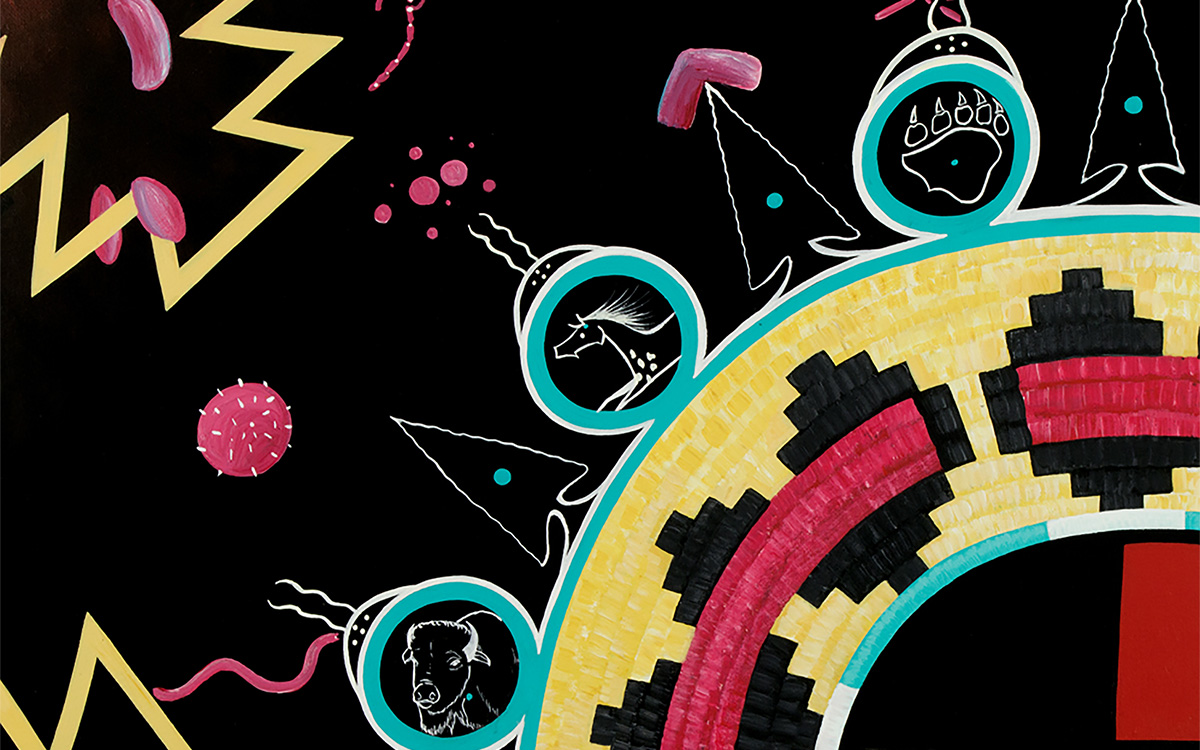
"Immune Response." 2017. 12 x 24 in. Acrylic on canvas. | Image courtesy of Mallery Quetawki (Zuni Pueblo)
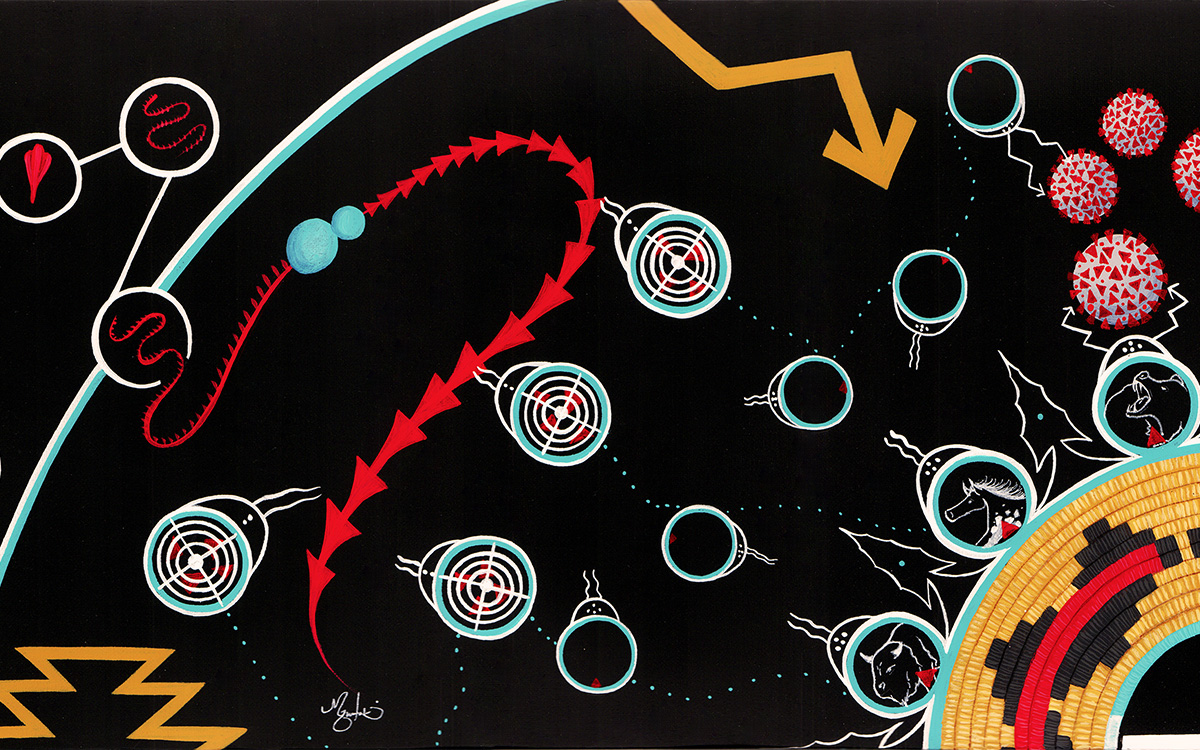
"mRNA Vaccine." 2021. 12 x 24 in. Acrylic on canvas. | Image courtesy of Mallery Quetawki (Zuni Pueblo)
Native symbology and immunity
To communicate complex concepts such as cytokine storms and immune dysfunction, Quetawki incorporates components of tribes’ spiritual practices in her art. A sweat lodge indicates purification; arrowheads, the color turquoise, or bears—considered sacred carriers of healing—indicate protection. “We have to go back to the basics sometimes and tell them, ‘This is your immune system.’. . . I say all those things are like B cells, T cells, and macrophages that protect their cells.”
Quetawki has translated CEHP’s uranium research into a series of paintings. One shows DNA damage caused by a “wrecking ball” of radioactive uranium overlain on a Pendleton blanket design, indicating a fabric that can be damaged. Another shows DNA repair as a turquoise strand of beadwork, widely used throughout Indian Country, being stitched together. Many of the tribes have taboos about hearing about bodily harm without solutions. “When we talk about DNA damage, we honor that our DNA repairs itself by bringing in a cultural idea of beadwork, and how when a string of beads breaks, we can fix it,” she explains.
Other paintings show the immune system protecting itself against harmful invaders as arrowheads protruding from a wedding basket, and the immune system attacking itself, as happens with autoimmune disease, with pairs of animals fighting.
With the help of Quetawki’s art, the team successfully recruited people to see whether supplemental zinc could reduce uranium’s harmful impacts.
“Balance is an important concept indigenously,” says Mackenzie. “If you tip the balance and add more zinc … what we're trying to do is restore balance.” In the lab, researchers have measured DNA repair indicators, including cellular oxidative stress. Although preliminary, results indicate zinc shows promise.
Expanding the effort
Nearly a decade in, Quetawki has created many pieces for the program, including ones depicting radioactive decay of uranium, phytoremediation of soils, and mRNA vaccines. Quetawki typically gives a fine art print, as well as flyers for distribution, to each tribal community they work with. She’s even created interactive coloring pages, “something folks can take and doodle on, draw on, add to, because it creates a dialogue, and helps them ask questions.”
In an attempt to train others to create similar art, she led a pilot course at UNM pairing CEHP graduate students and postdoctoral researchers with Native artists, including one high school student. Together, they created paintings, spoken word poetry, sculptures, music, and digital art.
Her vision includes sharing Indigenous ways of knowing with scientists. “High school students are so curious. Master students are still wanting to know a lot. Doctoral students are starting to burn out, and I like to ask them, ‘Where … did that disconnect happen?” she explains. “I'm constantly reminding seasoned researchers to ‘bring the humanity’ back into their science. You're studying rocks. But what implications does it have on the community of where that rock came from?”
After watching her mom navigate colon cancer, she created outreach material and resource guides to help tribal members navigate medical care. During her mom’s journey, she says, “I really saw all the gaps in our health care system, especially with Indigenous people.”
The approach calls to mind writings from Potawatomi botanist Robin Wall Kimmerer, author of the bestselling Braiding Sweetgrass. As a professor, she sat on student committees where other professors ridiculed students for describing the plants they worked with as beautiful. When she asked students why they studied a particular issue, they’d answer practically: to get a good dissertation, or to get a job. “Nobody mentioned love,” she writes. “I dream of a world guided by a lens of stories rooted in the revelation of science and framed with an Indigenous worldview—stories in which body and spirit are both given voice.”
Quetawki agrees, emphasizing the fallacy in how most academic institutions view Indigenous communities. “When people talk about building a capacity for a community, I think the other way around: We have to build the capacity within our institutions.”