Big Bend’s Burros Cause Delight and Frustration
A Texas community is split on what to do with its feral donkeys
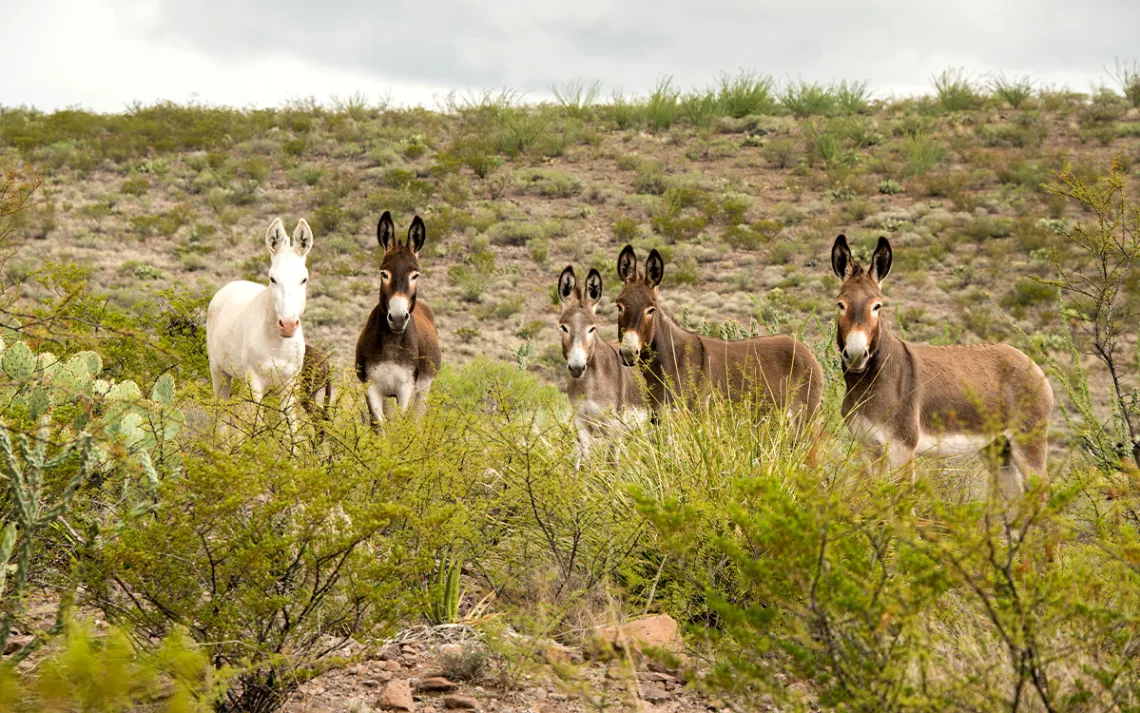
Burros in Big Bend Ranch State Park, Texas. | Photo by Mathew Risley/iStock
The burro (Spanish for “donkey”) has a long history in South Texas. Settlers brought them to mining towns in the early 1900s to help haul minerals and metals, such as mercury. When those industries ended in the 1930s, many of the miners who moved away left their burros behind. But the growth of the herds, now feral for many generations, is neither natural nor necessary—it’s a direct effect of the subdividing and selling of large sections of ranch land, a process that has shaped the landscape of the Big Bend region for decades.
By the 1960s, the steady growth of burro herds began to impact the national park, and the park resorted to a lead poisoning program. On the surrounding land, over 270,000 acres called Terlingua Ranch, small populations persisted. Terlingua Ranch was a working ranch until it was subdivided and sold to private owners in the 1970s. Most of the new owners were not involved in agriculture, which brought more water to smaller, individual plots. There was little fencing because people moved to Terlingua for the wide, open spaces and natural beauty. Today, as a direct result of steady gentrification, burro numbers are higher than they have ever been.
Pam Gordon, one of the owners and operators of Jackass Flats Improvement Association, and the only one permanently based in the area, keeps a close eye on the numbers.
“There are multiple big herds, 40 to 50 head, on either side of the highway, as well as two to three bachelor herds of around 15 to 20 head. Two years ago, our observations in the backcountry showed between 300 and 350, ranging 20 to 30 miles, and that number is certainly higher now.”
Gordon has seen them dig holes up to four feet deep, looking for water. And while some species have been shown to benefit from this behavior, many wildlife ecologists contend that burros are more harmful to local ecosystems than helpful. Burros compete with native wild animals for food and other resources in the desert, where they are especially well adapted. That competition has intensified due to climate change. According to Raymond Skiles, a retired Big Bend National Park wildlife biologist, the burros’ basic needs to eat, move around, and wallow impact the habitats of wild endangered species like the yellow-billed cuckoo, and rare species, such as the black hawk and gray hawk. They also impact numerous and important prehistoric archaeological sites at the border.
Despite these potential hazards, local residents are passionate about keeping burros around. Other species that were introduced by humans, like hogs and aoudads, are successfully managed by killing programs in this region. Neighboring Big Bend Ranch State Park had lots of burros until the rangers started shooting them in the late 1990s, followed by more culling in 2005-07. But the killing programs were met with an outcry from residents, some of whom objected to burro killing because of the animals’ religious significance.
The Texas Parks and Wildlife Department cannot step in to manage burros because they are domestic animals, unlike deer, bears, and javelinas. The Department of Agriculture can only round up animals inside the national park or those that wander over from Mexico. As a result, there is no agency responsible for managing the herds on Terlingua Ranch. The sheriff’s office considers them a public safety hazard and deals with the vehicle-burro accidents along the highway, which routinely results in dead burros and injured drivers.
“The sheriff told me, ‘Catch them all.’ The county wants them off the highway,” Gordon said. “There have been four burros hit between here and the park since January. People and burros will keep getting hit, so all we can do is try to catch more.”
Gordon runs a small private sponsorship program for the burros they manage to round up. People can sponsor individuals or whole herds in the association’s care to help offset the costs, from feed and water—a hot commodity in the desert—to veterinary care, including castrations, sterilizations shots for the jennies, and euthanasia for sick animals. She also runs a general store, pavilion, community center, campground, music venue, networking center for trade and work, as well as a Dutch oven cookoff and burro races, all under the name and mascot of the lowly jackass.
Many people are highly invested in the burros’ welfare. Favorites include Biscuit, a retired show burro who does tricks and once toured the country. Some residents get angry about the burro race because it involves roping. But the races are meant to encourage potential sponsors and to educate the audience about the impact burros have on the land, especially tourists. Gordon now must lock the gates to the corrals because tourists sometimes try to set them free in the middle of the night.
Lovika Allain has lived in Terlingua since the early 1980s, and said there were always free-roaming burros and horses around. Her 100-acre property is located close to the entrance to one of the most remote and scenic parts of Terlingua Ranch, known as the Solitario. These days, at least one loose herd climbs up the mountain to her home anytime she leaves the gate open. They eat everything they find, defecate where they stand, and some get aggressive and pushy. But Allain considers them a normal part of daily life here, just one more challenge of living someplace this remote and wild.
For artists Christine Meaux and Doug Engel, who moved deep into the Solitario from Houston, free-roaming animals add to the region’s magic. “Seeing animals on roads every day, rather than city traffic, makes me so happy. It’s part of why we moved here,” Meaux said. The burros’ presence is good for the artist’s mind, Engel said. They regularly drive past the same loose herds that visit Allain’s land. “We love to see them roaming free. It’s got that wild feel. That’s why we’re here. The silence and the rawness and the toughness—that’s the stuff of creativity.”
While Gordon occasionally coordinates private adoptions, she is wary of burros going home with people who don’t know what they’re getting into. Correct nutrition is an issue—burros don’t eat the rich feed that other livestock animals eat. They eat desert flora and can become irritable and develop joint problems from rich hay and alfalfa. But the biggest challenges are behavioral. Most potential adopters don’t realize that these are wild animals and may not make the best pets. She has a young female in her enclosure and has had to relocate her because too many people are expressing interest. Burros can become aggressive as they mature and require space, fencing, and sometimes specialized handling. Gordon screens her adopters but fears that even that is not enough to ensure a stable, healthy life for the animals. She prefers that the burros stay with her rather than go to the wrong home and end up on the sale block or going to slaughter.
The future of Jackass Flats remains uncertain. One potential possibility is an animal therapy program for residents who request psychological help. Another is to keep growing the sponsorship program, to help the public be more involved and informed. In any case, for the growing numbers of burros to live at a safe distance from the highway, Jackass Flats will have to continue to grow.
“We might file for 501(c)(3) status, just so we can apply for grants to buy up more land for the burros, before it’s all bought up by people moving down here,” Gordon said. “And at this point, I’d much rather have more burros than more people.”