The Bright Lights of These Little Bugs Are Dimming
How researchers and citizen scientists are tracking firefly populations and supporting conservation efforts
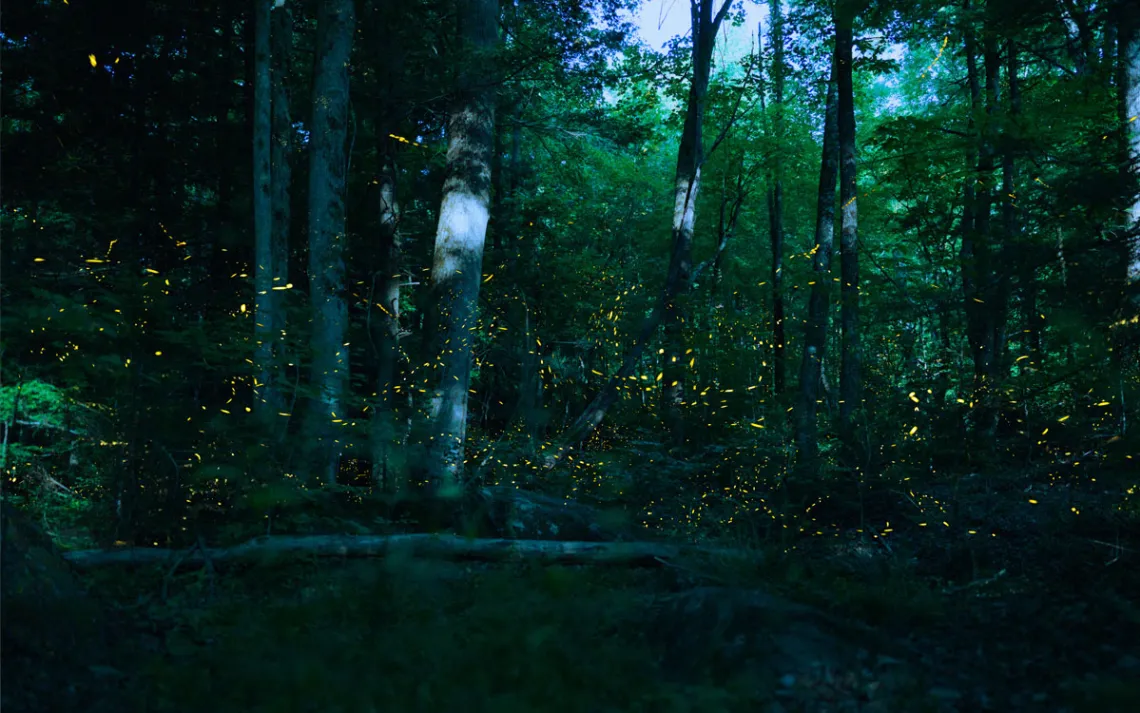
Fireflies in the Great Smoky Mountains. | Photo by Iris Huang/iStockphoto
As summer approaches, many people might be looking forward to the nightly glow of a once-common phenomenon. The Morse code–style illuminations of fireflies are arguably one of the most magical moments of summer evenings across North America. “Everyone just seems to love them,” said Candace Fallon. “I have yet to meet anyone who does not like a firefly.”
Fireflies are technically beetles, and according to Fallon, people are reporting seeing fewer of them than they used to. But by how much the effervescent insect numbers have shrunk, no one knows.
In her capacity as a senior conservation biologist for the Xerces Society for Invertebrate Conservation, Fallon was part of a 2021 firefly assessment together with the Firefly Specialist Group of the International Union for Conservation of Nature (IUCN). Analyzing 132 species (out of a total of 178) across North America, researchers discovered that a third of the species were doing OK, but over half couldn’t be assessed because of a lack of information. “We don't have baseline data for historical population numbers,” Fallon said. “And we don't really have numbers for current populations either.”
To get a better idea of current populations and threats fireflies face, the Xerces Society launched the Firefly Atlas in 2022. The aim of the group is to paint an overall picture of firefly health. But with only Fallon and her colleague Richard Joyce coordinating efforts, they quickly realized they’d need some help. To that end, the Atlas invites citizen scientists to get involved by logging sightings and uploading photos into a database. Researchers can use that as a tool to map populations and guide conservation strategies.
Fallon says that anyone can become a firefly researcher. The online portal is publicly available, and users are invited to report sightings, locations, and conditions. Budding naturalists with ample time and energy are encouraged to take a dedicated training to recognize individual firefly species. This option requires access to known habitats, such as wetlands and forests, so that detailed counts and surveys can be conducted. Thus far, their work has yielded some exciting discoveries.
“There is this one in Arkansas, the Ozark spark firefly, which hadn't been seen since I think the '60s,” Fallon said. “And some Firefly Atlas surveyors went to … those sites and … ended up finding it.”
But while the Atlas is proving successful, Fallon also admits there is still a lot unknown. Fireflies depend on very specific conditions to survive—moist soils, leaf litter, and undisturbed habitats. It varies from species to species, but typically firefly larvae remain in their infancy for up to three years, while adult fireflies (the ones we see flying at night) live for a brief two to three weeks.
Conservationists think that learning about this life cycle—what the larvae eat and the temperatures they need to survive—could play a larger role in conserving firefly habitat. For example, researchers think the juvenile fireflies light brighter than their adult counterparts because it's a sign to would-be predators that they aren’t edible—it's a warning to stay clear.
At a different firefly research initiative, called the Firefly Life Cycle Project at Colorado’s Butterfly Pavilion, scientists are doing just that. The facility is the first stand-alone, accredited invertebrate zoo in the world. The project allows scientists to collect adult fireflies from the wild to breed in laboratories.
In the last nine years, the staff has successfully reared five fireflies. However, the most significant breakthrough came in 2025, when a female named Georgia, raised entirely in the lab, successfully reproduced after being paired with wild males.
“By understanding more about the life cycle, ecological requirements, and behavior of native fireflies, this research provides critical data to guide conservation efforts across Colorado,” said Francisco Garcia Bulle Bueno, director of research and conservation at the Firefly Life Cycle Project.
As elsewhere, the exact number of firefly species in Colorado is unknown. But another program led by community scientists is helping to map populations statewide. Called the Colorado Firefly Watch program, it is similar to the Firefly Atlas. People are invited to observe and record fireflies through an open web portal.
While naturalist groups help track existing populations, Fallon and her fellow researchers are trying to determine why the iconic glow of fireflies is dimming. One of the reasons populations of fireflies could be decreasing, she said, is habitat loss due to urban and agricultural expansion. This causes light pollution that diminishes the flash patterns of the insect's bioluminescent antenna. In Delaware, for example, coastal development threatens the Bethany Beach firefly.
In 2024, in response to a petition and legal agreement with the Center for Biological Diversity, the US Fish and Wildlife Service proposed listing this particular species as threatened under the Endangered Species Act. This is the first firefly species to be proposed for listing under the act, and conservationists fear it may not be the last.
Around the world, there are 2,600 firefly species. According to Sara Lewis, co-chair of the IUCN Firefly Specialist Group, of the 150 firefly species assessed by the IUCN, approximately 20 percent are threatened. “In many regions, increasing drought puts fireflies at risk,” she said. “Because to survive, they need at least some moisture during all their life stages.”
However, there is data that indicates that when human interference is minimal, fireflies thrive. For example, the Painganga Wildlife Sanctuary in Maharashtra, India, where light pollution and development is low, has thousands of fireflies. Examples like this show that when fireflies are left alone, they can thrive. Successful endeavors like this are why experts from the Fireflyers International Network created the first World Firefly Day, celebrated the first week of July.
The goal of the commemorative day is to increase public awareness of the plight of fireflies. In the process, its supporters hope that people will seek out information about how they can help the luminescent bug. But even without large sanctuaries, staff with the nonprofit Fireflyers International Network say there are things that people can do to help. For instance, one of them is turning off porch lights, which can restore the darkness fireflies need to communicate. Meanwhile, Fallon suggests leaving leaf litter in gardens to provide habitat for the insect.
Allowing fireflies to thrive is a message Lewis hopes will resonate as the world celebrates World Firefly Day 2026, over the Fourth of July weekend. She added, “I think stepping outside to watch fireflies instead of fireworks will be the very best way to celebrate America's 250th.”