
Dog vs. Lanternfly
Four-legged friends are working as scent detectives across the United States
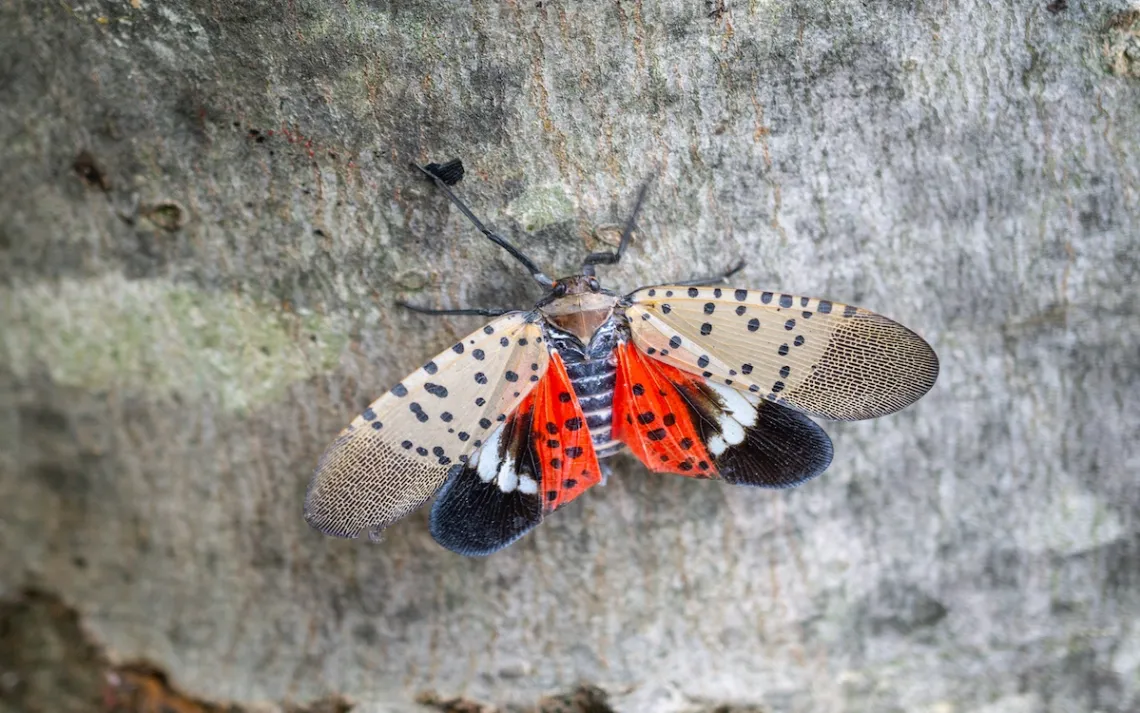
Photo by arlutz73/iStock
The striking yet destructive spotted lanternfly has devastated agricultural areas and forests across parts of the United States over the past decade. Native to Asia, spotted lanternflies were first detected in the United States in 2014 in Pennsylvania. They’ve now spread to 19 states, likely due to unintentional transport, with a particular concentration in the mid-Atlantic.
The insects have voracious appetites, sucking gluttonous amounts of sap from trees and plants. This weakens their structure, and the sticky honeydew left behind invites the development of fatal diseases, such as sooty mold, and other pests. It’s a particular concern for many agricultural areas, notably vineyards. A January 2025 study in the Journal of Integrated Pest Management estimated that New York’s grape industry could eventually lose almost $9 million each year due to these insects.
While cities and landowners have tried everything from vacuums to circle traps to reduce their numbers, others are turning to a more innovation solution: dogs.
A dog can have almost 300 million olfactory receptors, making them one of nature’s most effective detectives. Bronco, a cardigan Welsh corgi that is one of four certified scent detection dogs, is one example. His owner, Paige Malone, volunteers him as a lanternfly detection dog to Cleveland Metroparks, a network of more than 325 miles of trails spanning over 25,000 acres. Bronco’s nose is capable of detecting scents we couldn’t even comprehend, like the insect’s eggs. The one-inch-long grayish-brown patches, filled with up to 50 eggs, are laid discreetly on hard surfaces, such as trees, benches, firewood, and even vehicles, making them tricky for the human eye to perceive.
“I wanted to find something more useful to the community,” says Malone. She had trained him since he was a puppy for competitive scent detection. “Once we found out about [the lanternfly need] we started in again with scent work. I knew I had good nose training down; it was just adding in that new odor.”
Cleveland MetroParks turned to dogs to help fight lanternflies after Connie Hausman, its senior conservation science manager, attended a lanternfly research and technology development meeting in 2024. “There was a poster [telling] how trained dogs were being used to locate and identify [spotted lanternfly] egg masses,” she says.
Coincidentally, about a month later, Hausman was contacted by some local dog teams that completed training through the Virginia Tech program advertised in the poster. They were looking to continue their dogs’ training and she proposed registering them as a volunteer team. The park system now has four certified scent detection dogs and their owners assisting, like Bronco and Malone.
Once a week, starting around the end of October and going into April, Bronco and Malone, alongside another scent detection team volunteer, trek through the park system’s priority locations—those where there are large lanternfly populations. As with many friendly dogs, Bronco sometimes gets distracted from his work, hoping for pets from parkgoers, but once an egg mass whiff hits his nose, he’s instantly focused.
“I can tell before he gets directly on an egg mass,” says Monroe. “His body and demeanor change. He holds his nose as close as possible and freezes his body.”
Bronco is rewarded with a favorite snack, like freeze-dried minnows, when he finds an egg mass. Monroe then examines the space, sometimes scraping the cluster off, and keeping a tally of how many are discovered. She then alerts the park to the locations. A few fresh ones might also be carefully saved to keep Bronco’s scent training up-to-date. This is the second season the park system has collaborated with lanternfly detection dogs. In the last season, Bronco and his team found and destroyed 3,500 egg masses.
In Pennsylvania, Lucky and Ruby assist the Pennsylvania Department of Agriculture. Lucky, a six-year-old German shepherd, is the United States’ first trained spotted lanternfly detection dog and joined the department in November 2020.
“She does inspections through the fall and winter months, finding egg masses that otherwise would have gone undetected [and] preventing possible transport of eggs outside the quarantine to infest a new area,” says Shannon Powers, a Pennsylvania Department of Agriculture spokesperson. Ruby, a three-year-old Dutch shepherd, joined the force in 2024. Both dogs search similar spots, like greenhouses, vehicle fleets, and log yards, but Ruby focuses on these in western Pennsylvania.
The notion of using dogs to sniff out lanternfly eggs is a recent one. Virginia Tech was one of the first to study the solution. For a study about five years ago, 182 canines from across the US were enrolled in the scent detection training. Handlers were free to choose how they trained their dogs to find the provided devitalized egg samples, but they had to make sure their dog received a positive reinforcement when they uncovered eggs.
“What’s really fun is it seems any dog can do this,” says Erica Feuerbacher, an applied animal behaviorist and study coauthor. “Of course, there are differences [in breed abilities]. Pugs can’t handle tough terrain or high temperatures that dogs like a [German] shepherd could, but in scent detection, a lot of dogs do just as well.”
One of the biggest training challenges for handlers is ensuring their dog recognizes the correct smells. For instance, while lanternflies are often found on their host plant tree of heaven, a dog needs to learn it's not the tree’s scent they’re seeking, but rather what could be hidden on the bark. It’s a learning process that can take a few months.
“We were adding different distractions,” says Monroe regarding the training. This included maple tree bark, grass, and rubber gloves (commonly used to handle egg samples). “With conservation, especially being out and about in the parks with people and dogs, you definitely have to work through distractions and [teaching dogs] to ignore those and to only alert for egg masses,” says Monroe.
Uncovering eggs during the “hunting” season is crucial, because once hatched, it’s pretty much a lost cause until autumn arrives again. “The benefit of being able to use these dogs is the window of time for egg masses which are the longest of the life cycle,” says Connie Hausman, the Cleveland Metroparks senior conservation science manager who encouraged the use of lanternfly detection dogs here. “Those egg masses are available for detection until the eggs hatch in the spring.”
“The egg masses have a really subtle earthy scent [for humans],” says Feuerbacher. “I just think it’s amazing dogs can distinguish that.… It’s just a reminder of the rich world they have through their olfaction we aren’t privy to.
The impact these dogs are making in their communities is gaining attention. Apart from citizen scientists, many state agencies are adding lanternfly detectives to their crew, like the Tennessee Department of Agriculture in August 2025. There are even hopes that eventually these noses could find other species, including Chinese and European praying mantids at Cleveland Metroparks and box tree moth eggs and larvae in Pennsylvania—something Lucky and Ruby are cross-trained to detect. Virginia Tech is also studying whether dogs, especially those without previous scent training, could help determine the deadly Pierce’s disease in agricultural areas and trees.
“In particular areas, spotted lanternflies might not be a concern, but something else is,” says Feuerbacher. “Our hope is that lots of teams develop locally and can be really flexible and have a quick reaction to whatever local concerns are.”