College Life Can Really Change a Bird
Urbanization is transforming dark-eyed juncos as well as chipmunks and voles

A dark-eyed junco
On any given spring day, there are upwards of 20 bird species around my backyard feeder. Underneath it, bunnies, squirrels, and chipmunks huddle for a shared meal of dropped seeds and fresh sunflower shoots. In the winter, there’s a shift. Snowbirds arrive, including dark-eyed juncos. These gray-and-white “birbs” (little, adorably round birds) forage for seeds, cautiously flitting up to the shrub nearby every few seconds before returning for more.
Dark-eyed juncos are the subject of a new PNAS study, which shows that juncos at the University of California, Los Angeles, campus have developed beaks that are shorter and thicker than their wilder, nonurban cousins, whose beaks are longer and thinner. The culprit for these changes might be human activity.
In 2018, study authors Pamela Yeh, an evolutionary biologist at UCLA, and Eleanor Diamant, assistant professor of biology at Bard College, began banding and measuring dark-eyed juncos on the UCLA campus and in the wildlands farther out to study their breeding behaviors. Then the pandemic hit. The Covid shutdown that upturned lives everywhere left the campus empty and disrupted their research. It also presented an opportunity: How would the urban dark-eyed juncos change without human influence?
“Because we had already done the groundwork prepping for the field season,” said Diamant, “we knew that the first nest on campus was set to hatch a week after the campus closed fully. So we also had this unbelievable … once-in-a-lifetime natural experiment, where we knew that the birds that hatched that year, the vast majority, at least, if not all, hatched in conditions without human activity.”
This enabled them to study the life stages, behavior, and phenotype changes of the birds in conditions without human food waste.
In their natural habitat, a well-rounded diet for juncos includes insects and seeds; on campus, that diet looks more like the ultra-processed foods that tend to disappear under a dorm room dirty-clothes pile or in bins that fill campus walkways. Campus junk-food juncos would eat those scraps, pecking them off the cement nearby. Without that resource, they returned to their natural foraging.
“There was a little bit of time lag,” said Diamant, but those juncos that were born during the second year of the pandemic developed thinner and longer beaks that were closer to their wildland families'. Urban juncos generally have two to three broods a year because of plentiful resources, while wildland juncos may only have one to two. When campus reopened and human foods became a resource again, the juncos born after returned to the thicker beak shape. Their hypothesis is that this rapid change reflects an evolutionary change occurring under strong selection pressures of human food waste.
“Those that could exploit them [resources] better still managed to produce a number of offspring,” said Diamant. “But there were accumulated differences in the next year: Those that could maybe eat seeds more, or exploit those better, had more offspring, which we’re seeing as adults the following year.”
Evolutionary change is generally small changes over long periods of time, but when there are enough strong selection pressures, important, unique shifts like these can happen.
The Galápagos archipelago is a quintessential example of strong selection pressures leading to widely disparate changes on islands over time. Last year, when I was in the Galápagos, I had a chance to see how strong selection could impact species isolated on unique islands in the archipelago. Giant Galápagos tortoises, for example, had different shell shapes depending on whether they could forage from the ground or if the plants on an island required stretching their necks upward.
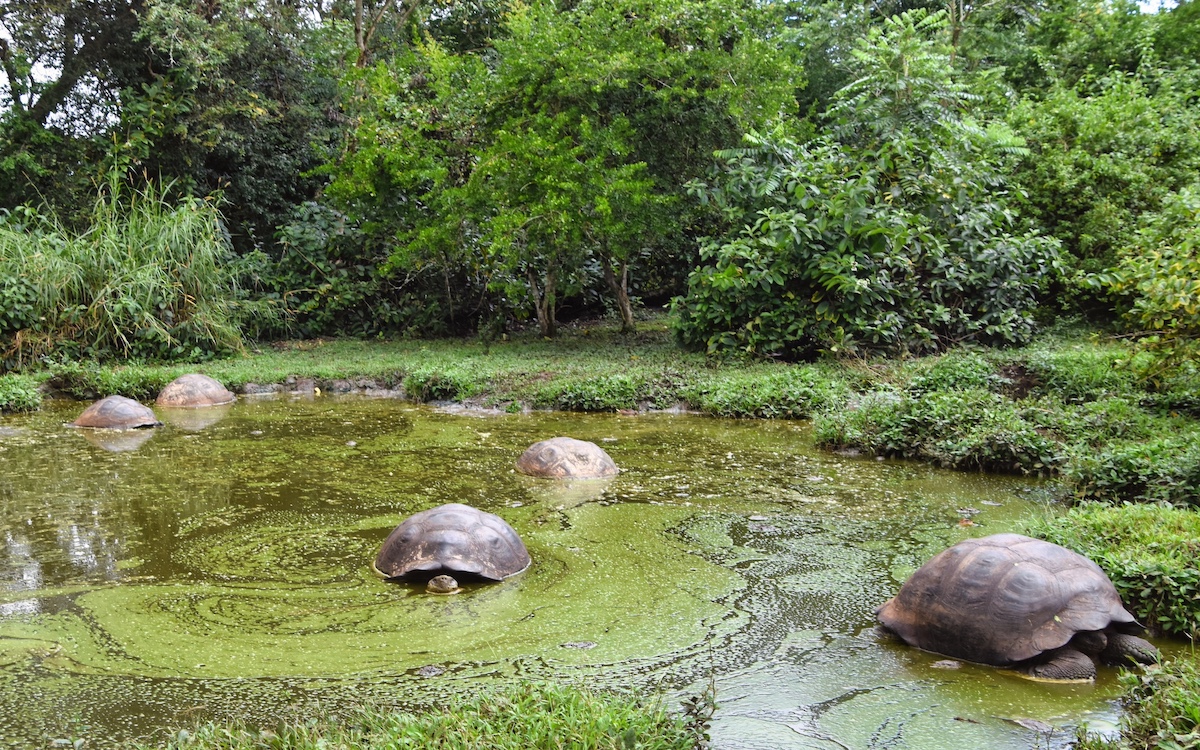
Giant Galápagos tortoises
But even in the Galápagos, where selection happened quickly for an evolutionary timescale, strong selection pressures can lead to quick responses in just a short period like that seen with the juncos.
Yeh pointed to a study of the response of Galápagos medium ground finches to the impact of a drought in the late 1970s. The food supply of mostly small seeds shifted, and the plants with larger seeds and access to “moisture” won out. That left “mostly large seeds and hard seeds, and the [birds] that could crack open those hard seeds were the ones with bigger, deeper beaks.” That led to a massive die-off of smaller birds and was followed by an increase in the population of larger birds later on.
On the UCLA campus, the pressures are strong and human driven. But it’s not just juncos that feel the impact of humans on their lives. A recent study of eastern chipmunks and eastern meadow voles in Chicago showed significant changes over a 125-year period due to life in Chicago.
“The first thing I did when I arrived here [in Chicago] was to revise our collection database to become fully aware of what we have,” said Anderson Feijó, assistant curator of mammals at the Negaunee Integrative Research Center at the Field Museum of Natural History in Chicago and a study lead. In that collection, he found specimens of rodents from over a century from the same areas.
Most scientific studies of animals can only be done over shorter periods of time (like that of the juncos), but he and his coauthors saw a rare opportunity in front of them. With over a century of skulls from chipmunks and voles in the collection, said Feijó, they could see how these biologically distinct rodents, one spending more time above ground than the other, “are responding to the same pressure in the same city.”
They found that chipmunk skulls grew larger, while their teeth row became surprisingly shorter, likely to adapt to the kinds of human foods they ate, and vole skull shapes varied based on the degree of urbanization, and vole ears had developed “smaller auditory bullae,” likely to adapt to sound in Chicago life. Their speculation on the causes behind these phenotype changes, said Feijó, will be tested this year through isotope studies and re-creation of brain shape from the skull data.
Both Yeh and Feijó see their studies as part of a growing area of research, pointing to a famous study of rat morphology in New York. It showed cranial and mandible shape changes for brown rats over a 120-year period, also with reduced tooth rows that were likely an adaptation to a softer, human diet.
“Science is dynamic,” said Yeh, noting that studies like these are helping to fill in the gaps and increase what we know and how we understand the space humans share with other animals.
The animals around us are being “pushed toward adaptation,” said Feijó, forced to survive new environments that “are not natural to them” thanks to human activity. He said that if change happens too fast, there will be a limit to adaptation and “that is why we have large-scale extinctions.”
“I think so many people think of humans [like], ‘We’re here, doing our own thing, and then nature is out here,’” said Yeh. “But it’s really incredibly interconnected, and we affect them, and they affect us.... We’re just another animal.”