Earth Breaches Seventh Planetary Boundary as Oceans Become More Acidic
The planet is increasingly in danger of exiting the “safe operating space” for life
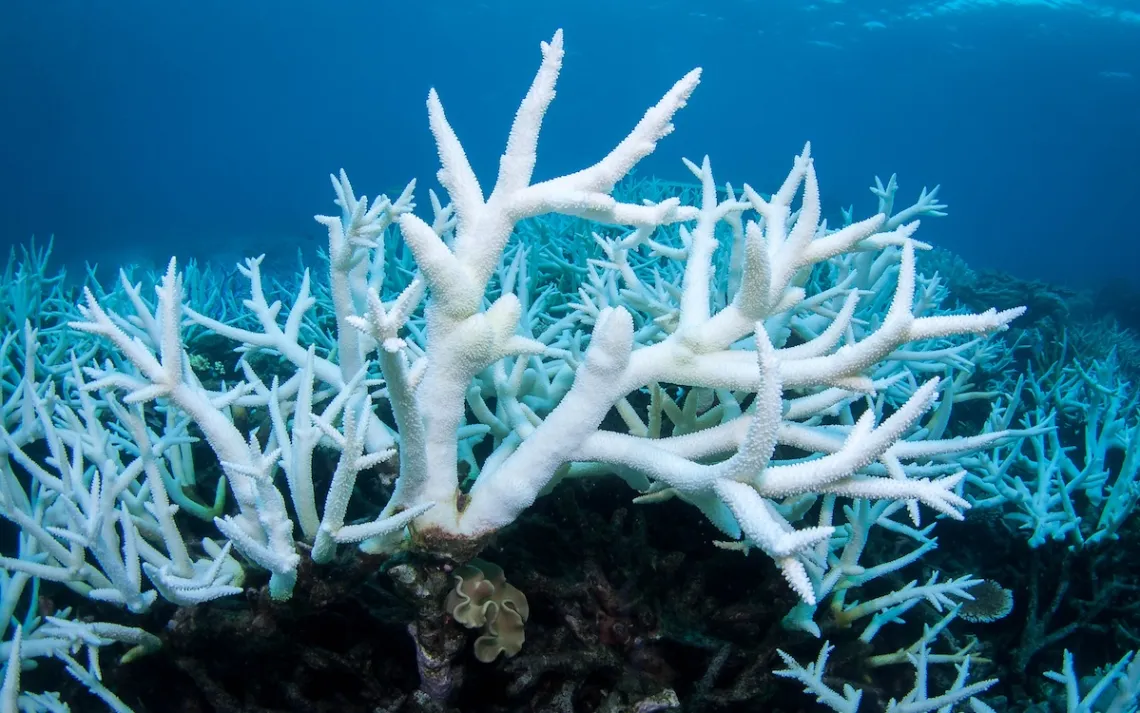
A 2017 bleaching event at the Great Barrier Reef. | Photo by Brett Monroe Garner/Getty Images
The Planetary Boundaries Science Lab at the Potsdam Institute for Climate Impact Research (PIK) released a report in September that showed seven of the planet’s nine critical Earth system boundaries have been breached, including a new one this year: ocean acidification. The Planetary Boundary Health Check report warns that now more than three-quarters of the earth’s support systems are beyond a “safe operating space.”
In addition to ocean acidification, often called the “evil twin” of climate change, boundaries have been crossed in the categories of climate change, biosphere integrity, land system change, freshwater use, biogeochemical flows, and novel entities (human-made chemicals and plastics). These are systems upon which human life depends.
“Humanity has enjoyed a very consistent climate over the past 10,000 years, which has really been the foundation for all of our society, of our civilization,” said Niklas H. Kitzmann, a scientist at the Planetary Boundaries Science Lab who served as lead writer and editor for the report.
On a planet with predictable climate trends, farmers can anticipate seasons and plant and harvest accordingly; consistent biogeochemical flows provide the nutrients for plants to grow; and access to freshwater makes it possible to irrigate the plants. With these systems out of balance, life on Earth will become increasingly less comfortable for humans, or at worst, in jeopardy.
“Luckily, we haven't seen any of the systems go completely out,” said Kitzmann. “But we're really pushing them beyond the limits.”
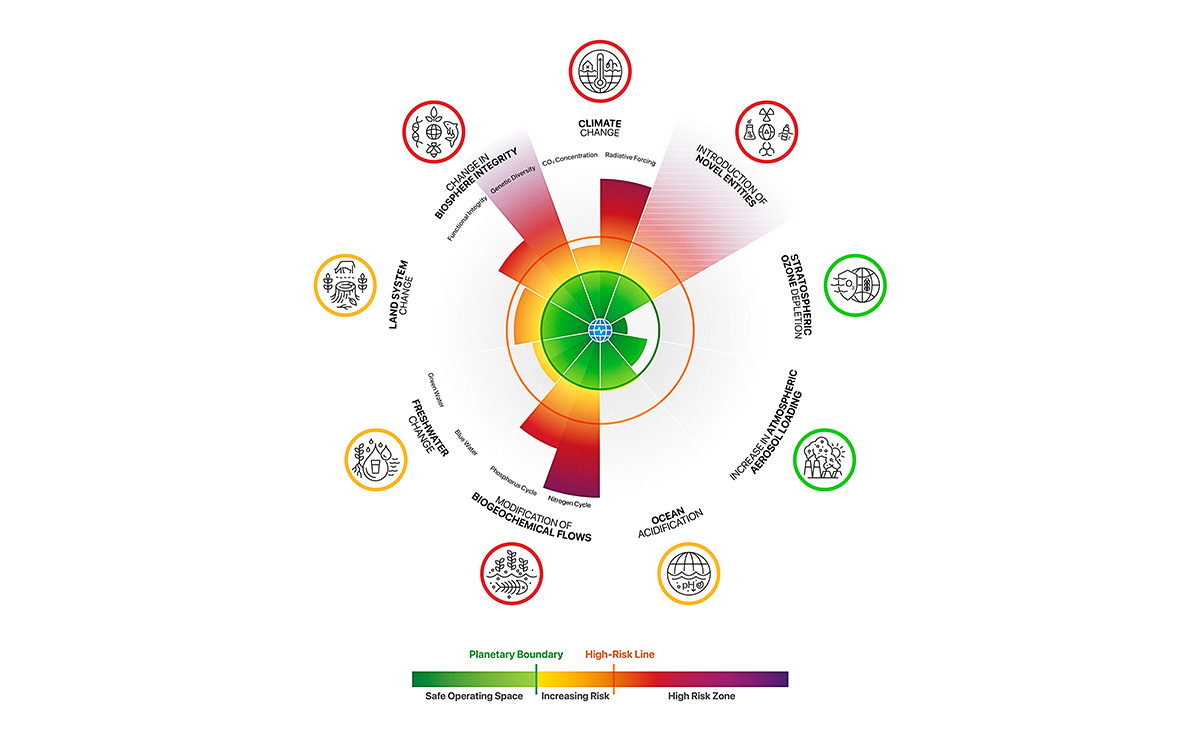
Image courtesy of Planetary Boundaries Science Lab
A separate report just released by the Copernicus Marine Service supports the conclusion that ocean health across the globe is at greater risk—manifesting what the United Nations has referred to as the triple planetary crisis, when climate change, pollution, and biodiversity loss affect oceans at a scale that threatens its ability to support key species and to act as a climate stabilizer. About 16 percent of endangered and 30 percent of critically endangered corals are exposed to rapid ocean warming or acidification.
The Planetary Boundary sets the safe operating space for ocean acidification at 80 percent of preindustrial levels, and it was crossed this year. This change threatens organisms like sea snails, corals, and plankton by damaging their calcium carbonate shells and skeletons. It also impacts their reproductive rates and growth rates. The loss of these organisms has ramifications up the food chain and would be hugely disruptive to marine ecosystems and fisheries.
Ocean acidification is overwhelmingly caused by buildup of carbon dioxide in the atmosphere. Stated another way, the root causes of climate change—fossil fuel combustion, deforestation, land use change—and ocean acidification are the same.
“We have to look at the planet as a really interconnected whole.” Kitzmann said. “One of the main messages [of the planetary boundaries framework] is, it's not just the climate or the biosphere; it's all of these interconnected things.… If we want to stop ocean acidification and all these other things, we have to stop emitting CO2. We have to stop burning fossil fuels,” he said.
While there are no known “tipping points” for ocean acidification, the same cannot be said about climate change in general. The collapse of major ice sheets, disruption of ocean currents, and the degradation of the Amazon rainforest could all contribute to such a change.
Kitzmann notes that while steering us back to safety may be a daunting task, especially in the category of climate change, we have seen an earth system go from danger zone back to safety before. “Ozone is a really positive example. It's of course orders of magnitude smaller than what we're proposing we do right now. Nonetheless, it does show that if we understand the direness of the situation, as a global society, we can come together and quickly demand change.”
Kitzmann points to the fact that we already have the technology—solar, wind, and more—needed to bring our climate back into the safe zone. “This is not an unsolved problem where we don't know what to do. We urgently need strong political action … also from private society, from industry, from all sides.”
The Planetary Boundaries framework sets forth the same goal as the Paris Agreement of 2015 to limit global warming to well below 2°C—preferably 1.5°C—above preindustrial levels. Achieving this goal would also help reverse ocean acidification.