ENVIRONMENT EXPLAINED
Breaking Down Compostable Bags
What you should know about these increasingly popular products
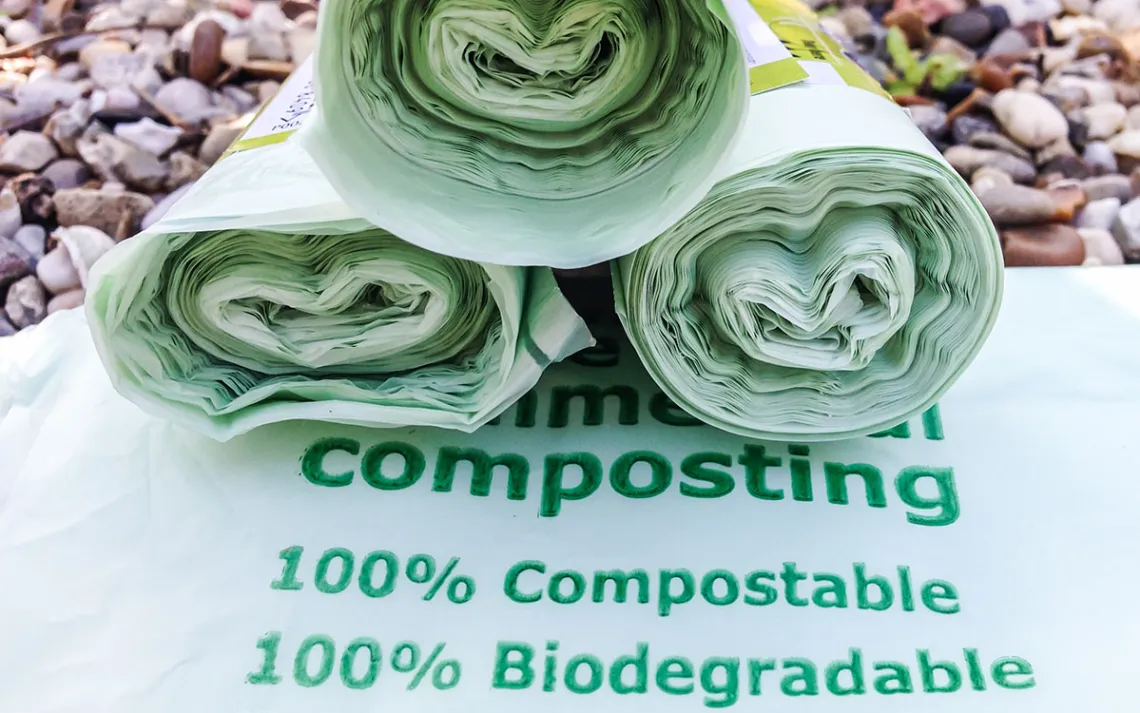
Photo by Deborah Pendell/Getty Images
We ask a lot from compostable bags. They have to hold in leaky organic material, and then disintegrate along with their cargo. They have to be strong, then fall apart at just the right time. (When people can do this well, we give them Oscars.)
The compostable-packaging landscape is dynamic and tricky. But deployed properly, compostable bags can be a helpful tool on our collective journey to create healthy soil and eliminate food waste. Here’s what you need to know about how to use them and when to lose them.
What does compostable mean, anyway?
In recent years, interest in compostable bags—along with other similar products, such as cutlery and packaging—“kind of just took off,” said Diane Hazard, executive director of the nonprofit Compost Research and Education Foundation (CREF). According to one industry report, the compostable-bag market reached $374 million in 2023. Experts expect further growth fueled by consumer interest in sustainability as well as pro-environmental regulations like plastic-bag bans.
Burgeoning markets can sprout confusing vocabulary. It’s easy to get tripped up by terms like biodegradable—which just means the product will break down into something eventually—or bioplastic, which indicates only that something is made from plant-based polymers, not necessarily that it will break down like a plant would.
Currently, there is no legal definition for the word compostable. If a product is labeled Certified Compostable, that means it has been validated by a recognized certification body and meets certain standards. For instance, bags certified by the Biodegradable Products Institute (BPI) fulfill the requirements set by ASTM International, an organization that provides voluntary standards that can be used to measure materials for strength, structural integrity, and other factors. Bags that meet its standards are known to break down into harmless materials after fewer than 12 weeks in a commercial composting setup.
In many cases, standards are eventually worked into legal regulations. For example, in the United States, plastic toys must meet ASTM safety standards, and the USDA has enforceable standards for what is considered "organic." Some composting advocates would like for "compostable" to follow a similar path—and some states, including California, have already banned the use of "compostable" and "biodegradable" to describe plastics that don't meet certain standards. In the meantime, look for a Certified Compostable label on products to indicate that a company has opted into certification.
How do compostable materials break down?
Over the course of this compostable-bag boom, manufacturers have developed a number of materials that achieve the tricky balance between holdup and breakdown. Once it reaches the necessary temperature in the middle of a pile, “each material type is going to have its own pathway to assimilation,” said Susanna Carson, founder and CEO of BSIbio, a Canadian compostable packaging design and distribution company.
Paper bags with cellulose linings “degrade slowly and become part of the structure of the compost.” They retain water and help to structure and promote airflow through a compost pile—the same role that leaves play in nature, Carson said.
Bags made from the popular biopolymer PLA (polylactic acid), which generally comes from fermented corn or sugarcane, get their strength from long chains of repeated molecules. When they are exposed to heat and water, these chains break into smaller pieces, which are either chomped up by microorganisms or degrade completely into lactic acid. Microorganisms also create and break down another polymer type, PHB, potentially with the help of fungi
Materials scientists are working on more options, some of which may eventually compost more flexibly or easily.
Does your commercial or municipal service accept compostable bags?
In the meantime, the most important thing for the average kitchen warrior to figure out is whether their local composter accepts these bags at all.
Compostable packaging (and compost in general) is an “emerging, evolving topic,” Hazard said. “Everyone is trying to adapt—from compostable manufacturers, to compost manufacturers, to jurisdictions.”
In 2016, the CREF and BSIBio started the Compostable Field Testing Program (CFTP), an open-source initiative that aims to systematically determine how quickly compostable packaging disintegrates in different conditions. The goal is to “give compost operators the information they need to make good decisions,” Hazard said.
Commercial composters may or may not accept compostable bags, which also impacts any public or private pickup services working with those composters. To learn what your hauler is willing to take, check with them specifically, and ideally often, Hazard said. The changing landscape can mean the rules change too.
Will compostable bags work with your home composting setup?
If you compost on your own rather than using a service, your compostable bag’s journey is harder to predict. Most home composting heaps don’t reach the temperatures of commercial facilities—they’re simply not big enough.
You don't necessarily need commercial-level temperatures to get effective bag breakdown, said Andy Brooks. Brooks is the cofounder of Bootstrap Compost, a composting business headquartered in Jamaica Plain, Massachusetts, that serves residential and commercial customers in the Northeast. Bootstrap lines their buckets with compostable bags, even though they do some of their composting on small farms, where piles might not reach the heat levels of commercial facilities. “We hit the bags with a pitchfork, and then we slice them with a hay cutter,” exposing them to oxygen and moisture, he said. “When we do that, we have great success.”
Although home compost piles are generally smaller and less hot than those on farms, the occasional compostable bag won't be an issue, and might even assimilate itself. A home composter should not “go buck-wild trying to process these things,” Brooks cautions. “But if you have a few items that fall into that category of nonfood organics that you do want to process, and you're doing a good job managing your pile … there's no reason, in my opinion, that you can't at least attempt.”
Carson has tried to compost PLA cups in her own backyard, just to see. It works, but the process is slow, she said. There is “breakdown over the course of years,” rather than weeks.
A compostable bag that ends up somewhere it really shouldn’t be—like in a landfill, or on the side of a road—won’t break down properly. “But if it’s working as designed, it will not have a negative impact,” Carson said.
Why use compostable bags at all?
Because one goal of composting is to reduce waste, it may seem counterintuitive to add another product to the mix. But professionals in different parts of the compost sector say that the availability of compostable bags has helped more people get on board.
Bootstrap Compost started using compostable bags around 2013. Before that, customers’ scraps went in bare buckets. Once they started lining them, they never looked back. “It’s helpful operationally,” Brooks said, and fits their ethos as a premium composting service. “We're cleaning all the buckets, and we're taking all that time and effort to make them nice and shiny, so throwing a bag in there is sort of like the cherry on top.”
Hazard thinks that bags help people get on board with something that can initially seem off-putting or icky. As composting efforts ramp up across the country, anything that smooths onboarding is welcome. “The bags help people to compartmentalize, literally and figuratively,” she said.