 The Magazine of The Sierra Club
Federal Funding Cuts Are Silencing the Wild
Mass firings may spell mass species loss as the Capitol clamps down on conservation spending
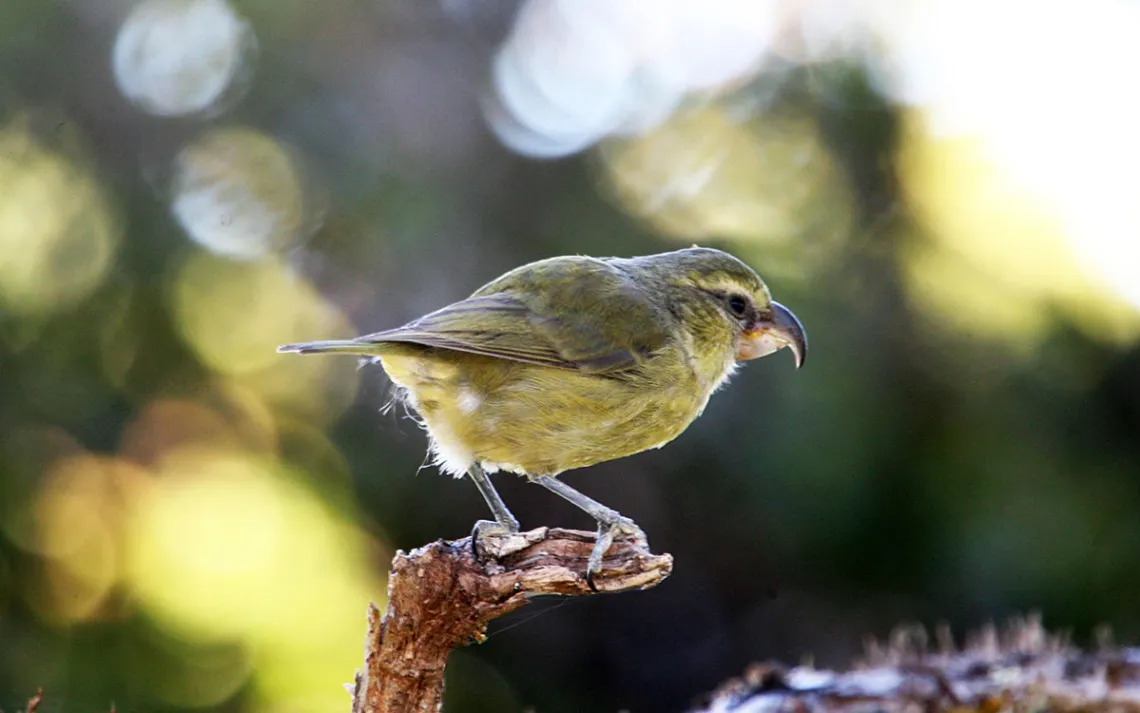
A kiwikiu rests on a branch. | Photo by Michael Walther/Oahu Nature Tours Inc. via Alamy
The calls of Hawai'i's kiwikiu, a honeycreeper found only on Maui, could soon vanish forever. Avian malaria and habitat loss, due to ranching and feral livestock, have hindered conservation efforts for over a decade. The kiwikiu is one of just 17 remaining honeycreeper species after more than 30 have gone extinct over the past century. The work of federal employees at the US Fish and Wildlife Service (USFWS), which is the agency charged with managing threatened and endangered species, has helped keep this struggling population on life support. Now, President Trump’s downsizing of the federal workforce is jeopardizing efforts to save these at-risk birds.
This trend has accelerated as Elon Musk, in his position as the lead at the Department of Government Efficiency (DOGE), has purged federal agencies of their most experienced employees. At the USFWS, Musk led an effort that some called the Valentine’s Day Massacre, where over 400 people were laid off. Facing an unprecedented brain drain, the agency spiraled into chaos, with reports of new layoffs putting federal workers on edge. The ripple effect disrupted not only the agency itself but also collaborations with states, tribes, and NGOs. According to former USFWS director Steve Williams, it could take "decades" to rebuild expertise lost in areas like endangered species policy and climate adaptation.
“Losing this many dedicated employees all at once is an especially devastating blow to conservation efforts nationwide and an intentional dismantling of science,” Desirée Sorenson-Groves, the president and CEO of the National Wildlife Refuge Association, said in a press statement when the firings were announced. “The National Wildlife Refuge System was already underfunded and understaffed. The people being fired today are the backbone of wildlife protection in this country. Without them, habitats will degrade, endangered species will go unmonitored, trails will remain unmaintained, and visitors will lose access to environmental education and recreation opportunities.”
A crisis for endangered birds in Hawai'i
Nowhere is this more evident than in Hawai'i, a biodiversity hotspot where unique species already face threats from climate change, invasive species, and habitat loss. On Kauaʻi, staff dismissals have disrupted operations at three national wildlife refuge sites, including the Kauaʻi National Wildlife Refuge. Here, wetlands serve as critical habitats for endangered water birds such as the Hawaiian stilt (aeʻo) and Hawaiian duck (koloa). Steven Minamishin, a former maintenance lead at the refuge, described how his team’s work managing water systems was essential to preventing avian botulism outbreaks, a deadly disease that threatens the lives of Hawai'i’s water birds.
“It's a massive thing that we need to monitor daily. And without that monitoring, it can be catastrophic.” Minamishin explained. He also pointed out that water-related risks are amplified further by environmental changes. “We've had increased flooding over the recent years, including the largest flood in a 24-hour period in the nation's history, which happened in 2018. And those events really exacerbated this critical habitat threat. That in itself is a monumental task to manage.”
Meanwhile, on the Island of Hawaiʻi, the Hakalau Forest National Wildlife Refuge, home to rare honeycreepers such as the ʻākepa and ʻakiapōlāʻau, has lost half its workforce. The loss is severely hindering habitat restoration and invasive species control. Losing any of these species could further destabilize Hawai'i’s ecosystems, according to the Hawai'i Department of Land and Natural Resources. Native birds still play vital roles in pollination and seed dispersal, but their decline has already led to changing seed dispersal patterns and research suggests that a continued decline could disrupt natural regeneration processes.
A national and global ripple effect
Hawai'i is not alone in facing these challenges. In Texas, similar cuts threaten recovery efforts for the Attwater’s prairie chicken, one of North America’s most endangered birds. Nationwide, an estimated 420 USFWS employees have been laid off, leaving critical conservation programs understaffed or abandoned altogether. The biologists at the Attwater Prairie Chicken National Wildlife Center played a role in maintaining an optimal habitat for the birds, as well as monitoring the health of the species and participating and captive releases. Now, the fragile progress that has been made in growing the species is threatened by loss of experienced staff.
The impact of federal cuts has also been felt in the Great Lakes, where the US Fish and Wildlife Service’s sea lamprey control program faced mass firings. Here, the program to control this invasive species is vital to the health of the region’s fisheries and worth millions of dollars annually. Given the “mission critical” status, some staff has been subsequently rehired, but this is just one example of how much is at stake when it comes to federal changes in funding.
Meanwhile, international conservation programs funded by USAID have also been impacted due to funding cuts. The abrupt halt affects hundreds of millions of dollars in annual biodiversity funding (USAID contributed over $375 million to biodiversity projects in 2023) and jeopardizes decades of progress for endangered species. The funding freeze halted $70 million for biodiversity and conservation projects in Colombia alone. Across the world, budget reductions like this have directly disrupted global conservation efforts by forcing reductions in anti-poaching patrols. This could spell disaster for species with slow reproductive rates, such as Sumatran rhinos (fewer than 50 remain), who face even greater risks without these protections as they are vulnerable to poaching and further isolation into fragmented populations.
David Wilcove, a professor of ecology and evolutionary biology at Princeton University with over 15 years of experience working in major conservation organizations in Washington, DC, is deeply concerned about both the short- and long-term effects of this budgetary crisis. He explained that federal support for endangered species conservation has long been insufficient and warns that, “any further cuts either in terms of money to the programs or staffing of the programs is going to inflict further damage on our ability to protect wildlife.” Wilcove notes that neglecting already vulnerable wildlife could lead to “irreversible outcomes like the extinction of species.” Beyond the ecological toll, he stressed that these cuts carry significant social and economic consequences, threatening not just biodiversity but the communities and economies that depend on healthy ecosystems.
A report by Southwick Associates underscores this point. Every dollar spent on conservation returns $2.40 in economic activity through tourism, recreation, and ecosystem services like clean water and air. Yet with federal funding slashed and workforce reductions underway, even basic ecosystem management practices, such as invasive species control or habitat restoration, are being delayed or abandoned.
What lies ahead?
Though volunteers and seasonal workers have always played an important role in conservation efforts, they simply cannot replace the expertise and capacity of experienced federal employees. Professionals like Minamishin and his team at the Kauaʻi National Wildlife Refuge Complex bring years of institutional knowledge to managing public lands and wildlife resources. He pointed out that developing skill sets and know-how to manage park resources can take years. With an ever-dwindling team of full-time employees, “nobody's there to train these seasonal people. It's not something they can just show up and do. And it takes an enormous amount of skill and experience to do these things,” he said. The loss of early-career professionals due to probationary terminations compounds this issue further by jeopardizing the future pipeline of skilled conservationists.
Ed Arnett is the CEO of the Wildlife Society, a network of 10,000 professional wildlife biologists, managers, scientists, academics, and students. He pointed out that delays in federal funding and the loss of skilled staff jeopardize science-based decision-making, the management of public lands, and the training of future conservation professionals. According to Arnett, “we’re witnessing the erosion of America’s conservation institutions. Workforce reductions will have long-lasting impacts well beyond federal agencies—trickling down to NGOs, academic institutions, and ultimately to species themselves.”
While federal funding shortfalls persist, public-private partnerships and grassroots advocacy have emerged as critical stopgaps. The Recovering America’s Wildlife Act (RAWA) coalition, led by the National Wildlife Federation and uniting 1,500+ businesses, tribes, and conservation groups, exemplifies large-scale advocacy, is pushing for $1.4 billion annually to preemptively protect at-risk species. Defenders of Wildlife is another group lobbying for Endangered Species Act funding and partnering with groups like ranchers to set up coexistence programs. Increased state funding, private donations, and advocacy for reversing federal cuts could help mitigate some of the damage, and community involvement also serves as a way to support local conservation initiatives.
After all, a future without biodiversity is a future without resilience. The web of life is not a luxury but a lifeline: When species vanish, ecosystems unravel, and humanity puts itself at risk, conservationists warn. To protect biodiversity, wildlife advocates say, is to safeguard humanity’s future, ensuring clean air, reliable food systems, and a world teeming with different types of life forms supporting one another. Simply put by Wilcove: “We need the other species on this planet to have a livable world.“