 The Magazine of The Sierra Club
Healthy Ecosystems Need Their Keystone Species
Here's why
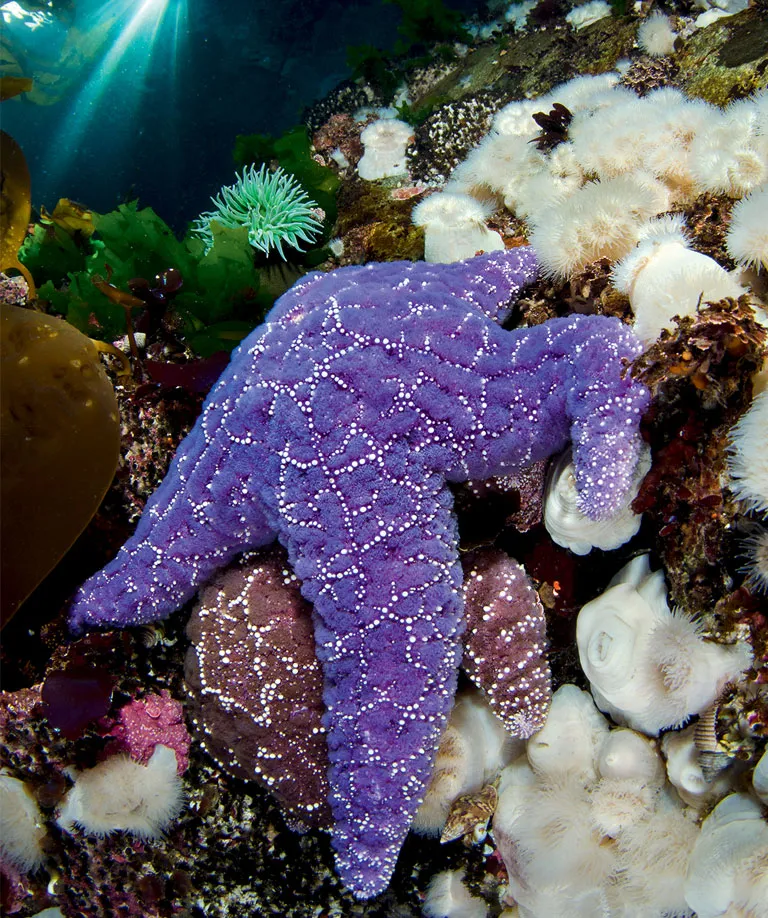
Photo by Alex Mustard
If you've ever played Jenga, you know what happens when you pull out one important block—the tower comes crashing down. In Minecraft, a similar thing happens: Pull out one block of sand and everything above it falls. In real life, some things work the same way. The top wedge-shaped stone in an archway, called a keystone, locks the surrounding stones in place and keeps the arch from collapsing.
About 60 years ago, a scientist named Bob Paine thought to use the term keystone species to help people understand how important sea stars were to their environment.
Paine was studying tidal pools at the edge of the Pacific Ocean in Washington state. He had a hunch that ochre sea stars were important to keeping that ecosystem balanced. Paine did an experiment to test his theory. He took notes on the many species he found in each pool—from limpets to sponges to snails. Using a crowbar, he then removed the sea stars and placed them farther out into the sea.
Three years later, Paine returned to the pools and found only eight species left. Ten years later, he found only one: mussels. Without the predator sea stars there to eat and control the mussels, the food web became unbalanced and suffered. The sea stars, it turned out, were crucial to keeping life healthy in the tide pools. Since then, scientists have identified hundreds of other species, in many sizes, that play extremely powerful roles in their habitats.
“You don’t have to be a keystone to be important,” explained Emily Fairfax, an assistant professor of geography at the University of Minnesota, “but if you are keystone, you’re really important.”
Consider the beaver. The largest rodents in North America, beavers are known as ecosystem engineers because they build sturdy dams, using sticks and mud, that reshape landscapes into wetlands. Adding more water to an area allows other creatures, like birds and fish and dragonflies, to thrive.
Keystone species are often predators. By hunting other species, wolves keep ecosystems balanced. After wolves were exterminated in Yellowstone National Park over 100 years ago, there weren’t enough predators to control the elk. The elk then ate trees, flowers, and grasses along the rivers and eroded their shores. Birds, bees, and small mammals had fewer food sources and no place to hide from predators, so their populations dropped. In 1995, scientists and park rangers reintroduced wolves into Yellowstone. Once again, they preyed on the elk, and the vegetation bounced back. Soon the insects and animals came back too, along with more bears and other creatures.
“Some organisms have more consequence than others, in the same way that your most valuable player has more influence than other teammates,” said Mike Phillips, who worked with the National Park Service on both red and gray wolf restoration efforts.
Some scientists also give MVP credit to the “mutualists”—plants, animals, and organisms that form important partnerships with other species. Bees, for example, collect nectar and pollen for food. As they move from plant to plant, they spread pollen, enabling flowers to grow.
Keystone species help scientists better understand how our marvelous world, with all its biodiversity, works. They remind us that all living things are connected—and that the stronger those connections are, the more we all thrive.
MORE KEYSTONE SPECIES!
Sharks are top predators that help balance marine ecosystems.
Sea otters eat sea urchins, which protects kelp forests from being devoured.
African elephants create water holes, spread seeds, and maintain grasslands by eating trees.
Oak trees support more insects, birds, and mammals than any other type of tree in North America.
Mangroves stabilize shorelines and provide fish nurseries.