The Magazine of The Sierra Club
From Growl-Rumble-Whoops to Moan-Whines: Hawaiian Monk Seals Have a Vocal Repertoire Full of Surprises
The endangered species is the only pinniped known to string together vocalizations with no break
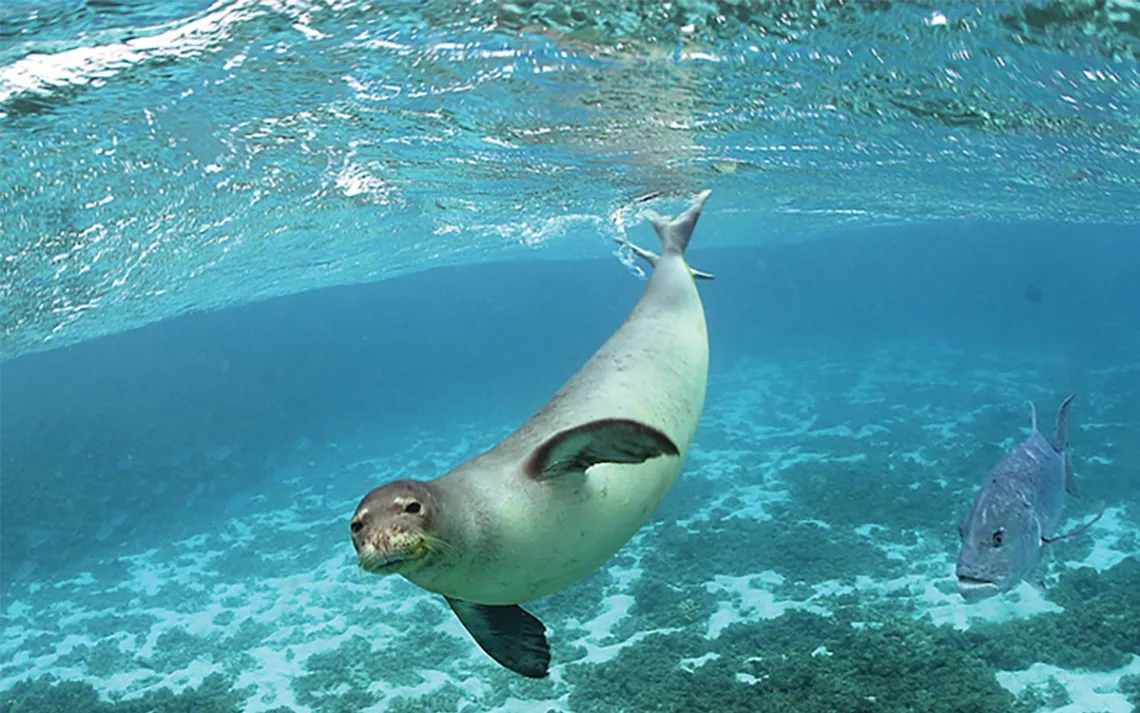
Hawaiian monk seal at the Pacific Islands National Wildlife Refuge. | Photo by James Watt/USFWS
More than a decade ago, I went camping alone on East Island—a small, sandy, remote dot of land on the coral atoll Lalo in Papahānaumokuakea Marine National Monument, our nation’s largest protected area. Every night I studied Hawaiian green sea turtles, or honu, for the federal government, squatting behind the animals in the soil to watch, tag, and measure the females. I had no cellphone, no internet, and no companions. When my shift ended around 9 a.m., I sat and watched 10-foot tiger sharks patrol water sometimes only a few feet deep, where they breached to eat fledgling albatross, young seabirds with six-foot-plus wingspans. Then I slept. When I woke around 4 p.m., I took a bath in the shallows. One evening, after I returned to land, I saw a male Hawaiian monk seal glide by, looking for a mate.
This male seal moved smoothly, alone, about 10 feet offshore, swimming parallel to the beach, its head just above water. It stopped in front of my camp, pushed its head higher up in the air, looked toward land, and uttered a long, low-pitched “bwaaaaaaaaaaa,” a sound often made around females.
The groan was one of a few calls I regularly heard the adult seals make above water. Sometimes, when seals saw another adult nearby, they issued a loud, higher-pitched, dramatic, “whoop, whoop, whoop.” At night, when I trudged around studying sea turtles, I heard them breathe out suddenly, as if clearing their nostrils. And mothers on shore sometimes issued a low-pitched groan, similar to that cruising male's, which their tiny black pups would sometimes respond to with a cute, high-pitched, “bwaaa.”
In November, a remarkable study came out that found Hawaiian monk seals have 25 distinct underwater calls, dramatically eclipsing the six underwater calls recently documented from a captive member of the species. Nineteen of those calls were something called combinational calls, in which seals consecutively strung together more elemental sounds. Hawaiian monk seals are now the only known pinniped—a group which includes seals, sea lions, and walruses—with that constructive ability.
“I was a bit surprised,” says marine biologist Jack Terhune, a professor emeritus in the Department of Biological Sciences at the University of New Brunswick Saint John, who has studied pinnipeds for more than a half century. “To my knowledge, it is the first example of this type of combining basic common call types into more complex groups.”
Leopard seals, for example, may put a sequence of vocalizations together with pauses, going A, B, C, D. But Hawaiian monk seals go ABCD. “There's no break in between calls,” says Terhune, who was not a part of the research. “And so that merging of the call types may add to the vocal complexity of their signals, although that has to be studied.”
Kirby Parnell, a PhD candidate in the Marine Mammal Research Program at the University of Hawaii, made the discovery. She had previously studied a captive Hawaiian monk seal for her master’s thesis at the University of California, Santa Cruz, and documented in a 2021 paper that underwater it made those six basic, or elemental calls.
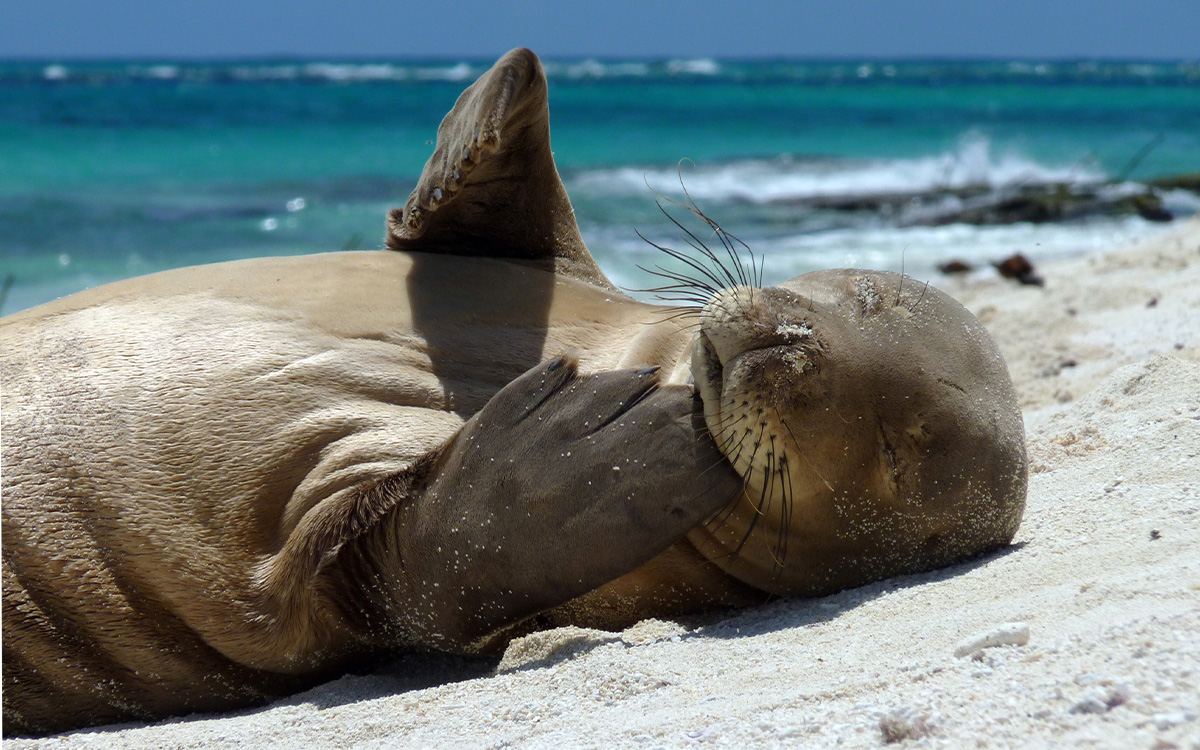
Hawaiian monk seal on Tern Island in Papahānaumokuākea Marine National Monument. | NOAA photo by Mark Sullivan, NOAA Fisheries Hawaiian Monk Seal Research Program
Before Parnell’s study of a captive seal, little was documented about Hawaiian monk seal submerged calls. She was surprised by that, as only about 1,600 individuals live in the wild. “There was no published findings about their underwater acoustic communication,” says Parnell. “So it's kind of shocking that this is an endangered species and we've never looked into their sound production underwater.”
After California, Parnell headed to Hawaii for her next step, studying seal calls in the wild. Between 2020 and 2023, she and her team dropped acoustic recorders at five underwater sites. Three recorders went in the waters of the main Hawaiian Islands, near Oʻahu, Niʻihau, and Molokaʻi. Two went in the waters of Papahānaumokuākea Marine National Monument, at the coral atolls Lalo and Manawai.
A Hawaiian monk seal calls out underwater, with snapping shrimp in the background.
After the recorders were retrieved, Parnell had 4,559 hours of sound to review. Over roughly four years, she worked with a dozen or so interns to manually look and listen for the sounds from a subset of the recordings. “What was a bit confusing in the beginning was the fish sounds,” says Parnell. “We were constantly like, ‘Oh is this a new call type?’ But over time looking through the spectrograms you can really tell, 'OK, that's not a monk seal.'”
People have documented Hawaiian monk seals calling underwater in the wild before, but the vocalizations had never been scientifically quantified and analyzed. Parnell’s team set out to classify the calls as one of the six published vocal types—croak, groan, growl, moan, rumble, whoop—and soon found most of those elemental calls appeared in sequences without ambient noise between them. They called the resulting vocalizations combinational calls. They heard growl-rumble-whoops, and moan-growls, and even a moan-hum-growl-rumble-whoop. A hum and grunt were found in the sequences, but never heard alone, so were not counted as elemental calls.
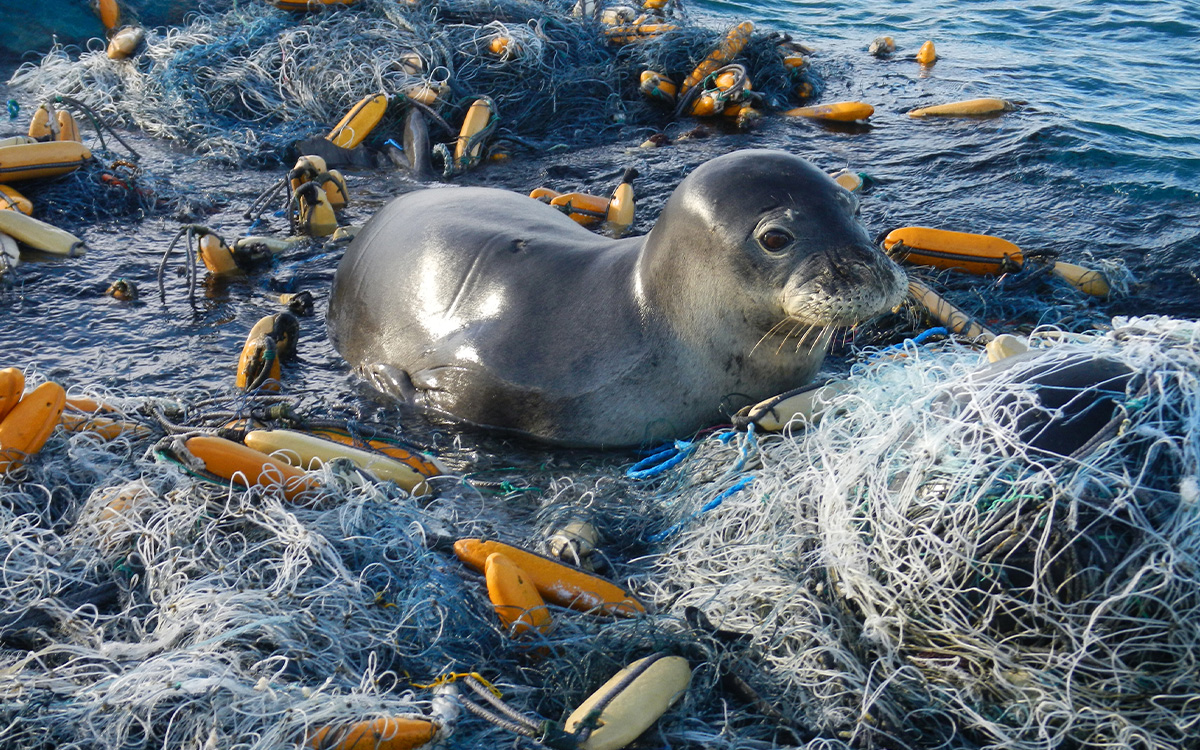
A young Hawaiian monk seal (ilioholokauaua in Hawaiian) rests on a floating mattress of tangled fishing nets. | Flickr photo by the Marine Debris Team of the NOAA Coral Reef Ecosystem Program
The team never heard the groan, but all told ended up with more than two dozen total calls. “I didn't expect quite the broad repertoire of those combined calls,” says Brandi Ruscher, a marine mammal sensory biologist at the Pinniped Cognition and Sensory Systems Lab at the University of California, Santa Cruz, who has studied Hawaiian monk seals but wasn’t an author on the paper. “I think that is a really, really exciting find, as well as I think she found one call and was able to associate that with foraging behavior.”
The discovery of a new elemental call, the whine, was the most exciting result for Parnell. During her course of study, she had heard the whine call on social media videos of the seals, and then later looked for the distinct vocalization on her audio recordings. After she found it, she went back to social media videos and videos from special tags put on seals to find out when the call was occurring. She heard it when the seals were swimming with their head inverted near a coral head or a rock. Sometimes in the videos, fish would swim out and the seals would try to bite them, which led the researcher to a hypothesis. She thinks the whine may startle prey species out of their hiding spaces so the seals can eat them.
Only one instance of the whine occurred alone, while it was heard in combination with the moan eight times. Terhune says such running together of calls could increase the complexity or intensity of meaning.
A Hawaiian monk seal calls in a whine, with shrimp in the background.
“As a rough example, it could be croaking, and if the animal got more excited, it might go to a croak-rumble,” he says. “Now that usage has yet to be studied, and it is important to keep in mind that the combination[al] calls make up a small proportion of the overall repertoire.”
While the croak alone occurred more than 35 percent of the time and the growl alone more than 45 percent of the time, the moan-growl-moan-whoop, for example, was heard once out of 23,417 calls.
Another key point in the study is that Hawaiian monk seal vocalizations are the same frequency as some anthropogenic noise, which could, at least to some extent, mask their calls. “One very important finding is that the calls are all below 1 kHz,” says Terhune. “And so [that] unfortunately overlaps the frequency band of the noise from large vessels.”
Parnell notes her finds are foundational to understanding how the seals might be impacted by man-made noise in the future. “And they're already facing a million other threats, so it's quite scary,” she says.
In the mid-19th century, hunting vastly reduced the Hawaiian monk seal population. But the seal rebounded somewhat, before undergoing declines beginning around the 1950s. The population has increased in recent years but still faces dangers, according to the National Oceanic and Atmospheric Administration. In Papahānaumokuākea Marine National Monument, threats include loss of key pupping islands due to storms and rising seas. For example, that island I lived on was mostly wiped out by a hurricane, though it has begun to reform. Marine debris is also a problem. From 1974 until 2024, 437 cases were documented of seals caught in fishing nets or other lost gear. Around the main Hawaiian Islands, at least 15 seals have died due to toxoplasmosis, a parasite often spread in the feces of cats—which makes its way into the ocean via runoff. The seals can also be harmed in Hawai'i’s nearshore and subsistence fisheries, as the endangered animals have been hooked at least 317 times since 1976. And rarely, humans directly attack seals. Twelve seals have died from blunt force trauma, and six have died from apparent gunshot wounds.
The recent finds about Hawaiian monk seal underwater sound gathered over the past decade might help officials protect the species, says Ruscher. Knowing sounds can help scientists focus on what areas the endangered species is using and at what times of year, and that could be used to manage anthropogenic disturbances. For example, if researchers learn more about where the whine calls occur, they’ll have a better picture of where the Hawaiian monk seals forage, which could lead to targeted protections.
For her part, Parnell is moving ahead with further studies. She’s using video and audio collected from social media and special seal tags to understand what behaviors accompany certain calls. “Are they swimming? Are they foraging?” she asks. “Are they interacting socially—is there another seal in the video frame?”
For her recent study, she estimates that about 50 people helped with deploying and retrieving the sound recorders, analyzing data, and supporting her in other ways. Her study was conducted under a government permit, and she teamed up with researchers working in the monument for NOAA, boat companies, and dive companies on Kauai, employees of the National Park Service at Kalaupapa on Molokaʻi, other scientists in her lab, those dozen or so interns who worked with her to analyze the data over four years, and more. Terhune says one of the wonderful things about her study was the sheer effort that went into it, but Parnell has a plan that may make things easier going forward. “Manually annotating all the data is absurd,” she says.
She’s working with a computer scientist who is creating an automated call detector and classifier able to run through acoustic data. He has developed it using data collected from seals in managed care. The next step is to test it on Parnell’s data from the wild and see how well it picks up Hawaiian monk seal calls amid all the background noise, from fish, boats, and even weather events. If the technology works and accurately detects calls, Parnell could see making it publicly available.
Future research could look at more aspects of calls and eventually answer deeper questions. For example, what do their calls say about the seals’ cognitive abilities? What do their calls say about their reproductive strategies?
“We're just now starting to understand this,” says Parnell. “And I think we should have four or five more PhD students look more into these things.”