Conservative States Play Increasing Role in Removing Wildlife Protections
Ken Paxton at the center of recent endangered species delisting for this rare bird and reptile
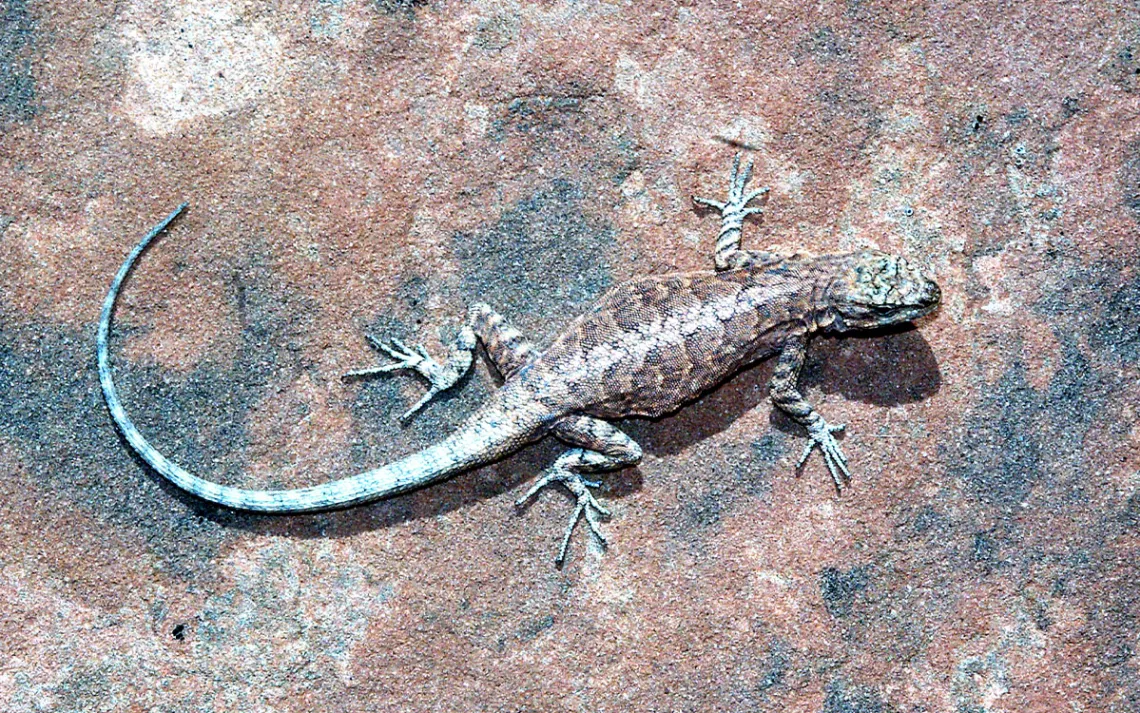
A sagebrush lizard basking on a rock that bears an uncanny resemblance in color. | Photo courtesy of Alan Schmierer
For 20 years, Bret Riley has grazed cattle on the grassy plains of southeast New Mexico. In addition to abutting the oil-rich Permian Basin, his land happens to feature habitat befitting two species that are struggling to ward off extinction. The first is the lesser prairie chicken, which shares the wide-open grassy spaces with Riley’s cattle, and the second is the dunes sagebrush lizard, which burrows in the sand dunes on the eastern side of his 23,000-acre ranch.
The region was once bursting with the prairie chickens, said Riley. “The old-timers tell me you couldn’t walk more than 20 feet without kicking a chicken,” he said. But conditions today are drastically different. So much so that the federal government listed the prairie chicken as endangered under the Endangered Species Act in 2023, and it did the same for the lizard soon after, in 2024.
Protections for both species, however, were short lived, not because their numbers recovered or because threats were eliminated. In fact, their delistings, both of which the Trump administration finalized this year, had nothing to do with a turnaround in the species’ fortunes. Rather, Texas Attorney General Ken Paxton sued the federal government, asserting that the conservation status "threatened Texas's oil and gas industry.” Ironically, he made this claim just as companies were reporting record production levels and soaring profits stemming from the Iran War.
Pulling species off the endangered list via litigation instead of recovery represents an increasingly common route to defeat the government’s listing decisions, legal experts say. “The anti-ESA cohort has figured out ways to undermine the effectiveness of the law by challenging the listings in the first place,” said Melinda Taylor, a University of Texas law professor specializing in environmental law. “It’s gotten worse than it used to be.”
In 2023, Paxton joined several other state attorneys general to ask the court to vacate the lesser prairie chicken listing. A year later, his office struck out on its own to advocate for delisting the lizard. Both cases found success upon Trump’s return to power.
The lizard and chicken share nothing in common except that their habitats occur on one of the world’s most prolific oil and gas fields. As such, both species have been at the center of decades-long legal and lobbying battles as industry groups and their political allies push back against their endangered species listing.
The groups notched an initial win in 2014, when US district Judge David Counts concluded that the lesser prairie chicken’s initial listing was arbitrary and capricious. By 2015, the listing was vacated. Years later, the Biden administration proposed relisting the chicken with a new strategy.
It would divide the species into two distinct population segments, arguing that the northern and southern populations were geographically and genetically separate. The northern segment included populations from Colorado to Kansas and were listed as threatened, while the southern segment—in New Mexico and Texas—was listed as endangered, with about 3,250 birds remaining. Industry and ranching groups again sued, arguing that there wasn’t enough evidence to show that the two populations were significantly distinct.
After President Trump returned to office in 2025 with an agenda to “unleash American energy,” the FWS reversed its position and agreed that it failed to properly divide the two population segments, prompting the agency to join the plaintiffs in a motion to vacate the listing. Judge Counts again ruled in their favor, prompting the FWS to formally remove the species from the ESA in February.
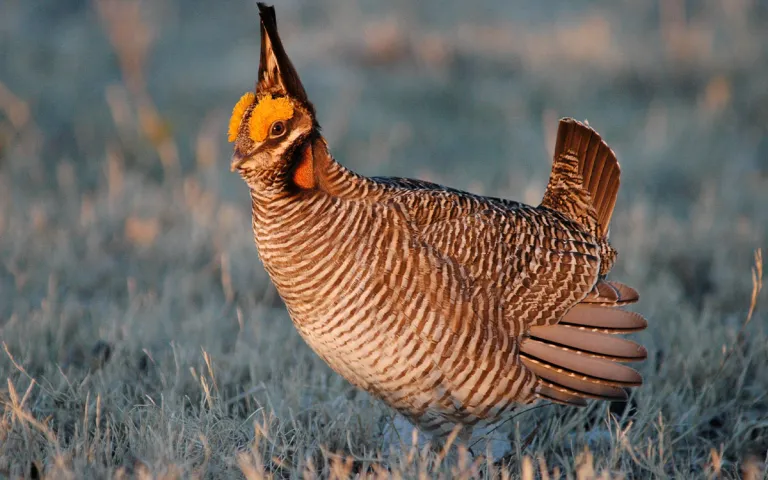
A lesser prairie chicken struts his stuff. | Photo courtesy of Patricia Zenone/USFWS
The dunes sagebrush lizard’s journey on and off the endangered list has received less public notice than the chicken, whose florid mating ritual has made it a symbol of grassland ecosystems. The lizard, on the other hand, spends most of its life burrowed beneath the sand, a habit that has made it difficult for herpetologists to estimate population numbers.
After spending 30 years as an ESA candidate species, the lizard was listed as endangered in 2010, prompting an opposition campaign spearheaded by former New Mexico congressman Steve Pearce. In response, Texas and New Mexico wildlife agencies developed their own voluntary conservation plans to reduce threats, such as frack sand mining and population fragmentation from sprawling caliche roads. Those two separate plans caused the FWS to withdraw its listing proposal, although each program has had varying degrees of success. In New Mexico, because 65 percent of the lizard’s habitat is on federal lands, it has been easier to protect.
The Texas plan had starkly different results. Because nearly all the lizard’s habitat was on private lands, the plan was built upon a conservation framework in which oil and gas companies, ranchers, and farmers voluntarily opted in to. But after failing to attract an effective level of participation, the plan eventually collapsed. The FWS finally listed the lizard as endangered in 2024, when it found that the species was “functionally extinct” across nearly half of its habitat.
In response, Texas Republican Senator Ted Cruz and Representative August Pfluger each filed bills proposing to roll back the designation. Paxton filed a lawsuit challenging the listing at the behest of the state’s oil and gas regulator. The Texas’ oil and gas business coalition, the Texas Independent Producers and Royalty Owners Association, accused the Biden administration of using the ESA as a political tool “to disrupt oil and natural gas operators.”
The opposition found success with the return of the Trump administration, and this year, FWS reversed course, concluding that the lizard’s listing was not based on the “best available” science–a requirement under the ESA. After the agency offered to settle the suit, federal district Judge Counts, the same judge that ruled against the chicken’s listing, vacated the lizard’s endangered status in July.
To Lee Fitzgerald, the lizard’s leading researcher at Texas A&M’s ecology and herpetology lab, the science demonstrating the lizard’s habitat destruction is “rock solid.” The lizard is a core research focus of the university’s Fitzgerald Lab, which has been mapping and tracking the species and its habitat since the 1990s. So, if any new research emerged that no longer supported the need for an endangered species listing, he would know. Yet he has no idea what discovery, if any, the FWS is referring to when it challenged the “best available” science backing the lizard’s 2024 listing decision.
“I think this claim by the Fish and Wildlife Service, and the buy-in from the judge, is not based on best science,” Fitzgerald said. “And it’s not based on tried-and-true experience either.”
The disappearance of ESA protections for the Permian Basin’s two threatened species comes amid the Trump administration’s broader attack on the bedrock environmental law. One of those attacks is a change in how agencies define the word “harm” in the statute. For decades, the definition of harm has included anything that causes significant habitat modification or degradation–the primary driver of extinction. But recent rulemaking has narrowed the definition of harm by saying that it must be direct and intentional, such as killing a species.
To help cut through some of the tension around the ESA, the North American Grouse Partnership, which Riley is a part of, in partnership with the Lesser Prairie Chicken Landowner Alliance, is advocating for a system that pays ranchers for implementing measurable conservation services. Just as markets pay grassland ranchers for beef production, so too should they be compensated for conservation services, the groups argue.
The proposal aims to establish ten 200,000-acre “ranching strongholds” across the southwest that correspond to lesser prairie chicken habitat. Ranchers within these strongholds can secure contracts that pay them fair market value for providing environmental services that offer a public good, such as improving soil health, expanding wildlife habitat, or increasing water retention on rangelands.
“I’m interested in saving the lizard, the chicken, and all other wildlife on the ranch – plus the cattle. It doesn’t have to be either-or,” said Riley, who is a member of the Lesser Prairie Chicken Landowner Alliance. “There’s a fine line between economic prosperity and ecological health on these landscapes. That’s the line that we have to walk.”