The US Forest Service Moves to Cancel Its “Best Idea”: the Roadless Rule
The Roadless Rule protected nearly 60 million acres of forest—until now
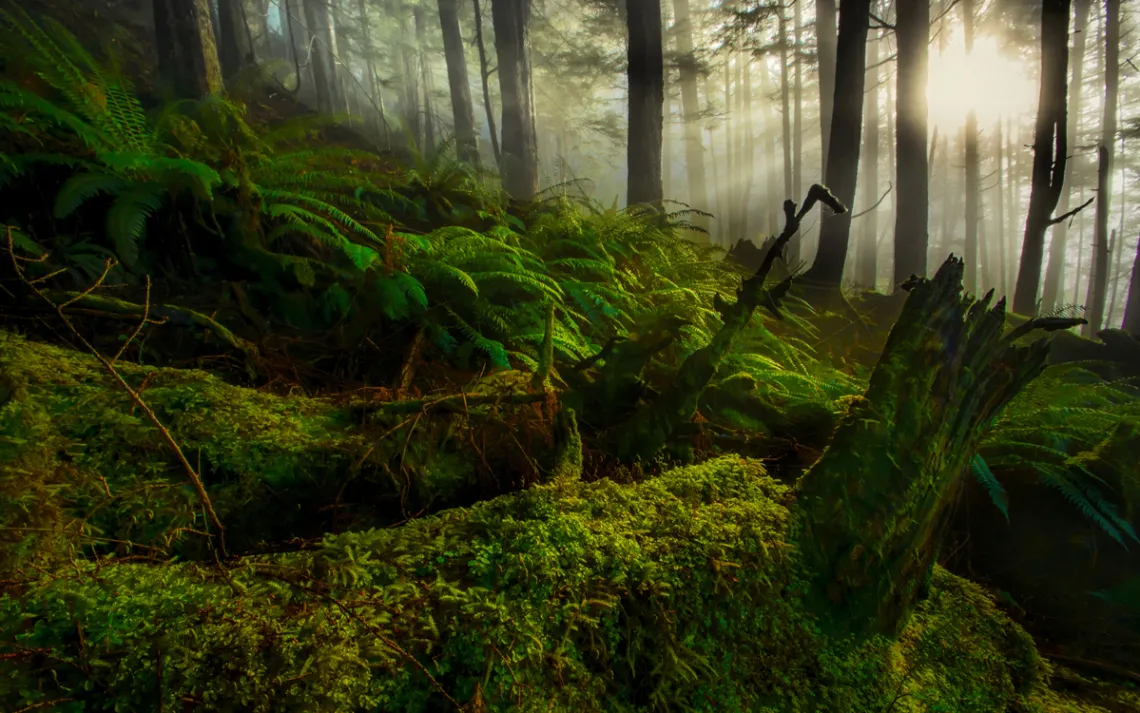
Sunlight filters through the rainforest canopy in the Tongass National Forest. | Photo by Carlos Rojas/Getty Images
Joel Jackson never forgot the last time the Tongass was in danger. It was the 1990s. Logging roads crisscrossed slopes around Kake, Alaska, a remote Tlingit community where he served on the tribal council. The deer and moose had fled. Hunters were drowning in storms as they traveled by boat to other islands in search of subsistence game.
Then, in 2001, the US Forest Service proposed a dramatic change: A prohibition on construction of new roads across 58.5 million acres of national forest lands. Jackson lobbied hard for the rule. For a quarter century since, vulnerable habitats and watersheds have been protected from the timber and mineral extraction that inevitably follows new roads–including 9.2 million acres of the nearly 17-million-acre Tongass National Forest.
“The Tongass is one of the most beautiful places in the world,” said Jackson. “It’s like walking into a beautiful cathedral.”
The “Roadless Rule,” shorthand for the official name (the Roadless Area Conservation Rule), is a rare public land management decision that enjoys overwhelming support across the political spectrum–from hunters and fishermen to environmentalists. Forest Service leaders at the time framed it as ecologically necessary and financially responsible–saving the agency billions on road maintenance. Alex Craven, the Sierra Club’s forest campaign manager, calls it “the most important conservation policy that most people have never heard of” and “the Forest Service’s best idea.”
On August 18, Agriculture Secretary Brooke Rollins announced that the agency was moving forward with plans announced last year to repeal the Roadless Rule in its entirety, opening millions of acres of public land up to road construction and resource extraction. In the Tongass, rescinding the rule would be “devastating,” said Jackson. The mature, culturally important yellow cedar trees left around Kake are used by weavers and form critical buffers to salmon streams. Without them, “our grandchildren and their grandchildren would never be able to see what old growth looks like,” he said.
The Trump Administration argues the Roadless Rule prevents land managers from fighting fires in national forests, undeniably a growing crisis. But research shows wildfire ignitions nationwide are low in roadless areas and highest near roads. Tim Ingalsbee, a former Forest Service and National Park Service wilderness firefighter and head of FUSEE, a nonprofit organization of firefighters, said that’s because the majority of wildfires are started by people.
Crude, single-use, mid-slope logging roads, the kind that would likely be constructed, are not useful to firefighters, who typically steer fires from ridgelines and along rivers, cautioned Ingalsbee. “Expanding the road network means expanding the opportunities for human-caused wildfires, either from accidents, carelessness or criminality,” he added. “Rescinding the rule to build new roads in some of the steepest, ruggedest remote wildlands left is about aiding firefighters' safety and efficiency, it's just bunk.”
Ingalsbee and other Roadless Rule supporters suspect the firefighting justification covers the real reason for rescinding the rule – opening protected areas to logging, mining, and other extractive industries. They point to the Forest Service’s own statement that rescission would comply with executive orders to increase logging on public lands. The Trump Administration knows logging on public lands is unpopular, Ingalsbee said, but also that people fear fire.
“This is a smokescreen for the desires of resource extraction and private profiteering from public lands,” Ingalsbee concluded.
Craven, the Sierra Club forest campaign manager, said the reason roadless areas weren’t logged prior to the 2000s is because it wasn’t profitable then – these lands lack high-quality timber and are expensive to access. That has not changed, and the idea that federal managers are now going to log in extremely remote places and turn a profit is “insane,” Craven said.
Republican governors have issued statements thanking the Trump Administration for moving to return roadless area management to the states and local decision makers. However, environmentalists have largely condemned this assertion. Garrett Rose, a senior attorney at the Natural Resources Defense Council (NRDC), said those statements also don't check out because localized management degrading ecosystems was part of the rationale for the original nationwide policy.
When the Forest Service instituted the Roadless Rule, it led a robust public comment period, which lasted 18 months and included 600 community meetings across the country, ending with 1.8 million comments, 95 percent in favor of the rule. This time, the public comment period, required by the National Environmental Policy Act (NEPA), will last just 30 days. When the agency first announced its plans to rescind the rule last August, it held a historically short 21-day comment period. The agency has held no public meetings for either comment period. The Sierra Club has organized its own meetings, as has Jackson for the Organized Village of Kake and the alliance of the Sovereign Southeast Tribes in Alaska.
Rose, who leads NRDC’s forest work, sees the lack of meaningful comment processes as evidence of a broader trend–removing the public from public lands. “The administration is trying to push the limits of what is an acceptable way to engage in changing regulations and rules as part of a deep-seated deregulatory ideology that tends to see rules as bad things across the board,” said Rose. Curtailing the NEPA process undermines its core purpose, he said–requiring agencies to inform themselves about the impacts of decisions they make.
Critics also see the rescission as part of a larger push to hollow out, dismantle, and transform the goals of the Forest Service, which involves closing three-quarters of the service’s research stations and a number of regional offices in a nationwide reorganization. Thousands of employees have left the service, including nearly half the staff in Alaska, and workers with decades-long relationships with Alaska Native tribes.
“I’m not real confident in their ability to manage land, the trees and everything, they cut so many foresters, it’s a skeleton crew in their offices,” said Jackson. “Who’s going to monitor? Even when they had full offices, they had a hard time keeping up.”
Those cuts align with the Roadless Rule recission, said Rose. “It’s further evidence to me that this is about deregulation and the overall project of reducing barriers to commercial logging of intact places on the national forest system.” After the comment period ends, the service will make their final decision on the rule, at which point the NRDC and other agencies could consider legal action.
“My stance has always been no logging, no road building in the Tongass. I show no compromise to my stance,” said Jackson. He fought for the Roadless Rule in 2001, and then again in 2016 when the first Trump Administration moved to exempt Alaska from the rule. This time, he said, “We’re not gonna back down. We’re gonna fight.”
IN MEMORIUM
Joel Jackson passed away on August 29. He spent 35 years on the Kake tribal council advocating for Indigenous rights and environmental protection.