The Hidden AI Carbon Emissions That Aren’t Being Counted
Data centers are already a huge source of pollution. A new study shows that emissions grow when the oil and gas industry uses AI.

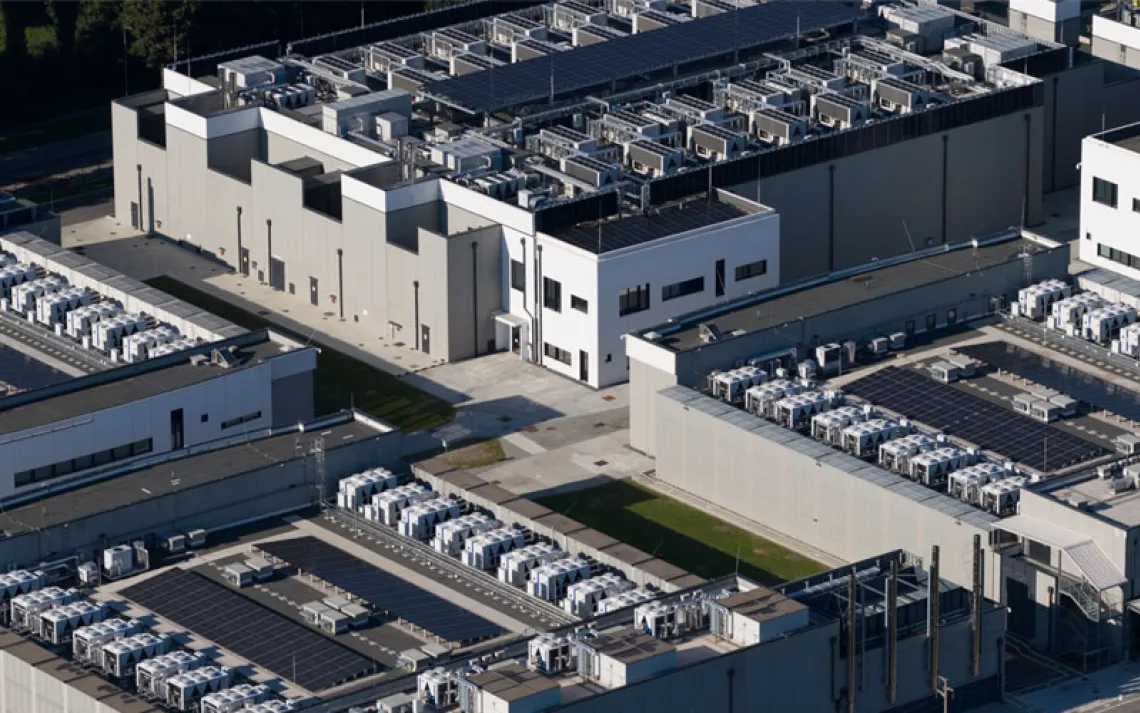
A data center in in Ashburn, Virginia. | Photo by AP Photo/Ted Shaffrey
Data centers used for powering artificial intelligence are presenting significant new risks to the environment. In addition to their water impacts, data centers use exorbitant amounts of electricity and are increasingly turning to fossil fuels as a primary and backup power source.
And according to a new study published in Nature, when the oil and gas industry uses AI to aid its operations, the “enabled emissions” could be greater than even the emissions coming from data centers.
For several years, oil and gas companies have used AI tools to identify new resources, speed up drilling, and extract larger quantities of fossil fuels. In 2023, Shell announced a partnership with SparkCognition to help find the “most efficient and sustainable way possible to identify new reserves”; last year, Devon Energy reported a 25 percent improvement in production after adopting machine learning models to monitor its oil rigs across the US.
These tools have made fossil fuel production easier and more expansive, and could increase global emissions by 470 million to 1.8 billion metric tons of carbon dioxide each year, the study found. That’s 3.3 to 13.3 times higher than the emissions produced by AI-powering data centers.
Data centers are already a major source of pollution even in spite of additional emissions from the fossil fuel industry’s use of AI. A 2025 study from Cornell University found that the current rate of AI growth would put about 24 to 44 million metric tons of carbon dioxide into the atmosphere annually by 2030. Another analysis of the 60 largest data centers under construction in the US estimates that they could cumulatively produce about 10.5 million tons of carbon dioxide per year—the equivalent of 24 million cars.
Data center developers are increasingly turning to gas to fuel their operations, which produces additional carbon emissions. In the last year, the amount of gas-fired power in development for data centers in the US has nearly doubled, according to research from Global Energy Monitor. It doesn’t help that the go-to backup fuel for data centers is diesel, which emits significant amounts of carbon dioxide and fine particulate matter when burned.
On top of those known emissions, according to the Nature study, are others related to the use of AI to power oil and gas operations.
“Tech companies are only required to report on their own operational emissions, which lets them off the hook entirely for what they're building the technology to do,” said Holly Alpine, one of the authors of the study. “So while everyone is focused on how much power a company is using as ‘the climate impact of tech,’ and the public narrative that ‘data center electricity vs. AI for sustainability’ is the whole story, that frame serves the tech companies perfectly.”
Alpine and her husband, Will, a coauthor of the study, are former Microsoft employees. They worked in the company’s responsible AI and sustainability divisions but left in 2024 after they discovered Microsoft was selling the AI tools they were building to oil and gas companies.
Alongside tracking emissions, the study also examined whether AI could be equally beneficial in deploying renewable energy. The findings were bleak. If the fossil fuel and renewable industries were to adopt AI tools at the same rate, renewable productivity gains would have to be four to five times higher just for global emissions to break even.
That’s due to a number of factors, Alpine said. Much of what’s holding renewable deployment back are nontechnical barriers like permitting delays and fragmented regulatory authorities, things that AI wouldn’t impact. Fossil fuels also still power far more global energy than renewables do, so there is simply more to gain in terms of volume, Alpine said. Without scaling back fossil fuel investments, reaching net-zero emissions—with or without AI—is practically impossible.
“You cannot get to a net climate benefit through renewable acceleration alone. It requires constraining fossil-side productivity gains directly, alongside whatever AI delivers for renewables,” Alpine said.
Artificial intelligence has long been touted as a solution to the climate crisis by techno-optimists. In 2024, Bill Gates said AI will accelerate green solutions and mitigate climate change (though this past week he published a memo warning of the dangers to society of unregulated AI). Last year, a study published in npj Climate Action found that AI advancements could reduce global greenhouse gas emissions from the transportation, meat, and dairy, and road vehicle sectors by 3.2 to 5.4 billion metric tons annually by 2035. Other proponents claim AI could help scientists make more informed predictions about environment changes or implement new climate adaptation strategies.
While all of that may be true, it's somewhat beside the point, said Samuel Dotson, an energy modeler at the Union of Concerned Scientists.
“The problem isn’t that AI can or can’t help solve climate change. The central issue is that it’s a distraction,” he said. “Solving climate change is less of an engineering problem and more of a political will or economics problem. . . . Not only are AI solutions to climate change a convenient excuse to build more data centers, but they’re also an excuse to delay essential political action that would reduce emissions now rather than ‘someday.’”
A reliance on AI to solve climate change could also entrench us further in the fossil fuel system, Dotson added. He pointed to UCS’s 2026 report Data Center Power Play, which found that if current regulation and clean energy policies stand, most of the projected AI power demand via energy-hungry data centers will be met by fossil fuels, particularly gas.
Alpine has similar concerns if the fossil fuel industry continues its unregulated use of AI tools; it will only make oil and gas cheaper and increase our reliance on fossil fuels at a time when the renewable transition is more important than ever.
“AI's effect, left to market dynamics alone, reinforces incumbent fossil systems rather than displacing them,” Alpine said.
To prevent that from happening, Alpine and her coauthors are pushing for enabled emissions to be considered in AI governance and regulation. There are currently no national or international policies regulating the oil and gas sectors’ use of AI.
“Nothing in current market dynamics prevents that lock-in,” Alpine said. “Our findings suggest it requires deliberate governance—treating enabled emissions as a distinct policy category and constraining AI-enabled fossil productivity directly, rather than assuming efficiency gains will steer us towards net emissions reductions.”