The Magazine of The Sierra Club
Why Heat and Data Centers Could Be a Deadly Combo
Emergency power for data centers could pollute the air when people are at their most vulnerable
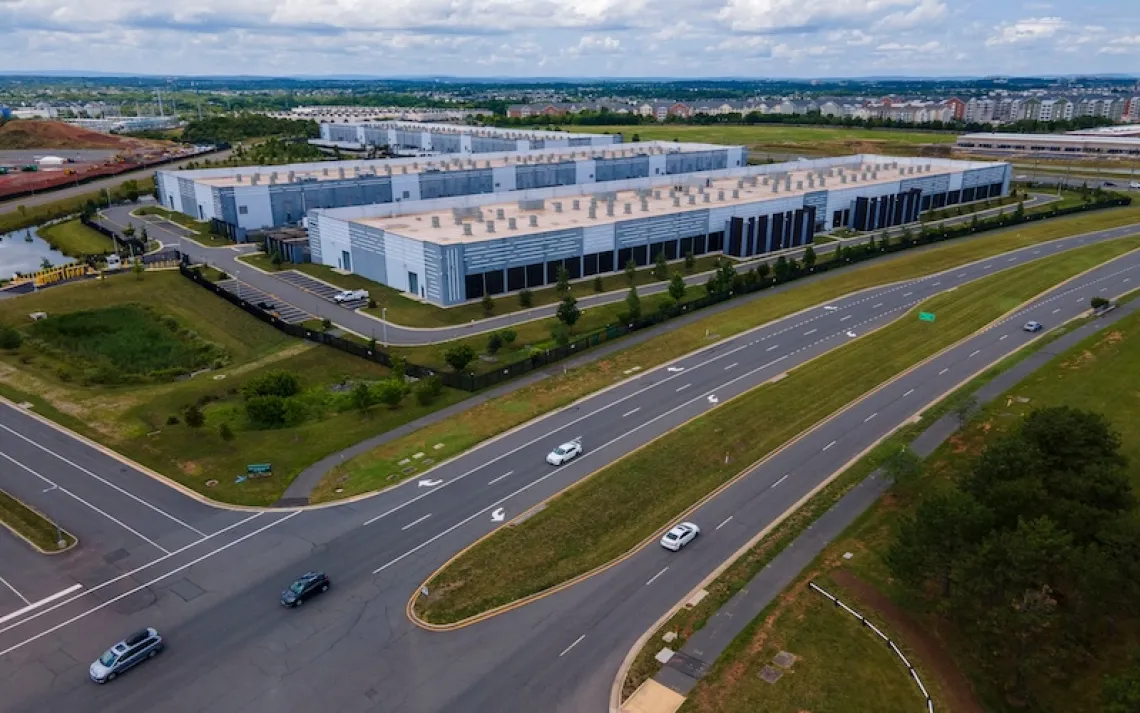
Photo courtesy of Hugo Kurk/iStock
On a blistering-hot evening in the middle of July, black exhaust rose above Vantage VA2, a hyperscale data center in Sterling, Virginia. The 18-acre data center campus, about 30 miles west of Washington, DC, had just turned on 51 emergency diesel generators after a critical power failure.
Greg Pirio, a Sterling resident who lives just 150 yards from the data center, could feel the diesel in his lungs almost immediately. “It was causing me so many problems with my lungs that I left my house, and I went to stay at my daughter's house,” he said. “She lives about 15 miles away.”
The generators at Vantage VA2 are just 51 of roughly 10,500 diesel generators at data centers across Virginia, one-third of which are located within 500 feet of residential areas or schools. The highly polluting fuel has become a go-to backup fuel for data centers not only in Virginia—which is home to a quarter of the country’s hyperscale data centers—but across the US. From 2018 to 2024, diesel generator capacity at data centers nearly tripled from 20 to 55 gigawatts, according to research from the Better Data Center project. It’s a concerning upward trend, and some experts fear diesel use at data centers will only increase as extreme heat worsens.
July was a sweltering month nationwide. More than 2,608 daily heat records were broken in three separate heat waves. The Northeast and Mid-Atlantic were struck in the first week of July, with Virginia breaking 125 daily temperature records. The West Coast was hit next, followed by the Southwest in the final week of July, putting at least 40 million people under extreme heat warnings.
High temperatures not only strain the grid but also impact its ability to deliver electricity by reducing the performance of transmission lines and power plants. For data centers, which require a reliable supply of electricity at all times, a strained grid or weakened power plant is detrimental. To maintain uninterrupted operations and free up electricity for homes and businesses, data centers are increasingly forced to rely on backup generators in times of high demand.
“Since diesel generators are already installed, there's a really strong temptation to run them because they're there right now, even when they were intended only for short-term emergency use,” said Peter Adams, a professor of civil environmental engineering at Carnegie Mellon University.
On July 2, the power demand for PJM Interconnection (PJM), the country’s largest electricity grid operator, reached 162 megawatts, pushing the grid dangerously close to its 180-megawatt capacity. The load likely would have surpassed the grid’s all-time demand record of 165,600 MW set in 2006 had it not taken emergency measures, the operator said on its website. Part of those emergency measures included getting the green light from Energy Secretary Chris Wright to allow data centers to turn on backup generators as a last resort to prevent power shutoffs.
“I hereby determine that a statutory emergency exists in the PJM Interconnection, L.L.C. (PJM) region, due to a sudden increase in demand, a shortage of electric energy, a shortage of facilities for the generation of electric energy, and other causes,” the emergency order from the Department of Energy reads. “I direct PJM and backup generation resources defined below to comply with this Order.”
Since May, the Department of Energy has issued orders of this nature six times to PJM, which serves approximately 67 million customers across 13 states and Washington, DC. On July 26, a nearly identical emergency order was issued to the Southwest Power Pool, which provides power to 14 states across the Midwest and West.
Elena Schlossberg, a community organizer based in Northern Virginia, says the Department of Energy’s support for diesel is frustrating. As the head of the Coalition to Protect Prince William County, the county just south of Sterling, Schlossberg has been at the forefront of data center resistance since 2014, when Amazon proposed implementing a transmission line to power its new data center. She's accustomed to both state and federal government decisions affecting her community.
“If they don't have to live next to [a data center], they don't understand the totality of the impacts they are inflicting on really hundreds and thousands of Americans at this point,” she said of the Department of Energy’s order.
Diesel generators emit fine particulate matter (PM2.5) and nitrogen oxides (NO2) that have been linked to a number of health complications, including asthma, respiratory illness, cancer, and heart disease, even when exposed in the short term. In Virginia, a Sierra Club survey found that diesel generators have been permitted to emit nearly 13,000 tons of toxic oxides of nitrogen and over 650 tons of particulates—comparable to the largest coal plants in the country. According to the Piedmont Environmental Council, emissions from the Vantage VA2 data center near Pirio’s home could cause between $53 million to $99 million per year in health-related damages.
A study from Virginia Commonwealth University found that toxic emissions from diesel generators at 138 data centers in Northern Virginia increased substantially from 2018 to 2023: Carbon monoxide emissions went up by 196 percent, nitrous oxide emissions rose by 111 percent, and particulate matter emissions increased by 139 percent.
“Diesel in general is a very polluting way of producing electricity,” said Damian Pitt, associate director of the Institute for Sustainable Energy and Environment at Virginia Commonwealth University and author of the study. “That's why typically we go to it as a last resort.”
Emergency diesel generators are also held to significantly more lenient regulations than major power sources like gas plants. There are no federal limits on the number of hours a diesel generator can be used in emergencies; operators must simply self-report the emissions to the EPA. During nonemergencies, like maintenance testing, run time is limited to 100 hours. In July, the EPA proposed loosening restrictions even further by cutting public participation from the regulation process for “minor” pollution sources like diesel generators.
“The stakes here in terms of public health are high,” Adams said. He conducted a preliminary study to project the effects on public health and air quality of running backup diesel generators continuously throughout the year at data centers (an imagined but eventually possible scenario). He found that if data centers got their power from diesel generators instead of the grid, it could cause about 500 more premature deaths per year in the US.
For surrounding communities, the compounding fear of extreme heat and diesel reliance is commonplace. Schlossberg dreads a cascading blackout—a domino effect of grid failures that eventually leads to the whole system shutting down. Diesel generators would switch on, and people would be left without power in scorching temperatures, breathing in diesel exhaust for an unknown period of time.
“There's no police that are showing up to say, ‘Listen, you're poisoning all your neighbors,’” she said of the scenario. “For people who have breathing issues or have other medical conditions, not having electricity or air conditioning—that's life or death, and that's not hyperbolic.”
While it sounds apocalyptic, it’s not entirely unlikely. In a report published in March, the North American Electric Reliability Corp warned that data centers’ volatile energy demands could lead to widespread, cascading power outages. That risk is heightened by the fact that nearly 80 percent of global data center capacity is threatened by acute climate hazards, like extreme heat, wildfires, and flooding, making prolonged diesel generator use during outages an increasingly likely reality.
To avoid this outcome in Virginia, both Schlossberg and Pirio are raising awareness and doing what they can to fight for more regulation—attending meetings and hearings, speaking with local officials, and connecting with other impacted Virginians.
“The thing that gives me hope is that so many of my neighbors around here are mobilizing,” Pirio said. “And we're looking at our legal options … in addition to what the government can do for us.”