How Particulate Matter From Wildfire Smoke Impacts Our Health
People with health issues say it worsened their symptoms or forced them to stay inside
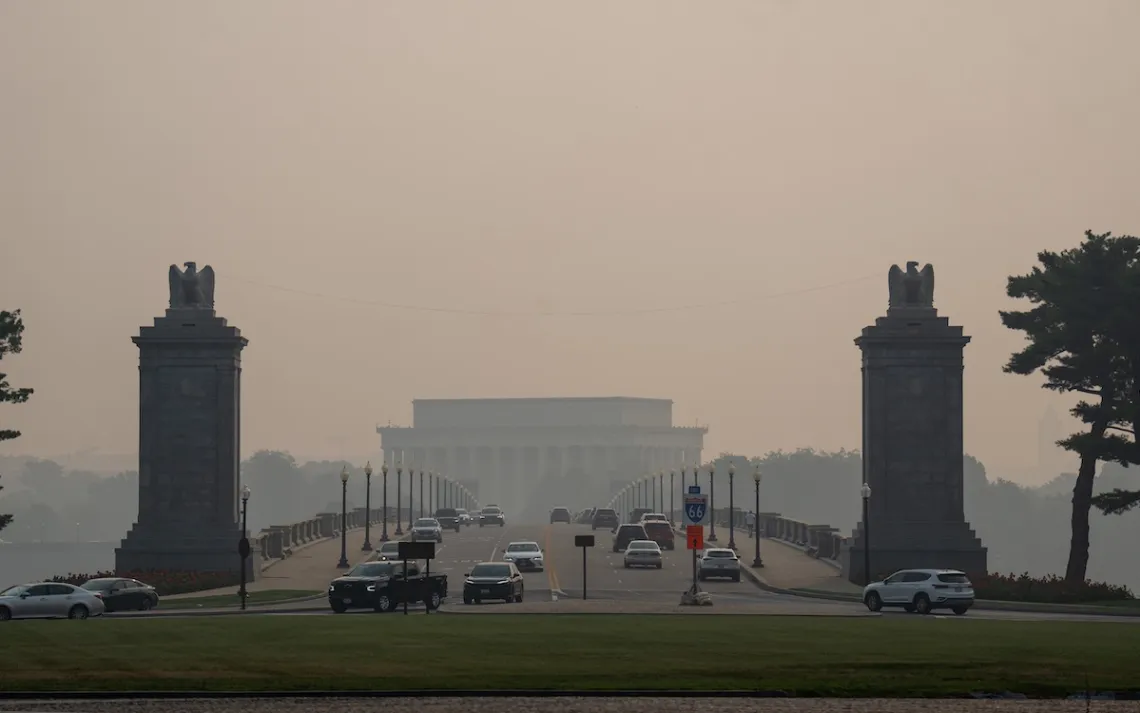
Smoke from Canadian wildfires settles across Washington, DC, on July 17, 2026. | Photo by Andrew Leyden/NurPhoto via AP
Alex Steiner went outside for less than two minutes to grab a package from her front porch on Friday, July 17. She lives in Washington, DC, a few blocks away from the capitol building, where air quality warnings were first issued the day before. Steiner immediately developed a headache and burning sensations in her mouth and throat, which were suddenly dry.
Inside her historic home, the air quality monitor, which detects particulate matter (PM) 2.5, was bright-red—measuring over 100 micrograms of PM per cubic meter. This is well above the Environmental Protection Agency’s limit of 35 micrograms of exposure during a 24-hour period.
“I was like, ‘What do I do?’ It was crazy. I really do try to basically stay inside when this happens,” Steiner said. She has lung issues and long Covid, and meets diagnostic criteria for myalgic encephalomyelitis, a disease marked by fatigue and countless other symptoms. Before she contracted Covid in 2023, Steiner worked in international security policy. Now, she is a patient advocate.
Steiner remembers the last time code-purple alerts cautioned residents in the Northeast that air quality was “very unhealthy.” That was in 2023, as wildfires burned in Canada.
Smoke blanketing the US and Canada
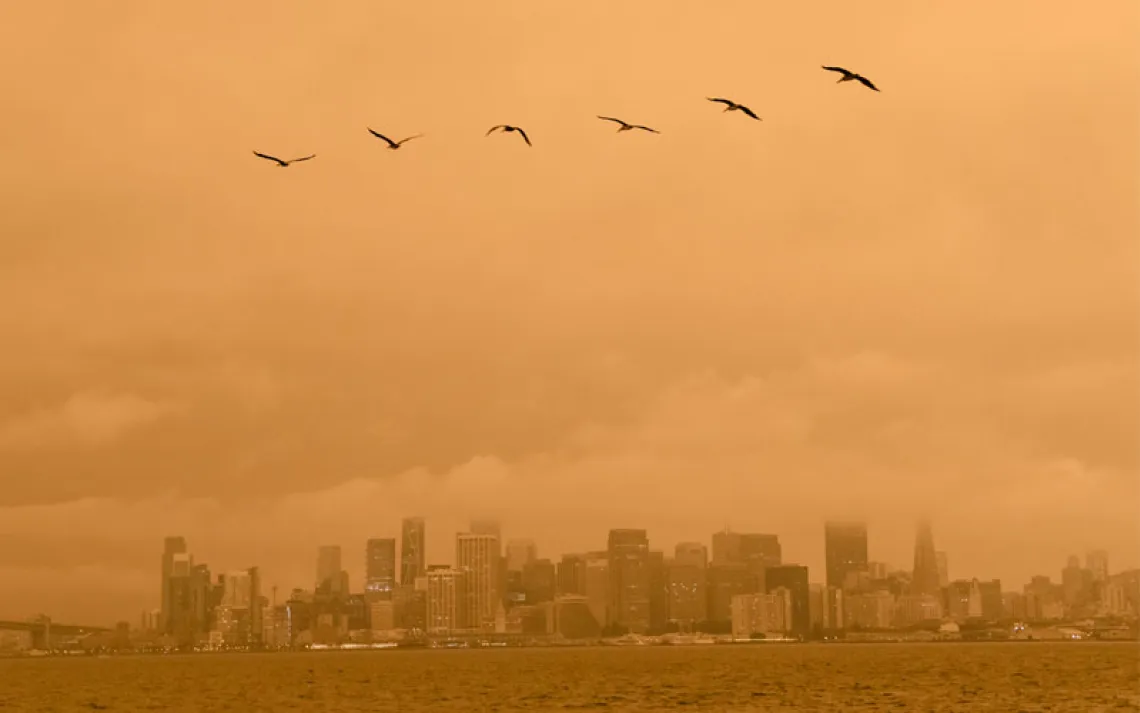
Last week, it happened again. Purple alerts warned over 100 million Americans in the Northeast and Midwest that air quality levels were “very unhealthy.” Residents in Chicago, Minneapolis, and Detroit faced some of the worst air pollution in the world. Levels measured between 146 in Minneapolis and 306 in Detroit, peaking over the course of two days. The smoke traveled northeast from Canada, where more than 800 fires are burning over 8,154,478 acres of land. Several fires are also ravaging northern Minnesota and now Oregon, California, Idaho and other states.
Political leaders, including Governor Kathy Hochul of New York and Governor Wes Moore of Maryland, urged residents, especially in sensitive groups, to stay inside with their windows closed. The public was advised to limit exposure to pollutants and wear personal protective equipment, such as a medical mask.
Steiner first noticed the smoke on Thursday and did not leave the house. Her baseline energy is fragile because of ME, and even shifts in temperature can worsen her symptoms, forcing her to stay inside. After developing a headache and feeling dizzy from briefly stepping outside on Friday, she sat near her HEPA filter and wore a mask inside her house for the rest of the evening.
Eventually, the air monitor decreased to around 20 micrograms. But through her window, she could still see the apocalyptic, hazy sky hanging over the nation’s capital.
The particles that likely worsened her symptoms are commonly emitted in wildfires. When inhaled, they can cause a cascade of symptoms, may worsen existing health issues, and lead to long-term complications.
“It’s like smoking a cigarette,” said Neeta Ogden, an allergist, asthma, and immunologist based in New Jersey. The materials found in cigarettes are also ingredients of wildfire smoke, including PM2.5.
Dangers of pollutants and particulate matter
Wildfire smoke is composed of water vapor, gases, and pollutants like cancer-causing carcinogens, including carbon monoxide, volatile organic compounds, polycyclic aromatic hydrocarbons, and PM. Some PM is visible to the human eye, while others can only be seen through an electron microscope. The smallest ones, PM2.5, commonly referred to as soot, have a diameter of less than 2.5 micrometers wide (100 times thinner than human hair).
“These particles are so tiny that they go into the smallest airways,” said Juanita Mora, an allergist and immunologist in Chicago and board director with the American Lung Association.
While all pollutants pose health risks, PM2.5 is the most dangerous and is associated with an increased mortality rate due to its ability to travel through the walls of your lungs and into the bloodstream.
As these particles travel into our airways, our bodies see them as foreign, and the defense mechanism is to protect. “Part of protecting is activating an inflammatory cascade,” Mora said. This response can cause symptoms that people may mistake for allergies or a cold: red and watery eyes, coughing, congestion or runny nose, wheezing, fatigue, trouble breathing, and even a headache.
In 1993, researchers found increased rates of mortality and disease from air pollution. The study focused on six cities in the United States, but they did not take the health effects of cigarette smoking into consideration. Now, other research documents increased rates of mortality and disease with air pollution including PM2.5 specifically, which puts people at higher risk of developing heart disease, lung cancer or lung disease, and even premature birth for pregnant women.
In the case of the September 11, 2001, attacks, some of the first responders were at a higher risk of developing early onset dementia, Alzheimer's disease, and lung cancer.
“You may not be feeling it that day, but how is it impacting your lungs 10 years from now?” Ogden said. “In other countries, we've seen places with bad smog or air pollution, like in India.”
In India, over a 15-year period, nonsmoking lung cancer increased in women by 8.3 percent, driven by indoor air pollution from coal, a carcinogen often used for cooking.
Climate change and increasing occurrences of wildfires
Days of wildfire smoke smothering cities are becoming more common around the world due to climate change. Incidents are expected to increase by 50 percent by 2100, according to a study in Science Advances. As rising temperatures leave the environments drier, they are more prone to easy ignition, which also impacts our health. Last week in Chicago, Mora saw more sinus infections and asthma exacerbation because of the smoke than she normally does.
Melina Recarde, one of Mora’s patients, first noticed the effects of the smoke on Thursday. “It smelled like everybody in the world was having a cookout,” Recarde said. Soon, she began to experience some tightness in her chest and had trouble breathing. After going outside, she developed a headache.
Both Recarde and her oldest son, Rafael Aleman, who is six, have asthma. Rafael seemed to be fine. In the middle of the night on Saturday, she woke to hear coughing from her two-year-old son, Samir.
“My younger son has never had asthma,” Recarde said. Before this, Samir did not seem to be reacting to the smoke and was hardly outside. By Monday, he was wheezing, and his rib cage was beginning to protrude in, signs that he was struggling to breathe. Recarde took him to see Mora, who also found fluid in his ears.
After a few days of antibiotics and steroids, Samir felt better. The air quality in Chicago is also improving, with PM2.5 measuring at 42, but Recarde is still recovering. The only person in their family who was unaffected by the smoke was her husband, Samirt, who is healthy.
When children are between ages nine and 11, their lungs are often still developing, according to Mora. Their airways are more susceptible to harm, especially from pollutants. “I tell them that from age zero to five, 50 percent of kids will wheeze with respiratory infections,” Mora said, “When we are talking particle pollution, if you can see it and you can smell it, then you're breathing it in.”
On days like these, Mora said it’s important to stay inside and if you do have to go outside, wear a protective mask.
For people in sensitive groups, including those who are above the age of 65, under the age of five, or who have underlying health issues, the smoke poses an even greater risk. Recarde, her two sons, and Steiner all fall into this group.
“I’m definitely worried,” Ogden said, “When I'm around, and it's one of these days when it's completely hazy in New York. People are walking around without any protection. I don't think people realize the real gravity of these kinds of days and how it can affect your body.”