Indigenous Voices Rose at COP30 While Forest Protection Fell Short
The annual UN climate summit ends with much to be resolved
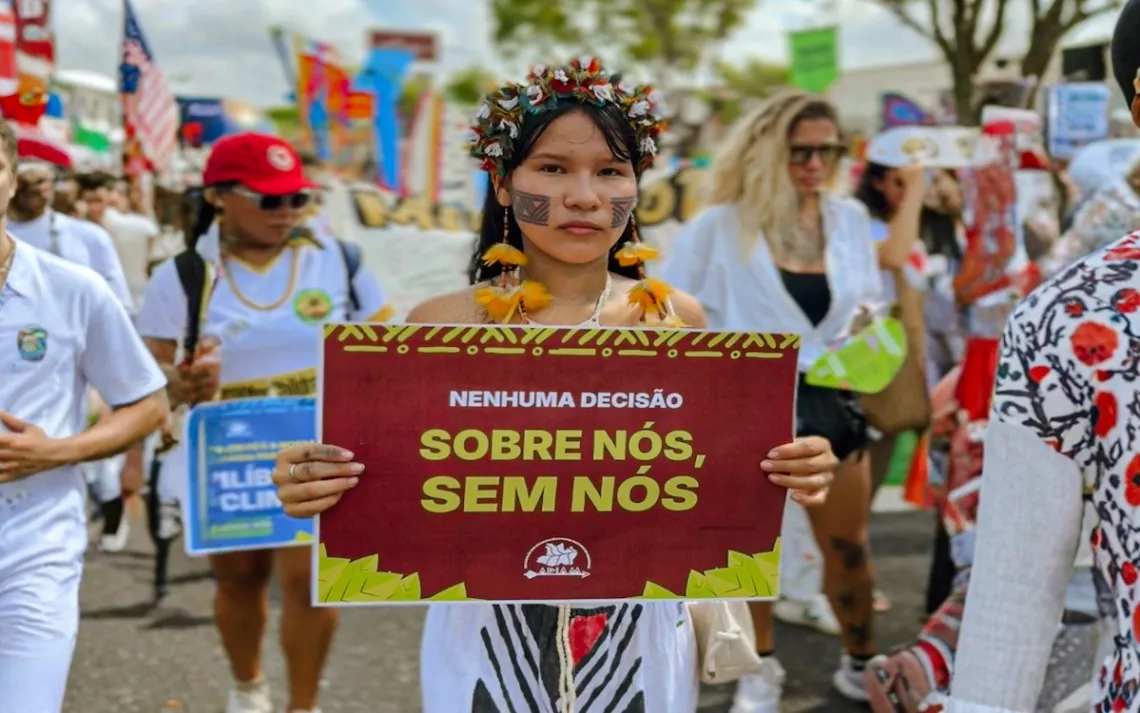
“No decision about us, without us,” read a sign held by an Amazonian Indigenous woman from the Articulação das Organizações e Povos Indígenas do Amazonas during the People’s March on the streets of Belém, Brazil, on November 15.
The 30th annual UN climate summit in Belém, Brazil, was promoted as the Amazonian COP—expected to bring deforestation and Indigenous rights directly to global climate negotiations. Inside the Blue Zone, and across civil-society spaces around it, those themes dominated discussions. But perhaps nothing became as potent during the COP as when Indigenous people came in droves to the conference site, stepping forward to be heard.
On Monday, November 10, the first day of COP30, delegates arriving at the venue encountered members of local Indigenous communities, including Tupinambá families from Belém’s riverside—some protesting, others selling handmade crafts—dressed in the paint and regalia they use for public gatherings. Whistles pierced the air (one Tupinambá woman told me they use them as a form of communication), rising above the broad brown façade of the tented complex, its wooden design evoking traditional Amazonian structures.
By Tuesday, dozens of unregistered Indigenous activists pushed past security and broke into the conference center, demanding stronger forest protections. Later in the week, around 90 Munduruku activists blockaded the main entrance, calling for an urgent meeting with Brazilian President Luiz Inácio Lula da Silva. They eventually secured a conversation with the COP president, André Corrêa do Lago, who held one protester’s baby as he listened, before military fencing went up along the conference perimeter. The two confrontations set the tone for a tenser second week, as the festive, open feel of the early days gave way to security barriers and a more controlled environment.
Tropical forests forever?
At the center of COP30’s forest negotiations was the Tropical Forests Forever Facility (TFFF), a proposed mechanism intended to raise billions in public capital and distribute returns to forest-holding countries and local communities. Originally envisioned as a $25 billion fund to be raised within five years, the version presented in Belém was significantly scaled back.
“We’re now left with $5.5 billion and a 10-year timeframe,” said Max Alexander Matthey, climate economist for CLIMA, the Climate Impact Auctions Initiative. “We need $10 billion minimum to get it going; otherwise, the Norwegians are not investing at all.”
While the TFFF was publicly welcomed as a step forward, Matthey said, the underlying structure raises serious concerns. The mechanism intended to support communities and forests is likely to be consumed by its own financial architecture, he argued. “The money that is supposed to support local communities and protect the rainforest flows into a dysfunctional, high-cost mechanism that will eat up most, if not all, of its revenues in financial fees and administrative costs.”
The extended timeline adds further uncertainty. The fund is not expected to be fully capitalized until 2036, delaying meaningful payouts for more than a decade. Matthey said this creates two economic obstacles: delayed support and diminished returns. “Because the fund will not be filled before 2036, meaningful payouts will start late. The mechanism cannot deliver timely support in the critical years ahead,” he said. “And even once operational, the smaller fund—with the same administrative and financial costs—means the pool of distributable returns will be very small.”
“A forest COP without a forest outcome is not a compromise; it is an embarrassment.”
Questions also remain about how the promised 20 percent share for Indigenous and local communities would be distributed. Matthey, who focuses on finance and incentives rather than representation, said that regardless of the allocation method, “there may be little left to allocate at all, and what does exist will arrive far too late for communities that need support now.”
Concerns over the weakened forest package came as negotiators tried to show broader progress on forest protection. According to CarbonBrief, countries backing the roadmap to end deforestation by 2030 collectively oversee about half of the world’s forests—including Brazil and the DRC—while major forest nations like Russia, Canada, and the US remain outside the initiative.
But the roadmap never made it into the final COP30 decision, and the nine-page text mentioned deforestation only once, using non-committal language that merely “emphasised the importance of boosting efforts to halt and reverse deforestation by 2030” to help meet the Paris goal.
In a statement, WWF said, “Wider political will to secure this in Belém was lacking.” As Panamanian negotiator Juan Carlos Monterrey put it, “A forest COP without a forest outcome is not a compromise; it is an embarrassment.”
Were Indigenous people represented?
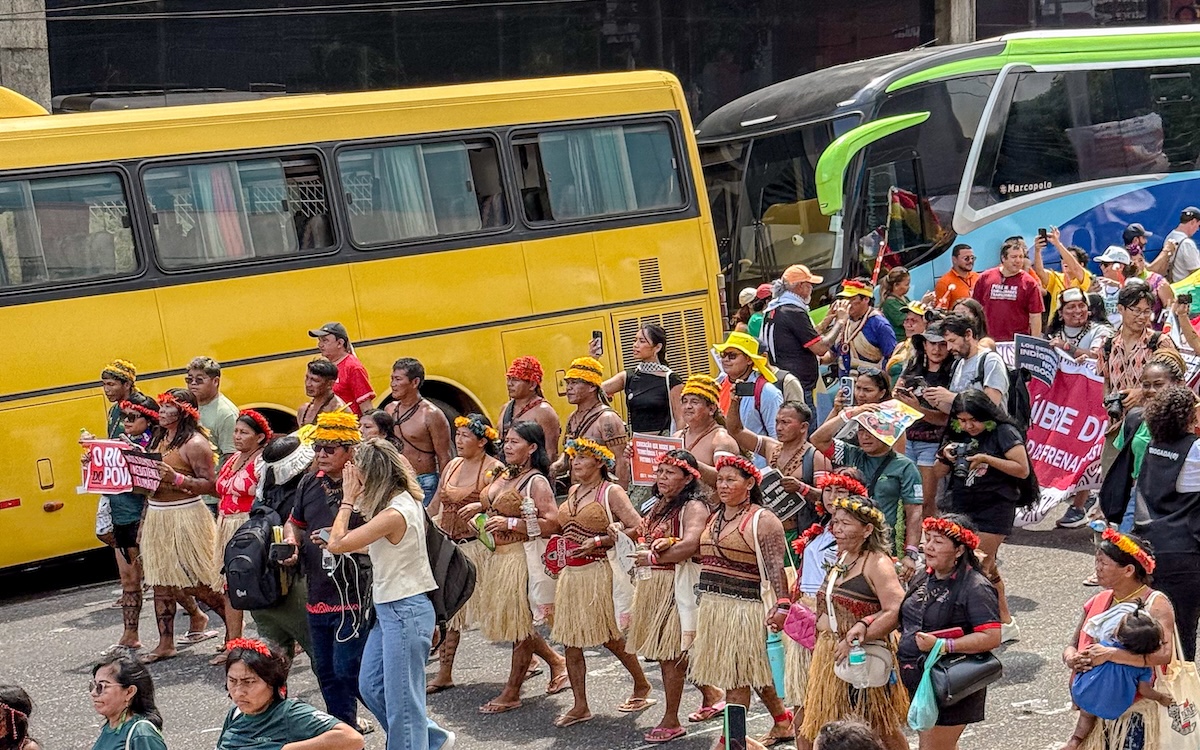
Despite its branding, COP30 delivered mixed outcomes for Indigenous peoples. Activists on the streets and around the venue were highly visible, but many said their access to decision-making spaces remained limited.
Among them was Taguide Picanerai, a young leader from the Ayoreo Indigenous community in Paraguay’s Gran Chaco, representing OPIT, the Organization of Indigenous Peoples of the Chaco, and GTI PIACI, a regional working group that protects Indigenous peoples living in voluntary isolation and initial contact. He said he did not feel Indigenous representation was complete, though some progress was made. “I don’t think we were represented 100 percent at COP30,” he said. “But many civil-society actors did hear our voice as representatives of our community and our organizations.”
Picanerai said the core challenge lies with governments. “States should take far more responsibility for combating deforestation and for recognizing the rights of Indigenous peoples and those in voluntary isolation,” he said. “It’s those same states that repeatedly do very little—or nothing—to actually fulfill their obligations.”
GTI PIACI has long monitored threats to isolated peoples, from deforestation to illegal contact attempts, largely outside formal UN processes. Picanerai said this work needs to become more central. “We’ve been addressing these issues in nonformal spaces,” he said. “This work should be taken much further into the more formal levels of the COP.”
His reflections captured the broader paradox of COP30: a summit held in the Amazon, where Indigenous presence shaped the atmosphere and the protests, yet where the structural pathways for Indigenous sovereignty and political power remained narrow.