The US Government Proposes Rolling Back Methane Safeguards
As methane emissions surge, the Trump administration continues to reduce oversight
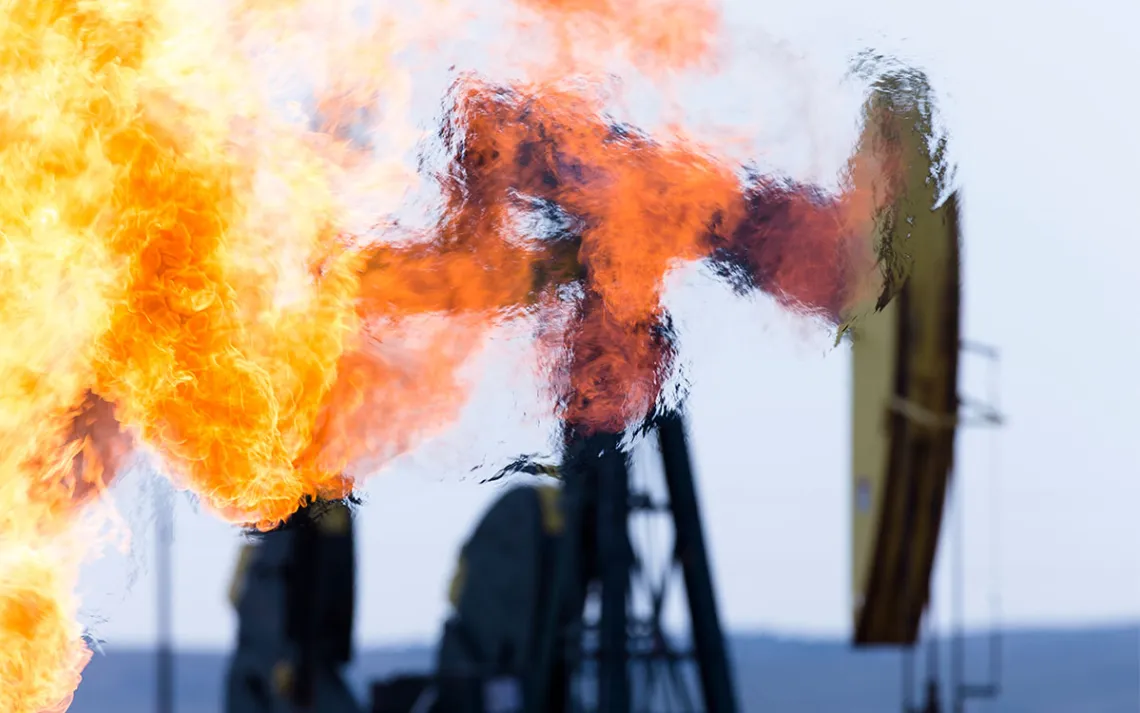
Methane gas flare and pump jack at an oil well in the Bakken oil fields of North Dakota. | Photo by Richard Hamilton Smith/Getty Images
Colorless and odorless, methane is second only to carbon dioxide among greenhouse gases driving climate change and its effects. Yet since 2025, the United States has had a spotty track record of regulating the gas. Now the Trump administration wants to weaken regulations even further.
In October, at a campaign rally in Texas, President Donald Trump and Environmental Protection Agency administrator Lee Zeldin announced a proposal to repeal Biden-era Clean Air Act rules requiring oil and gas industries to detect and fix methane leaks on “marginal,” low-producing wells. They also plan to eliminate the Super Emitter Program, which allows approved third parties to identify large methane releases and alert federal agencies. Trump and Zeldin cited cost to businesses and consumers as the factor.
Without these safeguards, methane leaks and releases of other carcinogens could go undetected or unrepaired, as nearly 7 million Americans live within a half mile of an active marginal oil or gas well.
“The gas leaks are bad,” said Euan Nisbet, earth sciences professor at the Royal Holloway, University of London. “They're very dangerous.”
While methane is not inherently toxic to human health, inhaling it in substantially high volumes in closed or poorly ventilated spaces can displace oxygen and cause health problems, including hypoxia. It can even explode if certain amounts come in contact with ignition sources.
There is also an economic cost: In 2023, failure to fix the leaks, venting, and flaring led to $3.5 billion in wasted gas, according to the Environmental Defense Fund.
Beyond these risks, methane is a good indicator of the state of the entire planet, according to Nisbet. The gas accounts for 11 percent of climate-change-related effects, is 80 times more potent over a 20-year period than carbon dioxide at trapping heat, but remains in the atmosphere for far less time, about a decade, compared to carbon dioxide’s ancient atmospheric lifetime of 300 to 1,000 years. It is also a key ingredient of natural gas.
More than half of methane emissions stem from human activity. The energy sector is responsible for roughly 35 percent, largely from oil and gas leaks. Agriculture and landfills are other primary examples. In contrast, the remaining emissions originate naturally from wildfires and organic rich, low-oxygen environments like ponds and reservoirs, which emit the gas as they break down.
The weakened methane oversight follows a massive surge in the gas between 2021 and 2022, breaking the record for the largest increase in emissions since the National Oceanic and Atmospheric Administration began tracking them in 1983. Atmospheric methane levels increased by 17 parts per billion during 2021, reaching 1,895.7 ppb. This is approximately 162 percent above preindustrial levels—around 715 ppb.
The latest methane regulatory rollback is part of a broader push by the Trump administration to dismantle climate regulations. Last February, the administration also rescinded the 2009 Obama-era Endangerment Finding, which declared the legal basis for regulation of greenhouse gas emissions from motor vehicles under the Clean Air Act. These policy shifts are not isolated to the US. In October, the European Parliament voted to delay certain methane monitoring, reporting, and verification obligations for oil, gas, and coal importers by three years. Scientists warn that allowing more methane to accumulate in the atmosphere could accelerate warming beyond US borders, complicating international efforts to slow climate change.
Currently, the United States is the second-largest contributor to increasing methane levels, behind China. With the US’s ability to regulate methane now impacted, scientists warn that the proposed rollback will impact our ability to reduce methane emissions.
“The Trump administration is trying to take us back to a time when this pollution was rampant. We know the damage that does to the climate, and we know the damage that it does to public health. It's irresponsible to say the least,” said Laura Peterson, a senior analyst with the Climate Accountability Program at the Union of Concerned Scientists.
The proposed rule focuses on “marginal” wells, known as stripper wells, that produce 15 barrels of oil equivalent or less per day. There are over 565,000 marginal well sites in the country, representing 80 percent of all active US oil and gas production sites. While these sites account for less than 10 percent of combined oil and gas production, associated infrastructure produces nearly 50 percent of methane emissions from US oil and gas production.
The October decision was largely justified as a way to lower costs for businesses and consumers. According to the EPA, the changes are projected to save businesses $45 billion between 2027 and 2050, while allowing the production of an additional 210 million barrels of oil and 1.41 trillion cubic feet of natural gas. But approximately 75 percent of marginal well sites are owned by larger companies whose average gross revenue in 2019 was nearly $335 million, the Environmental Defense Fund found.
Scientists are not only worried about the consequences for the planet but also how other countries will respond to the US proposal.
“It's really urgent because the rise in methane is one of the main reasons why the Paris Agreement is endangered,” Nisbet said, adding that many countries also look to the US and EU for methane policy decisions. “I think the other thing is the psychological impact of this. Some tropical countries, they'll say, ‘Well, look, you know, the US is not doing this. The European Union is not doing this. So why should we?’”
In the 2015 Paris Agreement, the international community, including the US, agreed to strengthen the global response to climate change by limiting the “increase in global average temperatures to well below” 2°C above preindustrial levels, aiming for 1.5°C. President Trump has withdrawn the United States from the Paris Agreement twice.
In 2021, the European Commission and 159 other countries pledged to reduce atmospheric methane by 30 percent below 2020 levels by 2030. Some of the world’s largest emitters, including India, Russia, Iran, and several African countries have not signed the pledge. With the surge in wetland emissions combined with the US’s dismantling of regulations, this goal appears less likely.
Future surges of methane may continue to happen, according to study coauthor Lindsay Lan, a carbon cycle and greenhouse gas scientist with the Cooperative Institute for Research in Environmental Sciences of University of Colorado Boulder. As the planet warms, natural sources will likely emit more methane.
“Scientifically, we call it positive feedback,” Lan said. In actuality, she added, there is “nothing positive” about the situation. “It just means that it keeps increasing the levels of greenhouse gases in the atmosphere.”
As additional warming threatens to intensify climate risks, the consequences will likely not be distributed equally. “It's heartbreaking,” Peterson said. “The climate harms resulting from these rollbacks are going to be hurting lower-income communities of color and Indigenous populations around the world at a way higher rate.”