The Jimothy Effect
How celebrity animals foster connection and change the way we look at the world
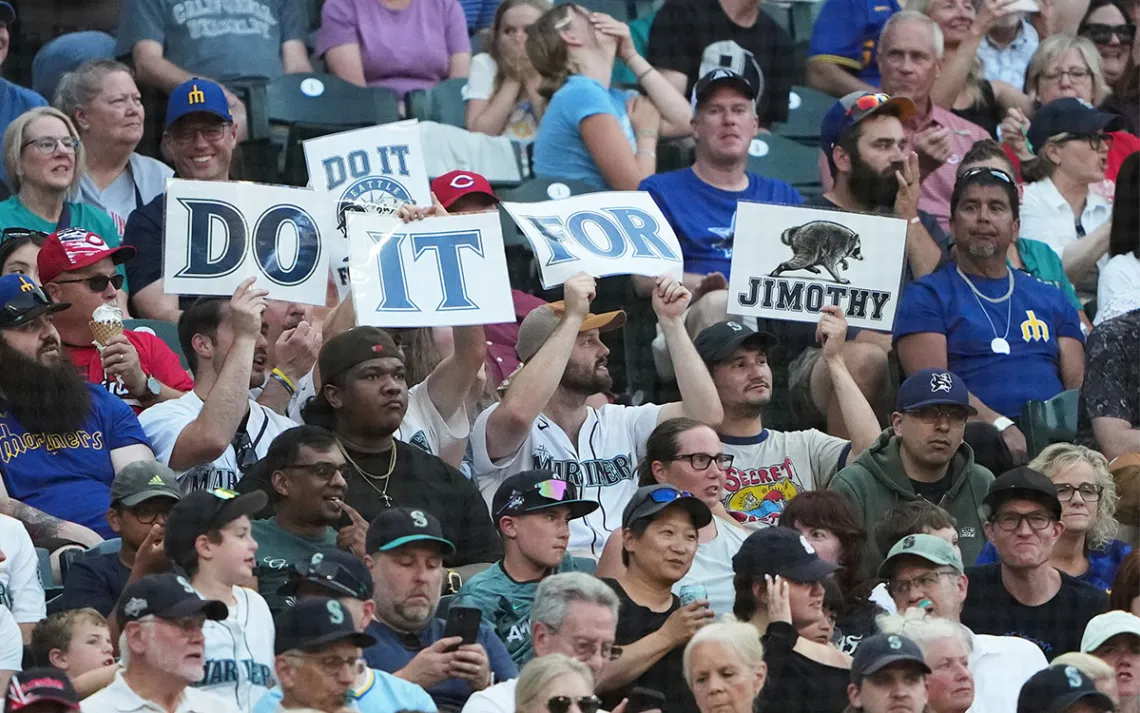
Fans of Jimothy, a Seattle raccoon with a spinal deformity who became an internet sensation in July. | Photo by Lindsey Wasson/AP
When I saw the first Jimothy posts, I was tickled by his basketball-esque body. The now famous Seattle raccoon looks like a plucky cartoon character, ambling around yards and scrambling atop fences despite his curved spine and awkward gait. Still, to see far-flung news outlets in the United Kingdom and Australia writing about him was a bit of a surprise. Videos of Jimothy got thousands of likes and comments.
Jimothy is hardly an anomaly. There was also Flaco the owl, who got New York City atwitter in 2024 when he escaped confinement at the zoo. Freya the walrus delighted Europeans from 2021 to 2022, before Norwegian authorities controversially euthanized her. UC Berkeley’s campus was home to nesting peregrine falcons made accessible, and famous, by a livestream; updates on the pair read like summaries of a trending reality TV show. Jackie, the bald eagle, enchanted people across the globe through the live-feed broadcast from Big Bear Valley, until her untimely death this past summer. And of course, there was P-22, the lonely cougar who roamed Los Angeles for more than a decade.
“The human mind is always looking for a protagonist,” said Christine Wilkinson, a conservation scientist at the Natural History Museum of Los Angeles County. “Once people connect with an individual animal … it can provide a window into a much larger ecological story.”
Cuteness and care
Most wild animals that go viral follow a familiar arc. A social media post sparks a flurry of local nature-spotting and news stories. National outlets follow, and soon enough, TikTok users the world over are following the saga. In some cases, such as Jimothy’s, there’s eventually corporate bandwagoning—a sign that the cultural moment is fading. (Jimothy is now immortalized as a plush toy, to the chagrin of some Seattleites.)
But why do wild animals get famous to begin with?
At the most basic level, it’s biology, said Joshua Paul Dale, a professor at Chuo University in Tokyo who defined the new field of Cuteness Studies. “Cuteness evolved because children need care and socialization,” he said. He explained that cuteness was such an evolutionary success that, over time, it “spilled over” into us finding nonhuman animals cute.
But plenty of animals are cute, so clearly, cuteness alone doesn’t cut it. To become a celebrity, no matter what species, researchers say it helps to stand out. It could be that their presence is unusual, such as the pair of barn owls that recently took up residence in a water tower on the Upper West Side—rare for New York City. They could have a notable behavior, like a neighborhood black bear with a predilection for hot tubs. Or, like Jimothy, they can simply look different in form or size or coloration.
“These animals don’t fade into the background,” said Sarah Crowley, an anthrozoologist and animal geographer at the University of Exeter in England who studies the relationships people form with wild animals. “If you see a bright-pink pigeon, that’s going to grab your attention, and then you want to understand who this is and why they’re like that.”
Jessica Gall Myrick, whose research examines the psychology of social media, said that when we feel curious, we’re open to new ideas and more engaged with the world around us. We ask follow-up questions. We observe our environment closely. We may even go outside to look at our own wildlife neighbors. In short, the novelty that initially captures our attention piques our interest. And that tickles our need to learn about the unknown.
“When anything looks different, we have curiosity,” Myrick said. “And curiosity is a really powerful driver of information behavior.”
Loss of nature interactions
Engaging with nature, even if it’s only online or facilitated by the digital world, is much needed, said Kevin Gaston, an ecologist at the University of Exeter. He explores the extinction of experience: the gradual dwindling of our real-world interactions with nature.
“That loss of nature interactions is increasingly common,” Gaston said. That’s partly due to the rapid decline in biodiversity, from bugs to birds. As humans encroach into wildlife habitat, species lose their home, leading to the number one driver of extinction: habitat loss. And that loss creates a feedback loop, where people have less access to nature. Bereft of green spaces, we may seek nature on our screens, whether it be through a vertical reel or a 24/7 live feed.
“People are observing and connecting with that animal, even though they’re not physically there,” Crowley said. “And that means people who might not otherwise be able to do so are.” (Her personal favorite is watching grizzlies catch salmon in Alaska.)
Still, with Jimothy as inspiration and curiosity as a guide, people can find nature almost anywhere, even in urban grayscapes, where access to parks is often inequitable. Wilkinson, the urban conservation biologist, got her start poring over the sidewalks of New York City. “I used to pretend to have my own nature show, like the David Attenborough of Queens,” she said. “The rats of the subway were my number one inspiration.”
The benefits of a digital wildlife interaction go far beyond just about getting to know the nature around us. Amid a seemingly endless onslaught of bad news about climate and the environment, a story like Jimothy’s can provide an important hit of dopamine that keeps people engaged. Research suggests that if you’re in a better mood, you’re better able to process negative information without just shutting down.
“It’s a little ray of hope,” Myrick said. “And hope is a really powerful motivator for people to engage with online content and issues around climate, the environment, and animals.”
In other words, stories like Jimothy’s are good for the planet.
We love an animal story
One of the main ways we connect with viral animals, and in fact what helps fuel their fame, is storytelling. “We humans are always going to try to storify things,” Wilkinson said. And in storytelling about animals, we lean on anthropomorphizing them.
As multiple people I spoke with pointed out, cities tend to impart their celebrity animals with the qualities they see in their denizens. New York’s Flaco was gritty and intrepid as he evaded capture. Hollywood’s P-22 was a lonely leading man, searching for his soulmate. And Seattle’s Jimothy is quirky and resilient, a local-news character who would slot seamlessly into Frasier. (No word yet on his coffee preferences.)
But attention on wildlife, especially an individual, can have a darker side. Adoring fans may hound famous critters to get a ’Gram-worthy video. Social media posts with wild animals, especially exotic ones, tend to get high engagement, Myrick said. That buzz ultimately contributes to the illegal wildlife trade. And in cases like Freya the walrus, where there’s concern about crowding around the animal, their popularity can be a death sentence.
“That’s the downside of the celebrity nature of it all,” Crowley said. “People forget that this is a wild animal.”
However, these stories can and do lead to significant conservation outcomes. For example, people’s empathy for P-22 bolstered support for the construction of a wildlife bridge over the 101 freeway. When it opens in December, the Wallis Annenberg Wildlife Crossing will be the largest structure of its kind in the world. Crucially, it will reduce the geographic isolation that plagued the wide-ranging cat.
“People can have a really hard time connecting emotionally with things like population estimates or habitat fragmentation metrics and connectivity metrics,” Wilkinson said. “We are built on story. So I think really being able to individualize an animal can help with [understanding] these broader aspects.”