Kelp Forests Are Vanishing Along California’s Coast
Here’s why, and what’s being done about it
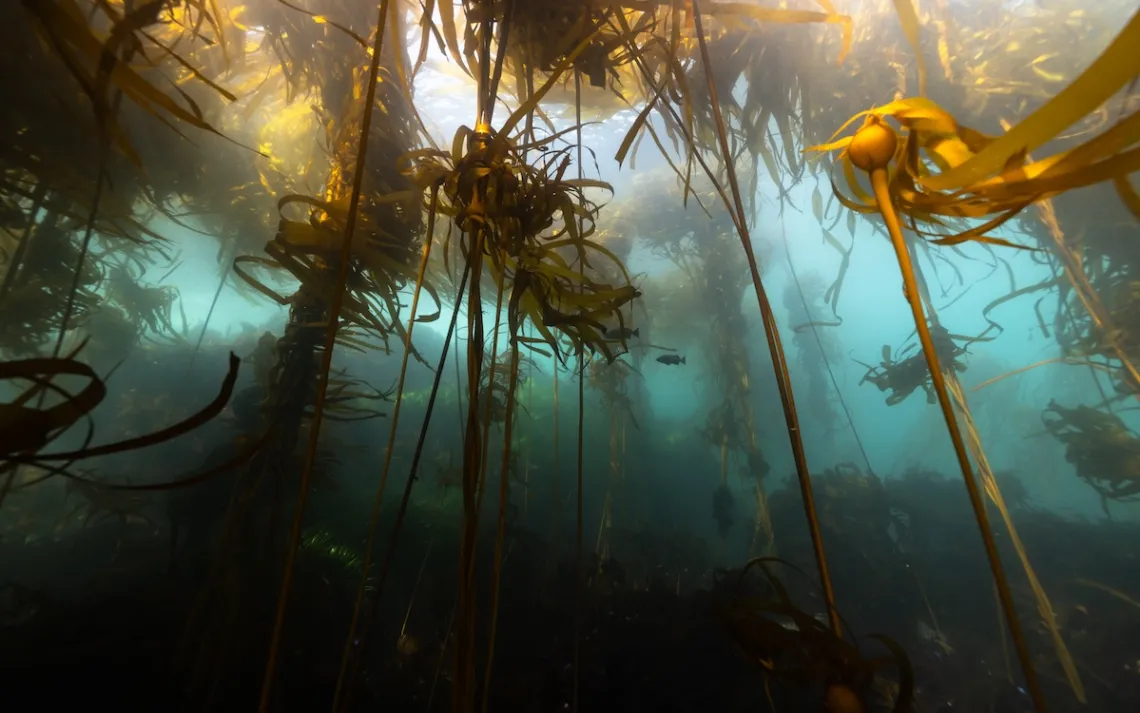
Bull kelp (Nereocystis luetkeana) off Monterey, California. | Photo by Jenny Adler
California has lush kelp forests up and down the coast. They are not only home to incredible biodiversity, but they also act as an important carbon sink and are among the largest producers of oxygen on the planet.
These essential marine ecosystems now face a triple threat from warming global temperatures, heat waves, and their main predators, urchins.
According to a new study, warming waters and heat waves are amplifying conditions along California’s entire coast that lead to greater stress for kelp forests. The study also looked at how Marine Protected Areas (MPAs) can help their recovery along parts of that coast where urchin predators are active. MPAs, the study concluded, will be vital in the years ahead.
Along the central coast, and especially the northern coast, sea stars have been the main predator for urchins. For more than a decade, they have also faced a devastating wasting disease that scientists now believe is caused by the bacterium Vibrio, which causes white lesions that quickly deteriorate the sea star’s body. The disease has been found to be more prolific when waters heat up. As the disease devastates the population, it leaves urchin numbers unchecked, which prey on kelp. Urchins then lay waste to the forests, leaving behind only massive barrens dotted in purple urchins on the cleared rock that once housed the forest.
In other words: As goes the sea star, so goes the kelp.
Kelp plays an important role in the ecosystem. They are nurseries, providing safe places for sea life, and they serve as carbon sinks. By some estimates, the world’s kelp forests store anywhere from 61 to 268 teragrams of carbon per year. Much of the planet’s oxygen comes from the sea, with the big players being kelp forests and phytoplankton.
“If you saw a forest get cut down, you would probably notice it on your drive to work,” said Jenny Adler, a conservation photographer and underwater photojournalist teaching at Duke's Nicholas School of the Environment. “If you’re walking on the beach, you might not notice that the forest that was right underwater isn’t there anymore.”
Using four decades of remote sensing data of surface canopies from giant kelp (Macrocystis pyrifera) and bull kelp (Nereocystis luetkeana), researchers were able to examine the impact of MPAs on the recovery of kelp forests from heat waves between 2014 and 2016. The study showed that by protecting these areas, they provided a “modest” positive impact for 8.5 percent of the recovering kelp forest canopy where the MPA was also protecting the marine life that fed on urchins, allowing kelp a fighting chance at recovery.
“We saw an effect largely in Southern California, where we have … other predators of urchins,” said Kyle Cavanaugh, a senior author of the kelp study at the UCLA Institute of the Environment and Sustainability and the UCLA Geography Department. In those MPAs, keystone species played an important role in controlling urchins.
“In Southern California, we have spiny lobsters and sheephead, which are both urchin predators,” said Cavanaugh. The situation is different in Central and Northern California, he added, where sea stars are also disappearing. “Those areas were likely more affected by sea star wasting disease, because sea stars were the main predator—they were the thing that was controlling urchins.”
The Trump administration has not been friendly to the notion of protected marine areas. The administration has moved to open previously protected marine areas to fishing.
And, a new report from the University of Exeter indicates that Earth’s natural systems are crossing significant tipping points. Climate change has put coral reefs into a definitive dead end. They are now said to be “crossing their thermal tipping point and experiencing unprecedented dieback.” The report includes what it sees as a similar impact happening on local populations of kelp due to increasing planetary temperatures.
Marine conservationists are hard at work to support the kelp forests. Adler points to efforts like the Sunflower Star Lab. “They are helping grow sunflower sea stars in, an actual lab, to release back out into the forest,” she said. Other nonprofits like the Giant Kelp Restoration Project are having divers actively clear urchin barrens. And California joined the International Union for Conservation of Nature as part of a commitment to create more MPAs.
And then there is the culinary option. Cavanaugh points to a solution where urchins are collected for urchin ranches where they can be restored and become viable, and valuable, as commercial seafood.
What is the value of protecting our kelp forests? Priceless, according to Adler.
“You can quantify that in some way if you want, like as an economist,” she said, “but to me, just the fact that it’s there, that it exists as a space, [means] it’s valuable.”