Nature’s Answer to Combating Wildfire: The Prairie Dog
Behold the most adorable little firefighter you ever saw
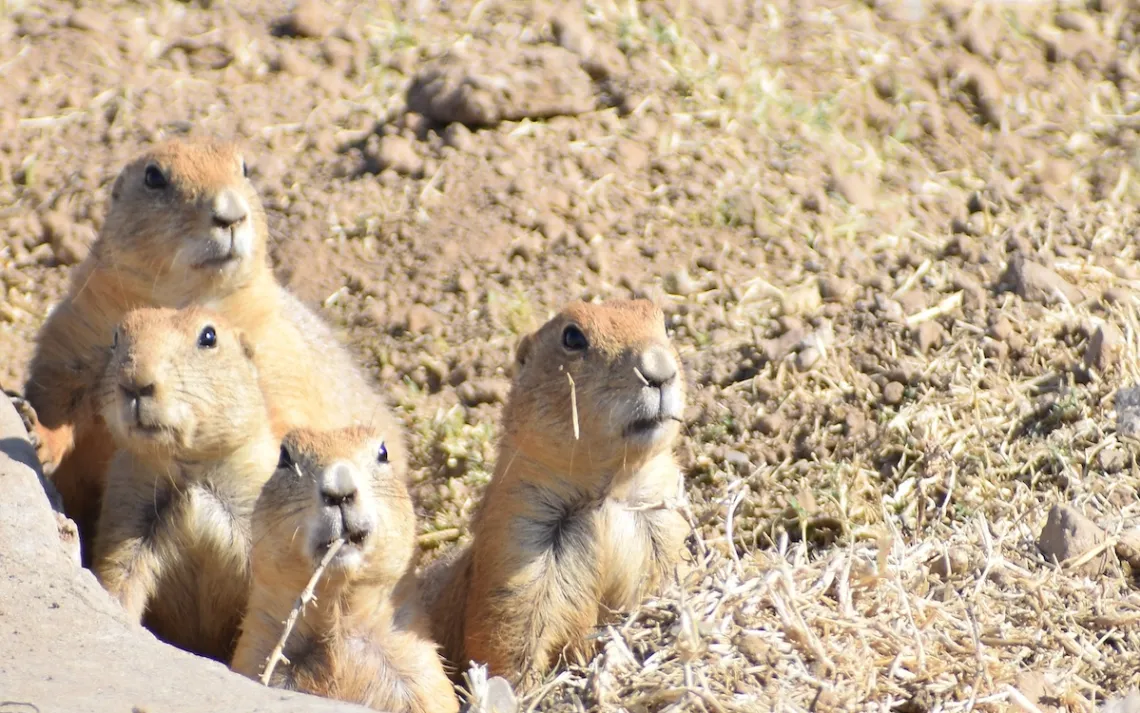
Photo courtesy of Courtney Duchardt
As social as a group of grannies playing bridge, prairie dogs chatter and gossip as if no one’s watching. Their colonies, called towns, are a lively affair with a variety of calls or vocalizations meant to warn of approaching dangers and signal when all is safe again.
Black-tailed prairie dogs are native to the Great Plains of the United States and only known to exist in North America. They live in burrows two feet below the surface in intricate tunnels built for their own protection, with dirt mounds at the entrance that keep them from flooding. They can live in groups of thousands or as small as a few dozen, and they survive almost entirely on vegetation minus the occasional grasshopper treat.
These little yappers also shape the landscape in ways that might help us as the planet gets hotter. Fire activity on the Great Plains has increased by 3.5 times in the last decade. Lightning is responsible for the majority of grassland wildfires, followed by human activities and negligence. Now new research suggests that prairie dogs are beneficial in reducing wildfires, according to a study published in the journal BioScience.
Experts in wildfire management
If you’ve ever witnessed a prairie dog colony, then you’ve seen that the landscape is barren with minimal vegetation. Black-tailed prairie dogs shape their ecosystem by essentially mowing the lawn around them, clipping vegetation so that they can see predators like coyotes, bobcats, eagles, hawks, foxes, badgers, and weasels in time for a quick escape. Research suggests that prairie dogs control for the spread of wildfires, providing them less fuel to burn.
Prairie dog colonies contain 71 percent lower shrub densities than undisturbed sites, according to research published in the journal Ecosphere. “Sites with wildfire or black-tailed prairie dogs had 8 percent lower canopy cover of shrubs and Wyoming big sagebrush,” wrote the study authors.
One video clip of a fire moving on a prairie dog colony shows that the fire moves along until it hits the colony’s territory and then just peters out. “The reduction in fuel means that the fire is less likely to spread as it normally would,” said lead study author Courtney Duchardt, a rangeland ecologist at the University of Arizona.
And the fire burns less hot with less fuel inside the prairie dog colony than would exist outside of it. The black-tailed species, which is the most common, will also clip woody vegetation which can control for fire risk, especially mesquite growth. This keeps it from growing into a mature tree, which would make for powerful fire fuel.
But Duchardt also contends that while we have ample research showing that large animals such as bison control for wildfires, the data on smaller animals like prairie dogs is limited. The point of her study was also to show how this is a species with fire control acumen that has been largely overlooked.
A host of threats
Five million prairie dogs once roamed the Great Plains, but now just 5 percent of their habitat is still intact. The Homestead Act of 1862, signed by Abraham Lincoln, intended to turn over around 270 million acres of American land to private land owners who became farmers and ranchers. Prairie dogs often eat the same shred grass, western wheatgrass, blue grama, and buffalo grass that their cattle live on.
Prairie dogs can really impact a landscape during a drought when there’s not enough food to go around. This is a species at odds with the ranchers whose lands it often inhabits, says John Hoogland, professor emeritus at the University of Maryland Center for Environmental Science, who was not involved in the study. “Poisoning is by far the biggest threat to prairie dogs,” he says. He adds that poisoning can kill entire colonies all at once.
The lesser-known grazer
The threats to prairie dogs have been devastating to their population. “They are a keystone species, and if prairie dogs disappear, the western US and into Canada will be a very different place,” Hoogland says.
Not just because of how prairie dogs work in fire prevention. They provide food for a host of other species, keep the grassland ecosystem intact by making homes for other animals, and improve the nutritional quality for other grazers like pronghorn sheep, bison, and bighorn sheep.
Hoogland contends that while researchers have discovered a possible factor that might impact fires, we know far too little about how and why they reduce fires. “This is just the first step in the research,” he says.
Duchardt agrees. She adds that dozens of papers look at how after historical fires, bison would eat the lush green regrowth and keep the vegetation down to a level that would make fire less likely. Prairie dogs used to be everywhere on those same Great Plains landscapes, and yet nobody has looked at their impact, she says.
Despite this research gap, we know by watching historical fire patterns and current fire management that prairie dogs shape the land in ways that seem to slow or stop fires. Their role is growing in importance as concerns over Plains fires grow. “It’s an undervalued service that these guys have been providing,” says Duchardt.